My Courses
 My Portfolio
 Refer & Earn
 My Purchases
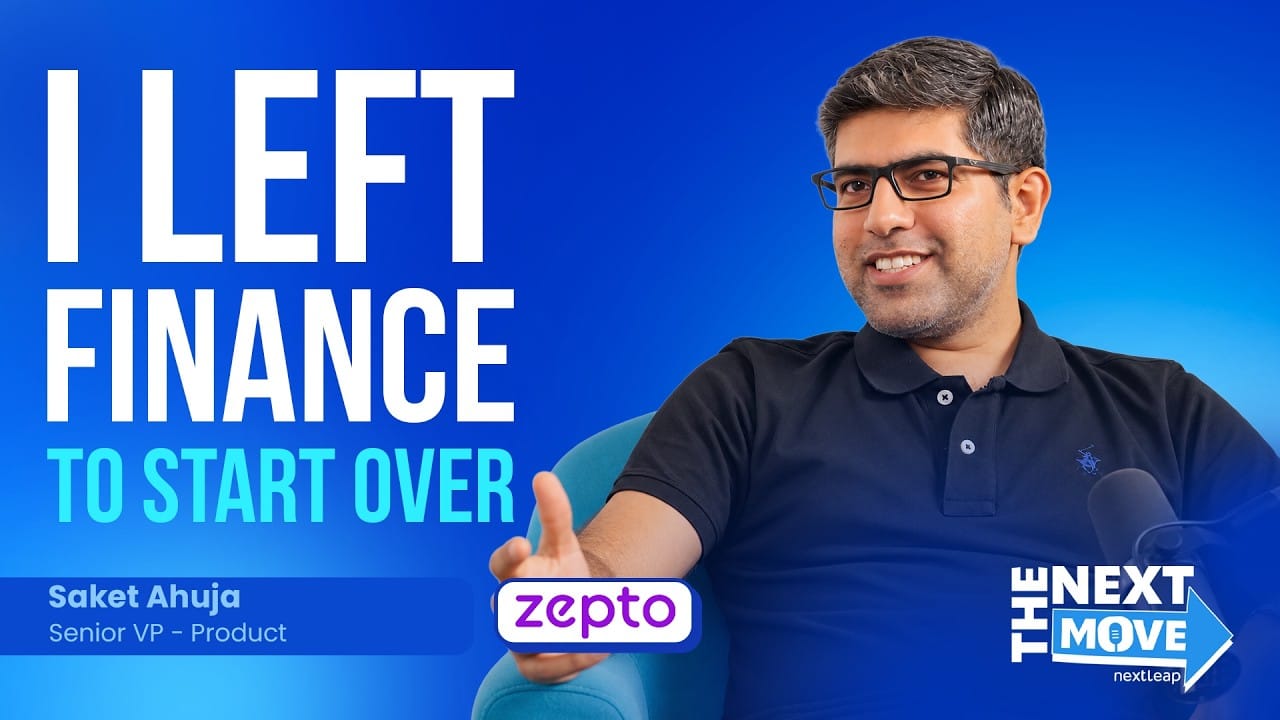
The Next Move is a NextLeap podcast where I sit down with leaders in tech to unpack the career decisions that shaped them, so you can make better ones of your own.
I have known Saket Ahuja since my college days. On this episode, I finally got to ask him about the decisions behind his career, one move at a time.
Saket studied metallurgy at IIT Kharagpur and spent seven years at Deutsche Bank on the global markets side, with long stints in Tokyo, Hong Kong and New York. Then he walked away from finance, started a shared-mobility startup called Mobibus, and moved into product at Ola, Swiggy and Careem. Today he is Senior VP of Product at Zepto.
What surprised me is how little his moves were about titles. He did not plan a jump from finance to product management. He kept following a problem he could see with his own eyes, and the role followed. In his words, he was "married more to the problem as compared to the solution."
Here are the 12 lessons I took away from our conversation on moving from finance to product management.
At a glanceWho: Saket Ahuja, Senior VP of Product at ZeptoCareer path: Metallurgy engineer (IIT Kharagpur) → investment banking → startup founder → product manager → product leader → Senior VP of ProductCompanies: Deutsche Bank, Mobibus, Ola, Swiggy, Careem, ZeptoHis core test for any move: "Find a problem which has not been solved and attack that problem"Best for: Non-tech professionals weighing a switch to product management, and new product leaders learning to build teams
Watch or listen: Full episode on YouTube
1. In a downturn, take the detour and keep going deep
Saket's interest in finance began with electives at the School of Management in his second year. By 2008 he had a pre-placement offer from Lehman Brothers in London. Then the financial crisis hit. Lehman was gone, no banks came to campus, and the job he did land had its joining date pushed back.
With three or four months free, he found an old email: an internship offer from Deutsche Bank he had ignored a year earlier. "I desperately replied to that particular mail a year after." There was no full-time role, only an internship. He took it, lived at a friend's place in Mumbai on a stipend of about ₹15,000, and the bank kept extending it until it became a full-time job.
When I asked what he would tell a 22-year-old facing today's AI uncertainty, he went back to depth.
"If you are genuinely passionate about something, there is always a space for the top 1% of the folks."
A crisis may hurt, he says, but "that would be momentarily" if you keep that depth.
2. Leave for a problem, not for the sake of leaving
Saket loved Deutsche Bank: the numbers, the travel, a stay in Japan he still remembers. But by 2016 something was missing. He had come to IIT for technology, and banks were not tech forward. He worked with a handful of hedge funds and pension funds. "We were not building anything. We were repackaging the stuff."
So why not stay in finance and do something tech-first? His experience was in stock lending and index swaps for international markets, which had little presence in India. There were hardly any parallels he could use to build for the masses.
"It's not that we need to go outside finance or we need to do something completely out of finance for the sake of it. It's about the kind of problem that we are able to see in day to day."
What did carry over was the numbers. Which route, how much utilisation, what the cost should be. "Every business has this underlying concept of numbers," he says.
3. Start with a problem you live with every day
Mobibus, his entrepreneurial stint, came from Saket's own commute. He lived off JVLR in Mumbai, with hardly any train connectivity. A cab to South Bombay cost ₹800 to ₹1,000. When the team spoke to office-goers in nearby societies, they heard the same thing: nobody was happy with the options.
The idea was shared buses from home to office and back. To raise utilisation, they would run the same buses for schools and IT firms, which keep different hours.
He did not start with a plan to become a founder. The thought process was simpler.
"We need to find a problem which has not been solved and attack that problem with whatever experience or skill set we have."
If they cracked it, good. If not, they would move to the next problem. It was "a very obvious problem," and they did not see a solution coming any time soon.
4. Stay married to the problem, not the solution
Around then, Ola launched Ola Share and Uber launched Uber Pool. Investors got cautious. Mobibus raised money from angel investors, but shared mobility needs heavy spending: discounts to drive adoption, marketing, and covering low utilisation until you reach scale. They ran it for almost a year.
While talking to founders tackling the same problem in NCR and Bangalore, Saket met someone at Ola. They were working on the same problem, at scale. After about a month of conversations, he moved.
"I didn't feel that I need to shut down my startup and move to Ola, because I was married more to the problem as compared to the solution."
He chose Ola over Uber because he wanted to build for India in an Indian company, and "most of the Uber decisions were taken in Valley." At Ola he worked on making Share profitable and making its timings trustworthy. He had "never built a product for the masses," and watching usage climb day after day was the reward.
5. A title won't teach you the craft, so find someone who will
At Ola, Saket was made a product manager.
"I was given a designation of product manager. I didn't know anything about product [management]."
There were only a handful of PMs in India then. He kept treating everything as a problem to solve, working across business and marketing too. In a hypergrowth startup, that was the expectation.
He says he learned what product management really means at Swiggy, under his mentor Ashish Chatterjee (ex-Flipkart product lead). That meant understanding the customer, collaborating with design, prototyping, then iterating "one iteration over the other" until most pain points were solved. He also learned how engineering, design and product come together to build a solid product.
It took time to unlearn the founder habit. "Coming from that entrepreneur mindset, I want[ed] to solve everything." At scale, he says, that "couldn't be possible."
6. Make your next move a step up in complexity
Saket moved to Swiggy in 2018. When I asked why, he gave three reasons. Swiggy in 2018 was at a similar stage to Ola in 2016, so he could ride the same wave of growth. He wanted to learn from leaders his Ola mentor spoke highly of. And the problem was harder.
Ola is a two-sided marketplace: customer and driver. Food delivery adds the restaurant.
"Ola to Swiggy, I found this as a natural inclination if I need to expand my skill set."
He ran Swiggy's assignment logic: which delivery partner gets which order, where idle partners should wait, when to batch orders, and when to send a rider based on how long the restaurant takes. It was his first time working closely with data science on multivariate problems, and his first real work with a design team. He also learned that optimisation "doesn't start after placing the order." It starts with nudging customers towards nearby restaurants.
7. To understand your user, do their job
Delivery partners are hard to relate to if you have never done the work. Saket's fix was blunt.
"Why don't you just start delivering the order yourself?"
His team first paired with delivery partners, then spent one day every month delivering orders themselves, including trips to Jaipur and Lucknow. On those runs they saw what dashboards don't show: restaurants that would not let partners inside, no shade in extreme heat, packets snatched in some areas. A new rider would not know where to wait after a drop in Koramangala to get the next order quickly.
Those insights led to bigger questions. How do you help riders maximise earnings? Could the work become a long-term choice for migrants, with support for their children's education?
"It's a product 101 where you need to understand the customer," he says. "You need to start acting like one."
8. Build a team that works without you
Saket started managing people at Swiggy, with a couple of people reporting to him. The first lesson was to let go. Earlier he had done everything himself.
"You need to start [to] build a team where if you are not around, the team functions almost in the same way."
Then, he says, your only job is strategic guidance and a team that enjoys the work and knows why it matters. He picked this up from watching Ashish Chatterjee, who would ask questions directly to Saket's team rather than to him, so the team built ownership and accountability.
Hiring is where he still spends a lot of his time. He checks for motivation and purpose, because compromising there hurts the person, the team and the company. "If that point is sorted, then you hardly need to do any work."
9. Keep motivation alive by deciding for the customer, not the number
Hypergrowth companies have extreme highs and lows. Everyone is motivated when things are going well.
"The real test is that when it's in the down phase, then you are still able to motivate the folks."
Saket's answer is in how decisions get made. "Your decision shouldn't just be basis [the] kind of number that you want to achieve. It's also basis what the customer wants," from first principles, and what the company can offer sustainably.
Then bring the team into those decisions. In his view, "the distress comes primarily" when leaders force their decisions on junior folks. If people are aligned to the vision and take part in the decisions, they will stand by you through a bad quarter. And they should be rewarded in proportion to the value they add.
10. Take the bet you can reverse
During COVID, when the restaurant industry had almost halved, Careem offered Saket the role of Director of Marketplace in Dubai, across food delivery, ride hailing, bicycles and quick commerce. It meant building for customers he had never built for and running several young businesses at once.
The boxes were ticked: Careem was among the most valuable startups in the region, and Dubai is close enough that he could visit India regularly and his parents could visit him. Moving his family was a big decision, and he credits his wife's support. And there was a way back.
"If I don't like it, I can anyway come back to India."
He learned how customers in Dubai and Saudi Arabia think about products, and how to lead a team from Egypt and Saudi Arabia. One thing was hard to adapt to: the pace. "Why can't we do this fast?" kept coming up for him.
11. When you meet real conviction, be ready to move
Saket expected to stay in Dubai for another year or so. Then he met Aadit, Zepto's co-founder, at a coffee shop in Dubai. Saket was struck by how much clarity he had at about 21. Saket already believed quick commerce would be one of the biggest hypergrowth stories in years.
Why Zepto and not Swiggy? He credits Swiggy for starting with Swiggy Stores and then Instamart, but says it "took its own sweet time" to build conviction on 10-minute delivery. Zepto had that conviction from day one, and so did he.
"If there is any model which could work, [it] is not like 30 minute, 45 minute. It's like instant."
So the Dubai stint was cut short. He has now been at Zepto for almost four years.
12. Choose the industry first, then the role
Saket's main advice for early-career professionals is not about picking product, engineering, data science or design.
"First you need to identify which industry or area or company really motivates you."
Once you find that, there are hundreds of roles within it. Then map how your role will change with AI over the next few years. He expects engineers' roles to change the most. PMs are changing too: "we are able to develop the entire prototype with the help of AI without using any designer or engineer help." But AI tools are "just the medium that can fast track you." You still have to go deep and work out where you add value.
As for his next move, he is staying put. Zepto has grown from core groceries into apparel, electronics and gourmet items, and he thinks it's still early days. "I just want to continue building what I have built over the last four years."
In this episode, we cover
- 00:00 Introduction
- 02:12 From IIT Kharagpur metallurgy to finance during the 2008 crisis
- 07:34 Career advice for a 22-year-old in an uncertain market
- 09:47 Seven years at Deutsche Bank
- 12:38 Why he left investment banking for technology
- 16:27 Why not stay in finance?
- 18:35 Finding a real problem to solve: Mobibus
- 20:25 The founder mindset and the move to Ola
- 25:20 Hypergrowth at Ola, and choosing Ola over Uber
- 28:59 Becoming a product manager without knowing product
- 34:09 Why move from Ola to Swiggy: two-sided to three-sided marketplace
- 39:47 What Swiggy taught him about product, data science and design
- 43:21 Understanding delivery partners by delivering orders yourself
- 47:03 Learning to manage a team
- 51:36 Keeping teams motivated through highs and lows
- 54:00 Moving to Careem in Dubai during COVID
- 57:10 Relocating your family for a career move
- 1:03:20 Why he joined Zepto
- 1:05:15 Why Zepto and not Swiggy
- 1:06:54 Career advice for early professionals in the age of AI
- 1:10:45 What's next for Saket
Referenced
- Earlier episodes: The Next Move Ep 01: Ram Papatla on going from IC to general manager · The Next Move Ep 02: Vikas Bansal on going from product manager to GM
- Companies mentioned: Deutsche Bank, Lehman Brothers, Mobibus, Ola, Uber, Swiggy, Careem, Zepto
Where to find Saket Ahuja
Switching into product from a non-tech role
Saket moved from banking into product by following a problem, then learning the craft from people who had done it well. If you are a working professional planning a similar switch, the Product Manager Fellowship at NextLeap teaches the product fundamentals he describes: understanding customers, working with design and engineering, and iterating. And if you are looking to upskill on AI, check out the NextLeap Applied Generative AI Bootcamp.
Subscribe to The Next Move on YouTube.
Frequently asked questions
Can you move from finance to product management?
Yes. Finance gives you comfort with numbers, metrics and trade-offs, which product work relies on. Saket Ahuja moved from seven years in investment banking to a startup and then to product at Ola, Swiggy and Zepto. His advice is to follow a real problem rather than switch for its own sake, then learn the product craft from experienced mentors.
What skills transfer from finance to product management?
Analytical thinking transfers best: modelling costs, utilisation and unit economics, and reading metrics to make decisions. Stakeholder communication and working under pressure also carry over. What usually needs building is customer research, working with design and engineering, and iterating on a product. Saket Ahuja says every business has an underlying concept of numbers to optimise.
How do product managers understand users they cannot relate to?
Spend time doing what your users do. Shadow them, then do the work yourself. Saket Ahuja's team at Swiggy spent one day a month delivering orders, which surfaced problems dashboards missed, such as restaurants not letting delivery partners inside or no shade in extreme heat. Pair this with interviews and data to separate one-off issues from patterns.
How do you know when to leave a stable job for a startup?
Ask whether your current work still connects to the reason you chose your career, and whether there is a specific problem you want to solve elsewhere. Saket Ahuja left banking because he wanted to build technology for the masses, not to leave finance for its own sake. Where you can, make a move you could reverse if it does not work out.
How is AI changing the product manager role?
AI tools now let product managers build working prototypes without waiting for a designer or engineer, so PMs can test ideas faster. The core of the job is the same: understanding customers and deciding where to add value. Saket Ahuja advises mapping how your role will change over the next few years, and treating AI as a way to fast-track value, not a replacement for depth.