My Courses
 My Portfolio
 Refer & Earn
 My Purchases
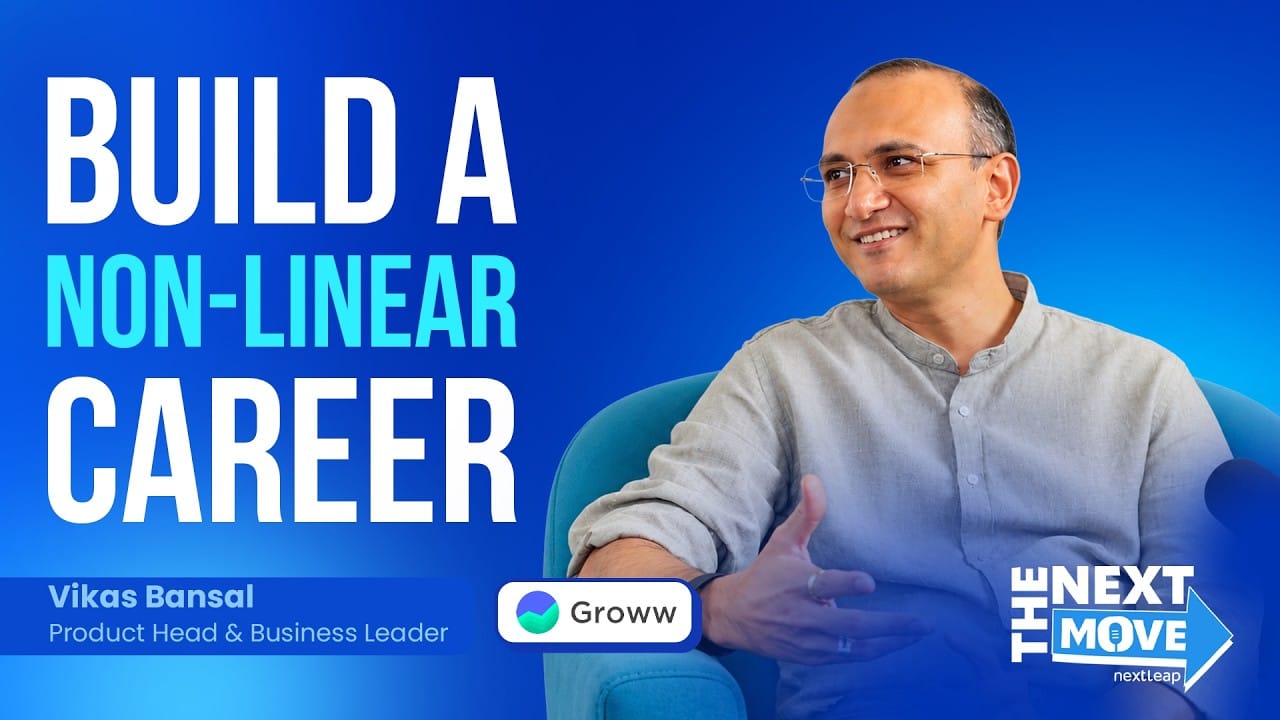
The Next Move is a NextLeap podcast where I sit down with leaders in tech to unpack the career decisions that shaped them, so you can make better ones of your own.
Vikas Bansal and I worked closely together at Flipkart. I thought I knew his story. Then I asked him why he made each move, and I realised I had only known the what.
Vikas started as a software engineer at GlobalLogic and then Google, left for an MBA at IIM Bangalore, and made an early bet on product management at NetApp. He spent nearly eight years at Flipkart, working as CEO of Jeeves (a Flipkart Group company) during this period. After that came Cure.fit, a startup of his own Crejo.fun, and now Groww, where he is part of the senior leadership.
What stood out to me is the thread running through all of it. Vikas does not pick sectors. He has worked across enterprise software, e-commerce, health tech, edtech and fintech. He picks the next muscle he wants to build, and then looks for the role that lets him build it.
Here are the 12 lessons I took away from our conversation on his journey of moving from product manager to general manager.
At a glanceWho: Vikas Bansal, Product & Business Leader at GrowwCareer path: Software engineer → product manager → product leader → CEO of Jeeves → Cure.fit → co-founder (Crejo.fun) → GrowwCompanies: GlobalLogic, Google, NetApp, Flipkart (including Jeeves), Cure.fit, Crejo.fun, GrowwHis core test for any move: "can my next move help me pick that up?" (the capability he is missing)Best for: Product managers and engineers weighing a move into leadership, a general manager role, a startup, or a founder path
Watch or listen: Full episode on YouTube · Short clip: How to build a non-linear career
1. Look at where your current path ends
Vikas loved Google. But he says "when you've reached somewhere, you then start asking what next," and when he looked ahead he saw two roads. One was engineering manager which involved managing people, which he did not want. The other was the pure IC track, in a team full of PhDs, and he could not see himself coding for the long haul.
"I always like the bigger picture."
At Google he met a few PMs and learned the role existed. He had already filled the CAT form before joining Google, so he gave the exam, got an admit from IIM Bangalore, and went. He was about 90% sure he wanted to be in a product role, and kept 10% open for anything else.
2. Bet on a role before the path exists
When Vikas joined his MBA in 2008, hardly anyone hired for product management in India. Only six or seven people in his batch went into it, mostly at MNCs like Microsoft and NetApp.
He had tried for consulting and banking too, and did not crack those summer placements. He is glad of it now. He knew what he wanted: "I would love to build things." He calls himself "still a builder." He was honest about the risk too.
"If in India the startup ecosystem would not have panned out so much, then it might have been a bad decision in hindsight."
The lesson for me: a bet on an early role needs a reason rooted in who you are, not just a hunch about the market.
3. Choose work you will enjoy, with people who stretch you
Vikas does not describe his early moves as risk-taking. His test is simple. The problem should be interesting and solved from first principles. If it repeats, he gets bored. And it should be solved with the smartest people he can find.
"I was not taking risky bets in my head. I was just taking bets which I'll enjoy."
His Flipkart move shows the test at work. A recruiter called on a Thursday, he did a first call on Friday, and had an offer by Tuesday. The other company he was close to joining took almost a month. Flipkart's speed of decision making drew him in. The Flipkart interviews were real problems, like designing a warehouse picking system. He had never been inside a warehouse. "I felt like the best way of learning is learning on the job, solving great problems with good people."
4. Learn a new domain by shrinking the problem
His first product at Flipkart was order management. Before joining, he had never placed an online order, and in the first month his engineers sounded like Greek and Latin to him.
What helped was that nobody arrived with 20 years of supply chain knowledge. Everyone was solving from first principles, so he did too. The only way to understand what was happening in the warehouse was to go inside it, then to the last-mile hub and the mother hubs. Break the big problem into small ones, ship, look at the metrics, learn.
"You can learn any domain, but you can't learn the other skills that easily."
That is why Vikas says sector is the last thing he thinks about. He chooses the people, the culture, the scale and the impact first.
5. Say yes to managing people if it widens your impact
"I was actually a hesitant people manager." When his manager said he could become either an individual contributor or a people manager, Vikas answered "without blinking" that he would stay an IC. He had left engineering to avoid management.
His manager sat him down and explained that in product, people management is not just people management.
"It's a way for you to increase the area of your impact by getting some more leverage."
Vikas decided to try it, telling himself he could always switch back. He started by mentoring one or two APMs. The team let him widen his scope and ownership, and he has now been in people management roles for ~14 years.
6. Plan your career like a product roadmap
After four to five years in order fulfilment at Flipkart, Vikas was getting comfortable and a bit bored. His mentors were nudging him, and he started applying product thinking to himself. Decide the end goal, work backwards, and ask which capabilities you need to build to get there.
His fork was CPO or GM. He knew roughly what the product role would be. He did not know the GM role, so he went to find out. He plans at least five years out.
"It's a cliche, boring question, and all of us kind of hate it. But when I started doing it, I felt like it is actually useful."
He does not review on a schedule; he reflects at milestones, like his one big sabbatical after Flipkart. The decisions are personal, but he keeps advisers for tactical input.
Looking back, he would change none of it. Each experience taught him something, the failures included.
"With whatever piece of information that I had, I feel like I took the best decision."
7. Alternate between zero-to-one and scale
After Jeeves, Vikas came back to fulfilment, then built a new vertical from scratch after Flipkart's acquisition of eBay India, while also running Flipkart's seller marketplace, which was scaling fast. He sees a trap in sticking to one stage.
"Switching from one 0 to 1 to another 0 to 1, you're just building one muscle… but you're not [strengthening] the other muscles."
This is also how he chooses a stage. He joined Cure.fit because it sat between one-to-ten and zero-to-one, and he wanted to see a startup from the leadership seat. He joined Groww for scale, without the playbook already written.
New muscles come easier when you know what to lean on. In the new business (2Gud at Flipkart) he had never built an app at scale or worked on the seller side. He used what he already knew from e-commerce and supply chain, and built a team around consumer PMs with complementary strengths.
8. Put the company ahead of yourself, and your intent stays clean
Flipkart had an unwritten rule that Vikas followed: "customer first, then company, then team, and then yourself." He says it was never a sacrifice. He grew fast following it.
His version of a founder's mindset is a question: if I were running this company, where would I add the most leverage? When what the company needs overlaps with what he would enjoy, he says yes. Sometimes he felt he could add more leverage elsewhere, and he went there.
"If you do the reverse order, it works for a year or two, but it doesn't work for the long run."
He adds that once the intent is clean from both sides, things fall into place.
9. Expect the CEO job to be unglamorous
Vikas ran Jeeves as CEO, with roughly a thousand people, many of them out on the street. The title is flashy. The work is not.
"You also do a lot of unglamorous pieces along with the glamorous title."
One day his HR head told him the office AC was broken and he needed to approve the replacement. Jeeves had been run like a separate company and was slowly being integrated into Flipkart's culture. He had to go deeper into every function, run town halls, and lead a culture change, while travelling almost every week. He had to be chief culture officer, chief product officer and chief people officer at once.
He thinks more of these roles are coming. "All the future roles are going to be GM roles," because companies want people to "own the outcomes," not just the input.
10. Build distribution by doing it
At Crejo.fun, Vikas and his co-founder built live online hobby classes for children. The ratings were good, retention was good and the children were having fun. But they could not crack distribution, and that is the biggest lesson he took from it.
"You might have the best product in the world, but if people don't know about it and if you don't know how to distribute it to masses… it's going to be really hard."
His advice to PMs is simple. "You can't just build that muscle by looking at YouTube videos." You have to go to the gym. Shadow someone who does it, then take a product through go-to-market, marketing, channels and the numbers. Do it once, twice, three times.
11. Shut down sooner, and shut down properly
Closing his startup felt, he says, like killing a baby. On perseverance versus pivot, he notes that we hear the few stories of founders who kept going and "you don't hear the other 90 stories which didn't go through that."
He looked at the numbers, went back to his advisers and concluded that continuing would be a drag and unnecessary burn.
"Taking decision sooner rather than later is better."
How he closed mattered as much. They kept enough money in the bank "that we're able to refund back to all the users." The whole team found new roles, and they sold some of the IP they had built to return part of the money to investors.
12. Don't start again on a rebound
After shutting down, Vikas took almost six months off. He will start up again someday, but he realised that "working in a startup versus running a startup are two different things." A friend warned him that starting again immediately would be "a rebound affair."
He went back to operating at Groww.
His checklist: scale, trust with the founders, and a domain he had not worked in. Fintech was the one left. He also wanted to build the distribution muscle at scale.
When I asked what his next move is, he was clear he wants the next few years with his daughter and at Groww.
"[Groww] is my place and the next stop is going to be my startup, when and what I don't know."
In this episode, we cover
- 00:00 Introduction
- 01:47 Why Become a Software Engineer?
- 03:13 Why Leave Google for an MBA? From Engineer to Product Manager
- 07:12 How to Break Into Product Management After an MBA
- 14:01 Choosing a Startup Over a Safe Job
- 21:06 How to Learn a New Domain Fast
- 24:34 IC or People Manager?
- 27:40 How to Move From Product Manager to GM roles
- 31:02 What's Hard About Being a CEO
- 33:17 How to Choose Your Next Role
- 42:27 Why Take a 0-to-1 Bet After Scaling Existing Products?
- 45:19 Taking a Career Sabbatical
- 49:15 How to Plan Your Career Like a Product Roadmap
- 52:22 Learning How a Startup Really Runs
- 57:53 How to Lead a Team Through a Crisis
- 1:00:59 Why Become a Founder?
- 1:06:18 Startup Lessons: Why Great Products Still Fail Without Distribution
- 1:07:31 How to Build Distribution Skills
- 1:09:20 How to Decide When to Shut Down Your Startup
- 1:12:21 Founder or Operator?
- 1:20:47 What to Look for When Hiring Product Managers
- 1:22:38 Future of Product Teams With AI
- 1:27:08 Is an MBA Still Worth It?
- 1:30:16 What's Next for Vikas
Referenced
- Flipkart's unwritten priority order: customer, company, team, then yourself (Lesson 8)
- Treating your career as a product roadmap: end goal, working backwards, capabilities to build (Lesson 6)
- Perseverance versus pivot, the founder decision Vikas discusses (Lesson 11)
- Earlier episode: The Next Move Ep 01 with Ram Papatla (Google)
- Companies mentioned: GlobalLogic, Google, NetApp, Flipkart, Jeeves, Cure.fit, Crejo.fun, Groww
Where to find Vikas Bansal
Moving from execution to ownership
Vikas's path from engineer to product leader to GM came from building one missing capability at a time. If you want to start with the product fundamentals, the Product Manager Fellowship at NextLeap is built for working professionals moving into product roles.
Subscribe to The Next Move on YouTube: https://www.youtube.com/channel/UCDmMqOjheQhcLTkOYb6wZ5g
Frequently asked questions
How do you move from product manager to general manager?
A general manager owns the outcome, not just the product. Vikas Bansal treated the move like a roadmap: he asked which capabilities he lacked, such as sales and looking at business numbers, and took a role that would build them. Look for a role with a business number attached, and keep building the skills you have not yet used.
Should you be an individual contributor or a people manager?
Neither is permanently better. In product, managing people can widen your impact because a team gives you leverage to cover more scope. Vikas Bansal, who first refused the move, says you still do IC work while leading, and you can switch back if it does not work. Try it small first, for example by mentoring one or two juniors.
Is an MBA worth it for a career in product management?
It depends on your situation. Vikas Bansal says that in the short term an MBA rarely makes sense, because of the opportunity cost and the education loan, and that you learn best on the job. In the long term he sees value in a holistic view of business, a diverse network and personal grooming. Weigh what you gain against what you give up.
How do you learn a new domain quickly?
Break the domain into small problems, solve them from first principles, then ship and look at the metrics. Spend time close to the work, such as warehouses or operations teams, and pair up with colleagues who are strong where you are not. Vikas Bansal's view is that domain knowledge is easier to pick up than skills like problem solving and leadership.
When should you shut down a startup?
There is no formula. Vikas Bansal's approach was to ask whether the business could become big and viable, look hard at the numbers and consult trusted advisers. He argues that deciding sooner is better than a long, unnecessary burn of money. Closing well means refunding users, placing the team and returning what you can to investors.
What do companies look for when hiring product managers?
According to Vikas Bansal, problem solving and product thinking are non-negotiable. Beyond those he looks for hunger, good intent and culture fit, and he would not hire someone who feels they have done enough or is not looking for impact, however strong their skills. Show curiosity, ambition and a record of learning new things.