
 My Courses
 My Portfolio
 Refer & Earn
 My Purchases
At a glance
- Before: Computer science graduate turned UX designer, wanting more decision-making
- Now: Product manager, after a full-time offer soon after finishing the NextLeap course
- Program: NextLeap Product Manager Fellowship
- What made the difference: Weekly assignments, mock interviews and self-directed case-study reading
- Biggest lesson: "You have to be a manager without authority."
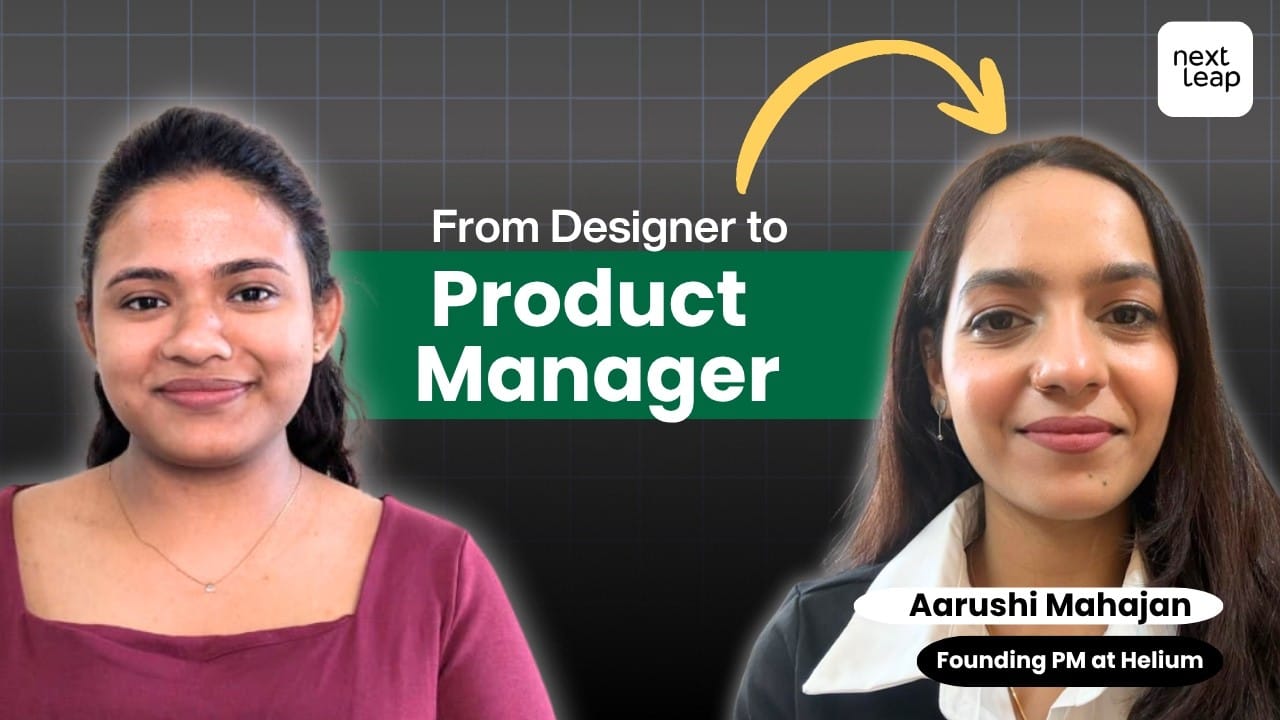
"I was told about the hardships but I couldn't understand it until I was in the role." That is how Aarushi describes the gap between hearing about product management and doing it. Her journey from UX designer to product manager began with a simple habit: always asking why. She shares what changed, what surprised her and how she prepared on the NextLeap Alumni Podcast.
Why did Aarushi go from UX designer to product manager?
She was drawn to work that was more decision-oriented, not pushed out of design. Aarushi began her career after a computer science degree and worked as a UX designer for a couple of years. She is clear that she never felt UX was not enough. "It just was something that I naturally gravitated towards."
Even as a designer, she made it a point to understand the why behind everything she worked on. UX also meant client conversations and understanding business needs, and she found she enjoyed making data-driven decisions and understanding stakeholders. When she learned that this work had a name, product management, she thought: this is the role I can do.
The name came during postgraduate study in Canada. She had chosen a business course because design options were limited, and she wanted to understand strategy, data and technical feasibility as well. Project management was her minor, and that is where she learned the difference between project and product. After researching it, she decided: "I don't care where. I just need to be in this role."
What changes when a designer becomes a product manager?
You spend less time perfecting screens and more time deciding what should be built and why. Aarushi says a designer can spend three to four days making screens beautiful. A product manager has to question whether that time is well spent for what the team is building.
The second difference is decision-making power. As a UX designer, she says, you often do what you are told. As a PM, you get to understand what is to be built and why. The foundation is still the same, she says. The difference lies in where your judgment is used.
The best advice she received before switching stuck with her: "you have to be a manager without authority." She explains why it hits harder in the job. "As a product manager, nobody's reporting to you. You're the manager of that product and not of the team." The people around you have their own managers, and you are part of the team while also managing the work.
What is the difference between a product manager and a project manager?
A product manager decides what gets built and why. A project manager makes sure it gets executed on time and within budget and constraints. In Aarushi's words, product management is about making decisions and understanding business objectives, while "executing part is all project management."
The lines blur in practice. She notes that roles are sharply defined mainly in very large companies. In smaller and mid-level ones you often do both, which she says also makes you a better people person.
How did Aarushi prepare for PM interviews?
She combined the NextLeap curriculum with a lot of independent reading and practice. She is open that she had time on her side because she was not working while she studied. Many learners do the course alongside a full-time job, and she does not want to downplay that.
What the NextLeap fellowship gave her was structure. "A curriculum gives you that strategic learning and also holds you accountable because every week there was some assignment that we had to complete." The assignments became a portfolio that showed she could solve problems.
Beyond the course, she read case studies online, listened to podcasts and watched YouTube. For interviews, she read about the company and kept up with new product launches. She practised product sense questions, product design questions and a few technical questions.
Mock interviews at NextLeap mattered too. "The first mock interview that I gave I was not confident at all and I think I fumbled a lot there." Over time, that turned into confidence, which she says matters in real interviews.
What do interviewers look for in a first-time product manager?
Confidence backed by honesty, and any relevant experience you already have. Aarushi points out that product management is usually a mid-level role, not a fresher role. But experience from software engineering, DevOps or design counts, because you have talked to people and worked in teams.
Her point about confidence is direct: "If you don't have confidence then even if you have experience it's not going to help. So it's always about being confident in what you know and also being transparent about what you don't know."
She names three skills for aspiring PMs.
- Communication. If you prefer sitting in a corner and working alone, she says, this role is probably not for you, and that is fine.
- Decision-making. Know when to say yes and when to say no, and be okay with hard calls.
- Willingness to learn. The market changes often, so you have to keep upskilling.
Do designers have an edge in product management?
Yes, she believes so, though she admits she may be biased. Designers already do a lot of the work: understanding what is being built, doing research, and knowing users' needs and business outcomes. She says they may be doing more than half of a PM's job.
She also has a warning. Repetitive design work is increasingly being replaced by automated tools and AI. Designers who stay stuck in producing UI screens three days a week may find it difficult. Those who move toward thinking about the approach are already moving into PM territory, and she says the line between the two roles is merging.
Her advice for designers who are unsure comes down to three things: understand business requirements, understand stakeholder needs, and start making data-driven decisions. And on the doubt itself: "If you're unsure about the role, that only means that maybe you haven't learned a lot about it."
Just because it has the word manager in it doesn't automatically make you somebody else's manager.
Watch the full conversation
Aarushi was in conversation with Nimisha on the NextLeap Podcast.
Start your own switch
Aarushi credits the weekly assignments, portfolio work and mock interviews of the NextLeap course for giving her structure and confidence. If you are a designer or another professional thinking about product, the NextLeap Product Manager Fellowship is a good place to see how that structure works. It is built around projects and interview practice, the same things she leaned on.
Frequently asked questions
Can a UX designer become a product manager?
Yes. Aarushi moved from UX design to product management and says designers already do much of a PM's work, such as research, understanding users and business outcomes. To make the move, start understanding business requirements, stakeholder needs and data-driven decision-making, then practise case studies and interviews so you can show that judgment.
What is the difference between a product manager and a project manager?
A product manager makes decisions about what to build and why, guided by business objectives. A project manager focuses on executing it within time, budget and constraints. Aarushi notes that only very large companies define these roles sharply, so in many organisations you may be asked to do both.
Can you become a product manager without prior PM experience?
Yes, but prior experience of any kind helps. Aarushi says product management is usually a mid-level role, and experience from design, engineering or other jobs counts because you have worked with people and teams. Upskilling through case studies and mock interviews, and showing confidence and honesty in interviews, can help you make the switch.
What skills do you need to become a product manager?
Aarushi names three: communication, decision-making and a willingness to keep learning. A PM has to work with many teams without formal authority over them, make hard calls about what to build, and keep upskilling as the market changes. She says people who prefer to work alone in a corner may find the role difficult.


