
 My Courses
 My Portfolio
 Refer & Earn
 My Purchases
At a glance
- Before: Four years as a support engineer at Sprinklr, after building startups of his own
- Now: Associate Product Manager at Akash Technology
- Program: NextLeap Product Manager Fellowship
- What made the difference: Deadlines, a community and a habit of building
- Biggest lesson: "Community is a very, very, very important thing when it comes to cracking product management."
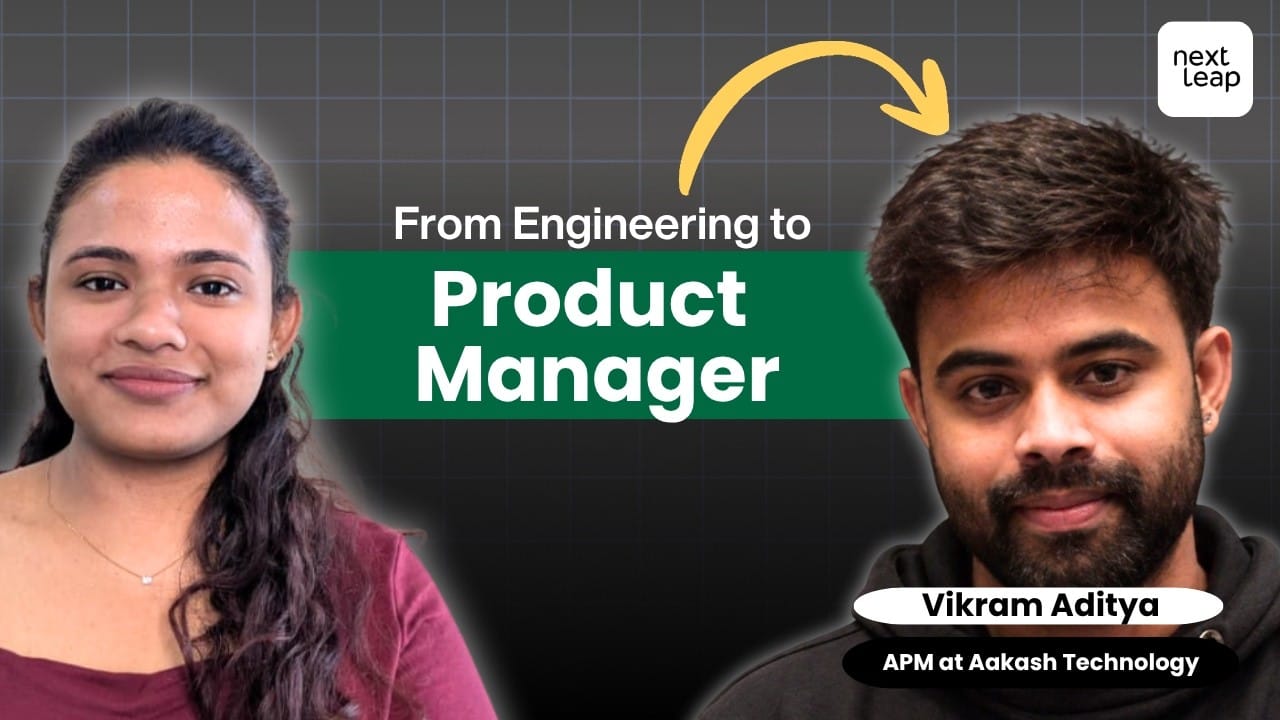
Vikram did not plan a career in product. He built startups with a small team, failed, learned and then spent about four years in support engineering at Sprinklr. His route from support engineer to product manager came from asking why things were breaking, and from a role he had not heard of until he met product people at work. He described the path on the NextLeap Alumni Podcast.
How did Vikram go from support engineer to product manager?
Gradually, and not by design. Vikram says he only learned about product management in the last three or four years. At college, the only way he knew to build things was to become a founder. That changed at Sprinklr, where he met a few product people and asked what they did.
"You don't have to be a founder to build a company. There is a role called as product management," he says. He puts the timing down to the years after the pandemic, when everything became tech first and digital first. Companies needed "a person who's an intersection of tech, business, users."
The moment he felt ready came after about three years at Sprinklr. The work had become repetitive, but his questions had changed. He was no longer only asking what was broken. He was asking why it was breaking and why it was not working as expected. Mentors at Sprinklr helped him from there.
What did failing at a startup teach him?
That learning, relearning and unlearning is a pattern, not a phase. Vikram built his first company with a team of four or five enthusiastic people. When they launched, the product did not gain traction the way they wanted. They went back to the drawing board and found they had "done couple of foundational things wrong."
They changed the model and relaunched, and it did well. He says the same pattern has run through his career: speed as a founder, depth in a job, and both in product management.
Why did support engineering shape his product thinking?
Because it combines technology, business and communication in one job. Vikram names support engineering as the phase that shaped his product thinking most, though he says no single phase did it alone. When a ticket comes in, you are the first touch point of the company. You have to understand the product, debug the problem and explain it in simple terms to a user who is not technical.
He says that after a couple of years, this becomes second nature. For anyone without product experience, he suggests looking at customer-facing roles such as support, implementation consulting or UX design. These are jobs where you interact with people a lot, and that shows you what is working and what is not.
What did the NextLeap Product Manager Fellowship add?
Accountability and a habit of starting with the problem. Vikram says enrolling in a course is better than learning alone because you are on a deadline, you have assignments to complete and you compete against a community. There is always an output too, such as becoming a top fellow and getting access to companies you can apply to. He calls the fellowship a 16-week course.
The bigger shift was about solutions. "All of us do this, right? Whenever we have a problem, we just jump to building solutions." The Product Manager Fellowship pushed him to see that the solution is a small part of the work, and that "what goes to make an amazing solution is the quality of the problem that you are able to drive."
Why does community matter for cracking product management?
Because you learn from what others have built and you get more people looking out for you. Vikram says that two years ago he would have said community hardly mattered. Now he would say it matters a great deal. In his cohort, he could look at the portfolios of 50 or more people and pick out the good and the weak.
He also sees referrals working in practice. He says he regularly sees people get hired outside NextLeap because someone from the community referred them. If you post that you are looking for a job in a community of thousands and even 20 to 30 percent read it, he says, you improve your odds. The only downside he can think of is that "you have to actually study."
How is building a startup different from building inside an organisation?
A startup gives you speed and flexibility, and an organisation gives you scale. Vikram says building in an organisation is easier because you have resources and a cushion if something goes wrong. In a startup there is chaos and ambiguity, but you can pivot the entire idea tomorrow based on new input.
In a company, you build for scale, not for a fraction of users. Those are the two differences he sees as fundamental.
Which founder habits help a product manager?
Vikram names three: being a self-starter, taking feedback well and not chasing outputs. His definition of the job is direct: a product manager exists "to build consensus in the organization." You get things done through others, so you need to sell a vision to developers, designers and business leaders.
- Self-starter. Learn things on your own so that you sound credible to developers.
- Taking feedback. If you have dealt with ambiguity, you know what you are weak at and can take feedback collaboratively.
- Not chasing outputs. If you are not fixated on the solution, you can see through to the problem.
Which AI tools does Vikram use as a product manager?
He uses different tools for different jobs, and says everything he does is now driven by AI. He writes PRDs with Gemini, codes with Antigravity, designs with Figma Make and uses Fathom as an AI note-taker in meetings. He adds that developers can now code far faster, so product managers need to use these tools a lot.
Where should an engineering student start?
By building. Vikram says the world has flipped in the last six months, with so many AI tools available. His advice is to go to forums such as Reddit or Quora, find good problem statements and build against them. That applies to anyone, whether an engineer, a lawyer or a doctor.
- Think from first principles and keep building.
- Join a community where you can take feedback, such as NextLeap or product communities on Discord.
- Learn the fundamentals first, because skipping them means doing it all wrong.
If you want to create things, product management job will find you even before you find a job.
Watch the full conversation
Vikram was in conversation with Nimisha on the NextLeap Podcast.
Start your own switch
Vikram's route ran through deadlines, a community and a habit of building. If you want a similar structure, the NextLeap Product Manager Fellowship pairs assignments and mentors with a cohort of peers whose work you can learn from.
Frequently asked questions
Can a support engineer become a product manager?
Yes. Vikram spent four years as a support engineer at Sprinklr and says the job trains you in technology, business and communication. You debug problems and explain them simply to non-technical users. He says that after a couple of years this becomes second nature, and it helped him understand product.
Does being a founder help you become a product manager?
Vikram says it does. Being a founder built three habits he uses as a product manager: being a self-starter, taking feedback well and not chasing outputs. He also learned that speed matters in a startup, while an organisation needs depth and scale. He advises building something on your own for a few months before applying.
Where should an engineering student start with product management?
Vikram says to start building. Find real problem statements on forums such as Reddit or Quora, use AI tools to build against them, think from first principles and take feedback from a community. He says this applies to anyone, not only engineers, and that learning the fundamentals first matters.
Which AI tools does a product manager use?
Vikram names Gemini for writing PRDs, Antigravity for coding, Figma Make for design and Fathom as an AI note-taker for meetings. He says developers now code much faster with AI, so product managers should use these tools regularly. Different tools suit different use cases, so try several.


