
 My Courses
 My Portfolio
 Refer & Earn
 My Purchases
At a glance
- Before: Business development associate, then an MBA with no offers at placements
- Now: Associate Product Manager at Newton School
- Program: NextLeap Product Manager Fellowship
- What made the difference: A product internship on the resume and proof of work
- Biggest lesson: "Rome was not built in a day."
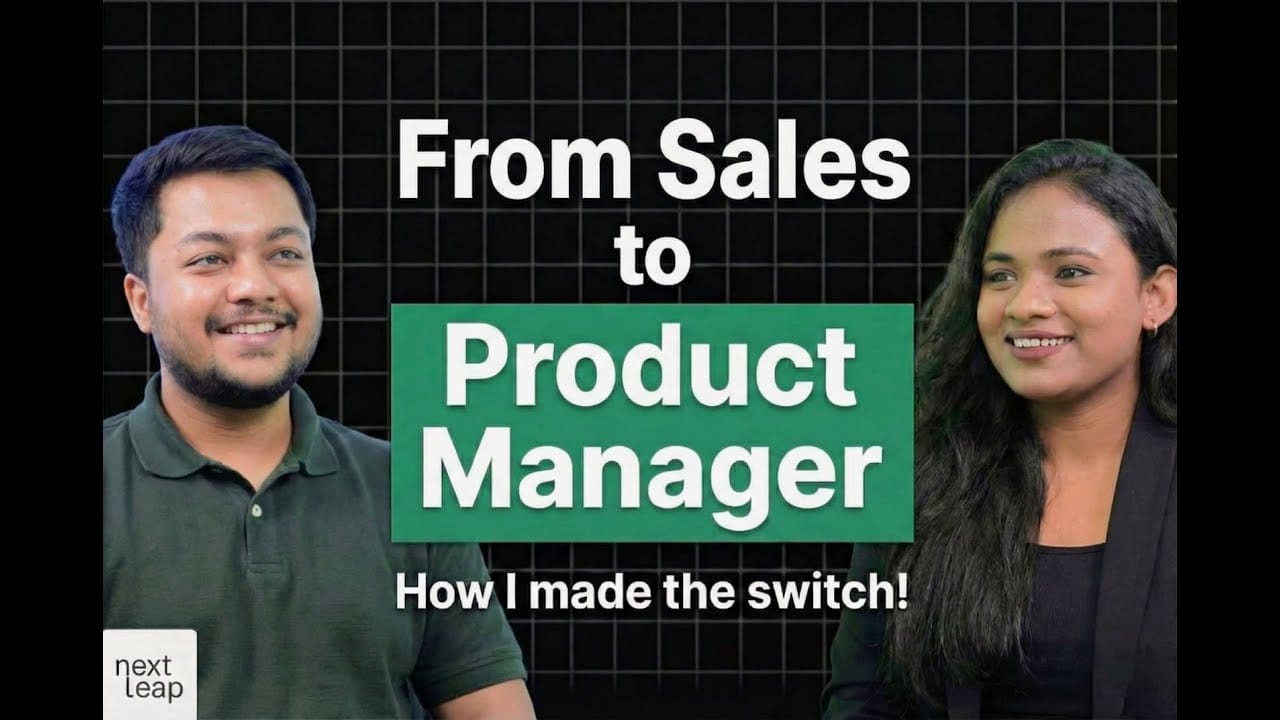
"Back then I thought MBA was a golden ticket to product management." Faraz began in business development, moved through an MBA with no offers at placements and then found his way into product. His story of going from sales to product manager shows why experience and proof of work matter more than a degree. He told it on the NextLeap Alumni Podcast.
Why did Faraz move from sales to product manager?
Because he wanted to build, not chase a number. A few months into his business development role, Faraz realised it was not for him. He was doing the same thing over and over, bringing a set of numbers to the table. "I was not building something. I was not enjoying my work." Looking back, he was selling something that someone else had built.
He wanted to go for solutions and solve things. That idea, he says, was his first nudge towards product management. He explains the job to a five-year-old like this: "Consider product as a building and product managers are the architect."
Do you need an MBA to become a product manager?
No. Faraz first thought an MBA was the only stepping stone, and that it would make the prestigious job easier to get. He now says it is not the case. People can learn from working product managers, talk to them, or join a course such as NextLeap.
His own MBA came after he quit his job, so that he would not end up in the same position. But his sales background meant that every job option he got was in sales. Everyone around him was getting placed and he had no offer. "It was a difficult time for me."
How did he keep going without an offer?
He joined NextLeap and focused on product. There were moments when he thought he should just take a job and start a career. Self-doubt was there, he says, but he also went through self-discovery. He solved complex case studies, wrote PRDs and learned how product managers think.
That gave him the confidence that he was on the right path and that eventually, if not tomorrow then the day after, he would get into product management.
What did the NextLeap Product Manager Fellowship teach him?
How to think like a PM. Faraz says he used to rush to the solution whenever he saw a problem statement. At NextLeap he learned to break the problem down in a structured way and find the true problem before solutioning. The Product Manager Fellowship also had classes where instructors who were veterans in the industry solved interview questions, and peer-to-peer mock interviews.
The peers were talented people like him, and that gave him confidence that he was not alone in pursuing this.
How did his first product internship help?
It put him among product managers. Faraz's first PM internship was at Healthkart. He saw different approaches to different problem statements, and worked on projects that needed a lot of stakeholder management: finding out what stakeholders needed and solving for their problems. He says these lessons still help him.
How did he land a full-time product role?
By putting the internship on his resume. Although he was an intern, he says he worked like a PM. Once he added the Healthkart experience, he started getting calls. Before that he got none, because he had no product experience. Then he got shortlisted, cleared round one and round two, and eventually had three offers. He chose Newton School.
The lesson he learned the hard way: "In product management you need to have some sort of experience." He had expected a big role at a big company without it. Even one internship, or a job close to product, helps. If your profile is not remotely close, he says, start from scratch.
How do you show proof of work with no product experience?
Build a portfolio. Faraz says if you have no product experience, the best thing to do is show recruiters proof of work: product teardowns, solved case studies and PRDs you have written. That lets a recruiter know you are capable, and it can get you shortlisted.
His advice to anyone in an unrelated role is patience. You have to acquire skills, seek opportunities and grab them.
Will AI take over product management jobs?
Faraz thinks AI has already taken many jobs, so people need to be aware of what it can do. He gives examples: an AI browser that books the cheapest ticket, and platforms that build a whole website from a prompt. He does not think AI will do everything alone, since it needs a human, but he believes the task force will reduce significantly.
In his own work he pastes competitor screenshots into ChatGPT for analysis. He used to make wireframes on Whimsical, and now he can paste a structured PRD into a prototyping platform and get a working website to show designers and developers.
How is product management different from sales?
It is not linear. In sales, Faraz says, he spoke to leads, converted them to prospects and then customers, and nothing else. As a product manager he juggles many things in a single day: finding a solution, doing research, testing what he has built and grooming designers and developers.
What keeps him motivated is that he is working on an outcome and can measure the impact he creates. "I'm not just selling a solution, I'm building one."
Rome was not built in a day.
Watch the full conversation
Faraz shared his story on the NextLeap Podcast.
Start your own switch
Faraz's turning point was product experience and proof of work, not a degree. If you want to build both, the NextLeap Product Manager Fellowship offers case studies, mentors and peer mock interviews.
Frequently asked questions
Do you need an MBA to become a product manager?
No. Faraz once thought an MBA was a golden ticket to product management, but says it is not the case. He completed one and still had no offers at placements because of his sales background. He suggests learning from working product managers, talking to them or taking a course, and getting some real product experience.
How does someone in sales become a product manager?
Faraz did not go straight from sales. He left business development, did an MBA, joined NextLeap and did a product internship at Healthkart. Adding that internship to his resume led to shortlists, and eventually three offers. He says you need some product experience, even one internship, to be taken seriously.
How do you show proof of work with no product experience?
Faraz recommends building a portfolio with product teardowns, solved case studies and PRDs you have written. That shows recruiters you can do the work, and it can get you shortlisted. He also suggests patience, since expecting things to change overnight does not work, and acquiring skills while seeking opportunities.
Will AI take over product management jobs?
Faraz says AI has already taken many jobs, so people must be aware of what it can do. He does not think it will do everything by itself, since it needs a human, but he expects the workload to shrink. He uses it for competitor analysis and to turn a PRD into a working prototype.


