
 My Courses
 My Portfolio
 Refer & Earn
 My Purchases
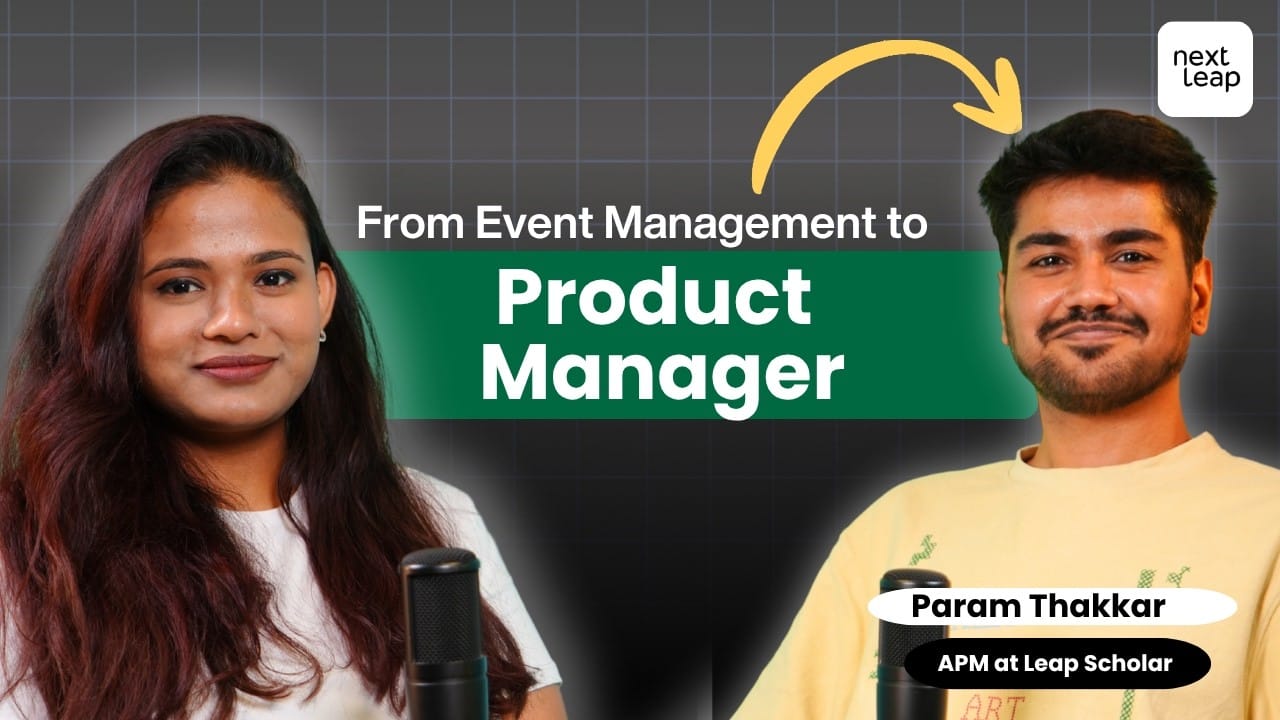
At a glanceBefore: Event and wedding planner, home-automation founder, then roles at Amazon and in sales at Capture CX. No coding background.Now: AI associate product manager at Leap ScholarProgram: NextLeap Product Manager FellowshipWhat made the difference: A portfolio of self-built automations, cold emails with custom decks, and structured product thinkingBiggest lesson: "Building is the most easiest thing in product management."
Param was in sales when he used ChatGPT to automate his cold emails. The results were good enough that his company told him, "You got to stop doing sales and do this full-time." That moment opened his path to product management. He had no engineering degree and no coding skills, and had worked in event management, at Amazon and in sales. Today he is an AI associate product manager at Leap Scholar. His story is a practical guide to becoming a product manager without a tech background: build things that solve your own problems, and let your portfolio speak for you.
Where did Param start?
Param began in event and wedding planning, a job he chose because he enjoyed high-pressure work. When COVID halted events, he taught himself to build apps.
He had always liked tinkering with technology. As a kid he changed phone software and side-loaded apps. With events on pause, he learned Flutter, a framework for building apps across platforms, with help from a newly launched ChatGPT. "I don't come from [a] tech background," he says. "I had to learn all of that."
He then started a home-automation venture, Autotopia Lifestyle, that let people control lights, fans and ACs from their phones. It taught him that "packaging essentially is the moat". A good product is about the experience you deliver, not just the hardware.
His next roles added more skills. At Amazon he investigated why sellers' accounts were banned, which meant a lot of root cause analysis. "I had to go 10 layers deeper," he says. At Capture CX he did cold calling and cold emailing. That was where he discovered he could build custom bots with ChatGPT Plus.
How did Param discover product management?
A colleague told him the role existed. Param realised it combined everything he enjoyed without requiring him to code.
"People don't know that you don't have to code," he says. "One would only think that you have to code if you want to build something, but that's not the thing. Someone told me product management as a thing exists, and that was best of both worlds, because I can't code."
The same colleague had taken NextLeap's course and recommended it. Param went through the Product Manager Fellowship page carefully. "I remember reading each and every word of that product management fellowship landing page. I downloaded their syllabus," he says. "I was fascinated [by] the amount of clarity there was."
What did the NextLeap fellowship change for Param?
It replaced "just build it" with structured thinking: map product outcomes to business outcomes, and understand why before deciding what to build.
"Before that, I would just build anything on Flutter," he says. "But after NextLeap I realised you can't just build. You have to spend 10x more time just to strategise [and] understand what to build."
He still remembers one line from the course, which he credits to NextLeap co-founder Arindam: the sole reason for any company to exist is to generate wealth for its shareholders. He also uses the Jobs to Be Done (JTBD) framework in his day-to-day work. "In product management you get a lot of information thrown onto yourself," he says. "You got to remove all that noise and focus on the job to be done."
Months into his PM role, he still goes back to his fellowship notes.
How can you get a PM interview without a tech background?
Build a portfolio of real, personal projects, and don't rely on job portals. Reach out to founders directly instead.
"As someone who comes from a non-tech background, your portfolio speaks for you," Param says. He warns that applying through LinkedIn or Naukri can get non-engineers filtered out early. So he cold emailed founders and sent each company a deck made for them, a skill he had learned in sales.
What matters is what goes into that portfolio. "Anyone can build a diet planning thing with AI," he says. "I look for creativity now." Two of his own projects:
- A rain alert. He lived on the 28th floor, and rain kept coming in through open windows. He combined a weather API with WhatsApp so he got a message to shut the windows whenever it rained.
- A menu-planning chatbot. Tired of the cook waking him every morning to ask what to make, he fed a chatbot his list of regular meals and some house rules. It generates a weekly menu and a grocery list.
"When you solve problems for yourself and get in an interview, the intent and the energy with which you speak, that communicates by itself."
What does an AI product manager actually do?
At Leap Scholar, Param builds AI products for users and AI workflows that make the company more efficient, and he is measured on metrics.
On the consumer side, he works on Leap Scholar's chat-first experience, where students can ask study-abroad questions to a specialised AI instead of a human. Internally, his team is working on automating how marketing videos go from idea to production.
The biggest surprise was how little of the job is about building. "Building is the most easiest thing in product management," he says. "Product management is all about iterating and moving your metrics. Product managers breathe metrics."
For his chat product, he tracks how many people start a chat and how many send five or more messages. Early on, users sent a couple of messages and dropped off. Talking to them and understanding their needs helped the team raise the number of users who stayed for five or more messages. "That would not have happened if I would just built and leave it off," he says.
He sees the job as testing ideas: "I just make hypotheses and validate those hypotheses. I think that is 80% of product management."
What does Param look for when hiring for his team?
He looks for intent, depth and a clear sense of why.
- Intent. "Intent beats skills any day." A PM needs dozens of skills, so the drive to get better at whatever problem you're given matters more than any single skill.
- Depth. He asks candidates about a problem they've worked on and goes "10 levels deep" to see if they know it well.
- The why. "Your job is to do exactly what is right by the user, because you're building the product for [the] user."
His advice for non-tech aspirants is honest. "If you don't get this naturally, of building things, understanding users, understanding people and actually having to solve problems, then probably product management is not the best thing for you." But if you're curious and don't settle for surface-level answers, he believes the role is for you.
Watch the full conversation
Param spoke about his journey on The NextLeap Podcast.
Start your own switch into product management
Param's story shows that you don't need to code to become a PM. You need curiosity, real projects and structured thinking about users and business outcomes. The NextLeap Product Manager Fellowship teaches frameworks like Jobs to Be Done and how to map product outcomes to business outcomes, the ideas Param still relies on at work. If you're coming from sales, operations or any other non-tech role, explore the Product Manager Fellowship and see if it fits your next step.
Frequently asked questions
Can you become a product manager without a tech background?
Yes. Many product managers come from sales, operations, events or other non-engineering roles. Coding is not required. What matters is understanding users, thinking in terms of business outcomes and metrics, and working well with engineers and designers. A portfolio of projects that solve real problems helps show hiring managers you can do the job.
How do you get a product manager interview with no PM experience?
Build a portfolio of projects that solve real problems, ideally your own, since generic projects rarely stand out. Instead of relying only on job portals, where non-engineers may be filtered out early, reach out to founders and hiring managers directly with a short, customised note or deck showing how you think about their product.
What does an AI product manager do?
The role varies by company. Typically an AI product manager builds AI-powered features or products for users, such as chat-based assistants, and may also design AI workflows that make internal teams more efficient. Like any PM, they own metrics, test hypotheses, talk to users and iterate until the product moves business outcomes.
What skills do hiring managers look for in an associate product manager?
Beyond specific tools, hiring managers often look for curiosity, ownership and depth: can you explain a problem you've worked on in detail, and why you made each decision? Understanding user needs, thinking in metrics and connecting product decisions to business outcomes are core skills for entry-level PMs.
Is building the product the main part of a product manager's job?
No. Building is only the start. Much of a product manager's work is talking to users, tracking metrics, forming and testing hypotheses, and iterating quickly to improve engagement and business results. A launched feature that no one uses creates little value until it is improved.
More alumni stories:


