My Courses
 My Portfolio
 Refer & Earn
 My Purchases
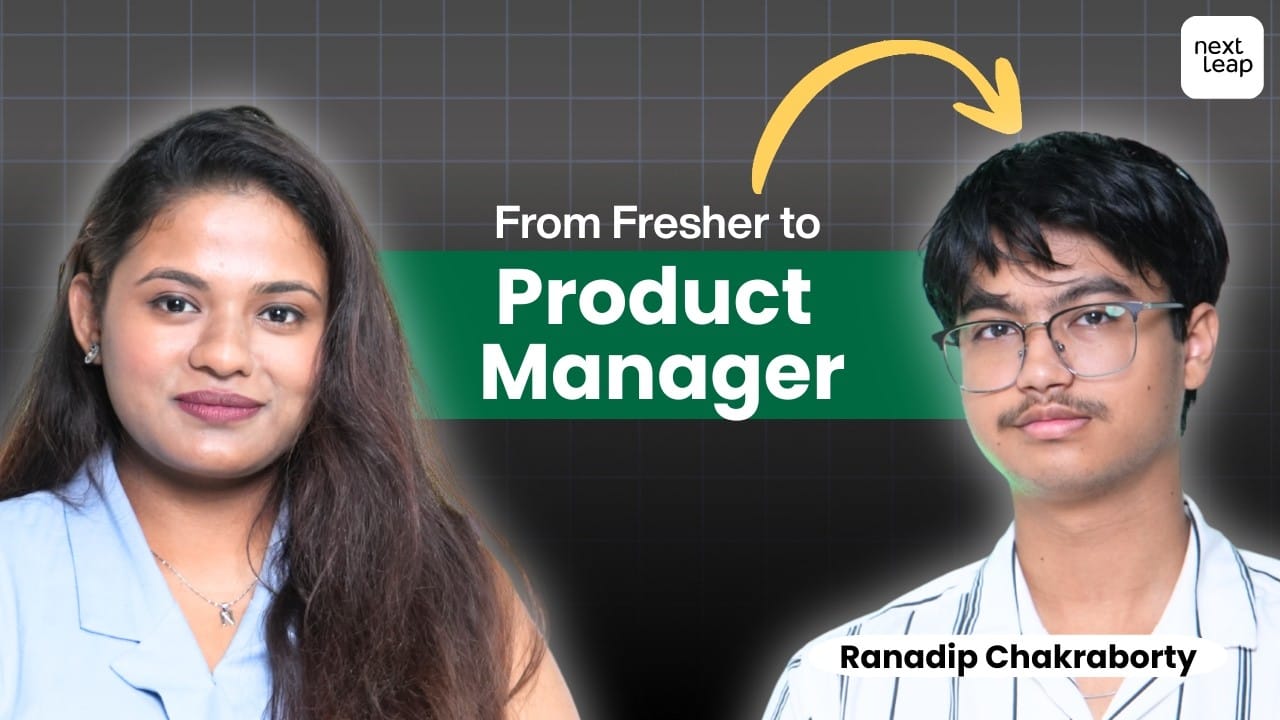
How a BITS Goa Student Landed a Product Management Role: Ranadip's Story
Ranadip, a final-year BITS Goa student, kept seeing PM internships that asked for experience. He built Vizhire, fixed the campus mess menu and landed a product and growth internship.
At a glance
- Before: Final-year BITS Goa engineering student unsure how to get PM experience
- Now: Product at Recruno, and builder of Wizhyre
- Program: NextLeap Product Manager Fellowship
- What made the difference: Real projects that solved real problems
- Biggest lesson: "Use AI as your intern, and not as your thinking companion."
"When I was looking for PM roles, everywhere it said we need one to two years or two to three years of experience. But PM internships is how I get experience. So that was a paradox." Ranadip, a final-year student at BITS Goa, found his way out by building things. His route to a product management went through a job-application tool he built for himself and a voting platform for a campus mess of 4,000 students. He explains how on the NextLeap Alumni Podcast.
How did Ranadip get into product management as an engineering student?
He explored his way there. Ranadip is pursuing a B.Tech and MSE dual degree at BITS Goa. When he joined college, he assumed he would follow an engineering path, like mechanical engineering, or the IT route many peers take.
After two years he began exploring other fields such as finance, product and consulting. Product management stood out. He liked the idea of solving problems, talking to users and using insights to shape solutions. He then found NextLeap and started the Product Manager Fellowship with a friend in September 2025.
How do you get a product management role with no experience?
You show recruiters what you can build. Ranadip says the trouble was never that students cannot get PM jobs. The real issue is that they need projects first, to prove they can build, solve problems and think like a product manager.
Working with a team is a bonus, because PMs coordinate engineering, design and marketing. But he is clear that it is not compulsory: "You can build products and projects yourself as well, and basically identify a problem and solve it for the people who are facing that problem."
What did Ranadip build that helped him get hired?
He built two things: Wizhyre, a job-application copilot, and a voting platform for his college mess menu. He also had the fellowship's milestone and graduation projects to talk about.
Wizhyre, a copilot for job applications
While applying for PM roles, he noticed he was typing the same details again and again. So he built a browser extension for himself, which became the first version of Wizhyre.
Then he wondered why he should not grow it for others too. "No one should be just filling one hour worth of forms and not getting an interview call. You should be instead preparing for the interview, not just fill job application forms." Wizhyre helps applicants fill forms quickly, track applications, and generate tailored answers from an uploaded resume. He built it end to end and launched it publicly. The experience taught him how products start and scale, and how the back end and database work.
The mess menu that students voted on
Ranadip was also the mess convenor at his college, which serves 4,000 students. Students complained about a lack of transparency and choice in the menu, which used to be decided by the mess convenor and committee.
He designed a voting-based platform, spoke to the administration and launched it. It took a month or two. For the first vote, in April, students chose between two options for each item, such as Monday lunch, and the final menu was compiled from the results. Many students said it was one of the best menus they had seen. As he sees it, this was product management in miniature: "we talk to users, we solve problems." The mess was the company, and students were the users.
Fellowship projects
Through NextLeap he worked on milestone case studies, including how ChatGPT's voice mode could better handle Indian accents and regional languages. For his graduation project he looked at WhatsApp's search problem: finding something important in an old chat. He proposed an AI-based approach so users can find what matters to them instantly. The fellowship gave him the fundamentals, like user research, PRDs and product design.
What skills does a student need for a PM role?
User research comes first, along with the judgment to pick the right problem. A company has thousands of problems and limited time, so, in Ranadip's words, "product manager's task is to focus on which problems are important and which are worth solving."
Beyond that, he names AI tools such as ChatGPT, Claude and Gemini for analysing data and brainstorming. He also names communication and leadership skills. Those are built by practising: talk to more people, talk to users, go to events, or host and speak on stage to build confidence.
How should a student use AI to build products?
Treat it like a junior teammate: it can build, but you decide what to build. Ranadip uses tools like Codex, Claude Code and Lovable, which can turn an idea into an app. But he stresses that the thinking still belongs to the product manager.
His line: "Use AI as a helper. Use AI as your intern, okay? And not as your thinking companion." If you delegate everything, he warns, "AI is the product manager, not you."
He gives an example from Vizhire. With several UI changes waiting, he chose to build an ATS résumé checker instead, because it would bring new traffic and help more users. AI could do either task. Deciding which was worth doing was his job. A vague prompt like "make a platform that solves job application issues" would give something unusable, he says. A good product needs a defined problem, a set of users and a clear idea of what to build.
What should your résumé look like for a PM role?
It should be structured, keyword-aware and honest about your projects. Ranadip calls the résumé the mirror of you, because it is the first thing a recruiter sees.
He recommends a common format so that ATS résumé checkers can pass it on. Use product-related keywords and clear sections for projects, experience, skills and education. Don't ignore education: at many campuses, recruiters shortlist on CGPA in final year, so a good CGPA matters alongside your projects.
Ranadip's advice for students stuck in the experience loop
Identify problems around you and solve them. If you are a student in the same loop, his advice comes down to a few steps.
- Find a real problem. Look in your college, your home or the wider world.
- Build something. An app or platform, using AI tools where they help.
- Ask people to try it. Get feedback and improve.
- Consider an unpaid internship early on. He says it can get you into a PM work environment, and you can switch to a better internship later.
The problem was not that people are not getting PM jobs. Problem is that we need to do some projects before to show recruiters that we can build, we can solve problems and we have that mindset that product managers require.
Watch the full conversation
Ranadip spoke with Nimisha on the NextLeap Podcast.
Start your own switch
Ranadip started with curiosity and a fellowship, then let his own projects do the talking. If you are a student or early-career professional trying to build proof of work for PM roles, the NextLeap Product Manager Fellowship offers milestone projects and a graduation project to help you get started.
Frequently asked questions
How do you get a product management internship with no experience?
Show recruiters what you can build. Ranadip, a BITS Goa student, made a job-application tool and a campus voting platform, then talked about them in interviews. Working with a team helps, but you can identify a real problem yourself, build a solution, gather feedback and present it as proof that you can think like a product manager.
Can an engineering student become a product manager?
Yes. Ranadip started in an engineering degree and began exploring finance, product and consulting after two years. Product management appealed because it involves solving problems and talking to users. He built projects, joined a product fellowship and used them to apply for internships, so an engineering background is a starting point, not a barrier.
How should a student use AI to build products?
Use AI as a helper for repetitive or technical work, not for your thinking. Ranadip uses AI tools to analyse data and build prototypes, but decides himself which problem to solve and for whom. He warns that if you delegate everything to AI, it becomes the product manager. Give specific prompts about the problem and the users.
What should a PM internship résumé include?
Use a standard structure with clear sections for projects, experience, skills and education, and include relevant product keywords so ATS checkers can pass it on. Ranadip also notes that CGPA can matter for campus internships, because recruiters may shortlist on it in the final year, so it is worth keeping strong alongside your projects.