My Courses
 My Portfolio
 Refer & Earn
 My Purchases

At a glance
- Before: Physics graduate who tried electronics and coding, then spent about 20 months in internships
- Now: Product Manager at Betterplace
- Program: NextLeap Product Manager Fellowship, where he became a top fellow
- What made the difference: Fundamentals, a portfolio and a peer group for mock interviews
- Biggest lesson: "Frameworks are tools. They are not reality."
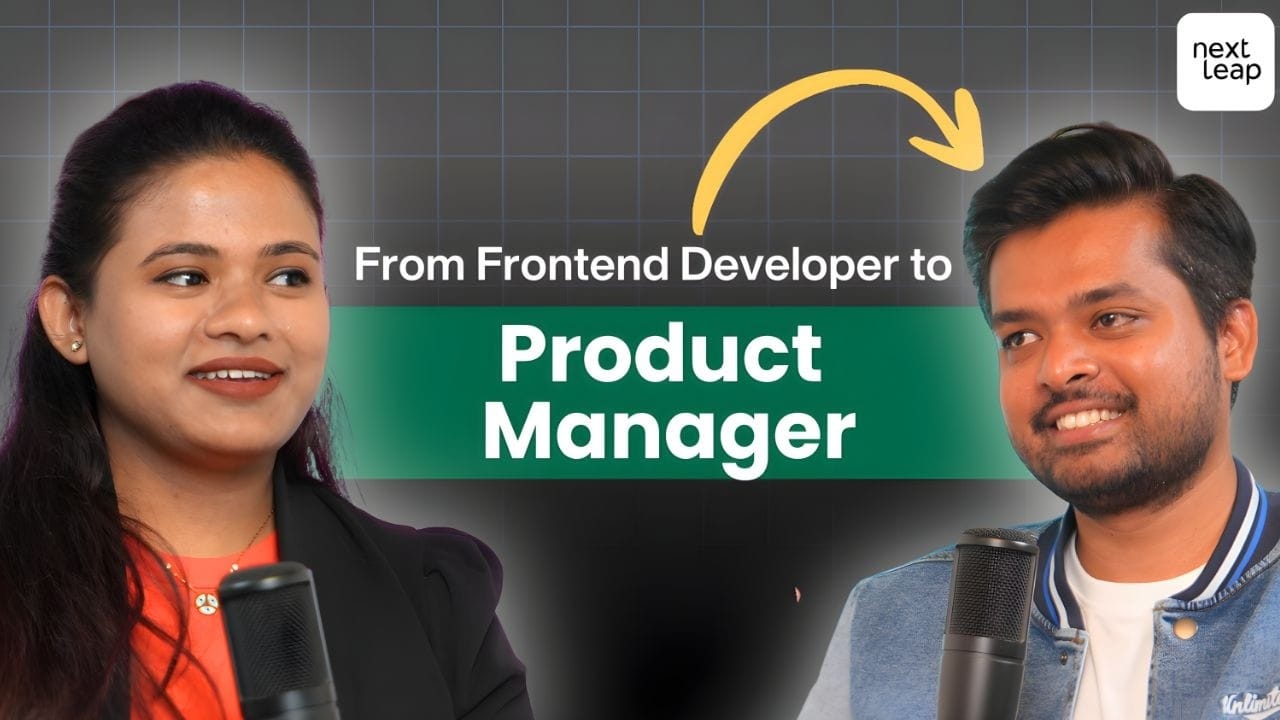
"Those 7 to 8 months felt more alive than the rest of my life." Hardik was talking about running a college cultural fest, and it pointed him towards product. His route from physics graduate to product manager included trial and error with electronics and coding, about 20 months of internships and a portfolio that stood out. He told the story on the NextLeap Alumni Podcast.
What does the physics graduate to product manager path look like?
By trying things until one felt right. Hardik studied physics because he loved it, found it scary once he was there, tried electronics and was good at it, and tried a bit of coding. None of it felt like something he wanted to do every day.
The change came when he became head of the organising committee for the annual cultural fest. Planning, executing and managing was what made those months feel alive. He thought he might start with event management, but he did not want to be too far from a technical approach either. "I somehow landed into product management and have been loving it so far."
How can non-technical aspirants get into product management?
Start with the fundamentals and step right into it. Hardik says everyone now feels product management is cool and that they do not need to code. But it is not an easy job, and you need good product sense. His advice is to find a good course or program, get on with it, and you will find out along the way whether it suits you.
Which internship helps you get into product?
He recommends the founder's office. Hardik had almost 20 months of internship experience, and he did sales, market research, marketing and data analytics along the way. He saw how a startup works and how business decisions influence product decisions.
His manager's view is that "the true definition of product management is doing what it takes." Roles such as business development intern, product analyst and product management intern can also give you a clearer sense of what happens inside a company.
What was scary about becoming a product manager?
Resistance to new ideas. In a new company nobody knows how deep your product sense is, so a proposal can get shot down and you may not find alignment with stakeholders. He says this feels scary in the first month. Then you find your people, build trust, and things start falling into place. It did for him.
How did NextLeap help Hardik crack Betterplace?
It gave him fundamentals, a portfolio and a peer group. Hardik knew from college that he wanted product, and he had been applying for internships for a long time. But talking to experienced people showed him his fundamentals were missing. He joined the Product Manager Fellowship and says it gave him the confidence that he did understand the basics.
The projects gave him a portfolio he could show. The cohort gave him people to practise mock interviews with, since he had no peer group interested in product before. After the cohort, he says, it took around two months to land his first real product internship, and he moved to a full-time role soon after.
It also gave him a reality check. He says it took more than one attempt to become a top fellow. He was working at the time and submitted half-baked assessments at first, and got rejected. Then he took a day off work, sat down, built an entire deck and became a top fellow.
Why does a portfolio matter for getting shortlisted?
Because it shows what you have done, and anyone can write anything on a resume. Hardik says some interviewers referred to him as "the guy who had a portfolio attached in his resume." He separates two steps: getting shortlisted, which a portfolio helps with, and cracking the interview, which depends on clear fundamentals and product sense.
What is Hardik's three-step roadmap for 2026?
He warns that the world is changing fast, and gives three steps.
- Join a good program. One that teaches product management as it is today, with AI built into everyday work.
- Build. Make automations and workflows that have a real-world impact.
- Create a portfolio. Show what you have done in the past year or two, because many people have product sense but cannot show it.
How does he use AI as a product manager?
To question his own thinking. Hardik writes down the problem, his solution and the problems it could cause, then feeds the document to ChatGPT and asks it to cross-question him. After finishing a PRD, he asks it for 20 questions about the document and to be relentless.
He also built a sales-funnel automation for his sales team that finds leads, gets contact details and sends follow-up emails. He says it saves around 35 to 40 percent of the team's bandwidth on research, which is two to three hours for each salesperson.
What skills does an aspiring product manager need?
Empathy is the one he says people lack, then structured thinking, communication and asking the right questions. "Honestly none of it is worth anything if you cannot understand your customers."
He tells a well-known story to make the point. People complained that a lift was too slow. Instead of building a faster motor, the company put a mirror in the lift, and later surveys said it felt faster. The problem was that people had nothing to do while they waited. A product manager cannot take a problem at face value.
What mistakes do PM aspirants make?
They overrate frameworks and wait for the perfect internship. Hardik says people think following RICE or a set of steps will get them a good product role. It will not: "Frameworks are tools. They are not reality." A good product sense matters more.
The second mistake is holding out for the ideal role. If you are not getting the internship you want, start with what you are getting, because it teaches you how a business works. You can switch later.
Take risks, leverage AI and if you feel like building something, build it.
Watch the full conversation
Hardik was in conversation with Nimisha on the NextLeap Podcast.
Start your own switch
Hardik's turning point was clearing his fundamentals and building a portfolio alongside peers. If you are coming from a non-technical background, the NextLeap Product Manager Fellowship offers projects, mentors and a cohort to practise with.
Frequently asked questions
Can a physics graduate become a product manager?
Yes. Hardik is a physics graduate who tried electronics and coding before finding product through organising a college fest. He then did about 20 months of internships, built a portfolio through NextLeap and joined Betterplace as an product manager. He advises learning the fundamentals first and building real work you can show.
Which internship helps you get into product management?
Hardik recommends a founder's office internship. He did sales, market research, marketing and data analytics, and saw how business decisions influence product decisions. Business development, product analyst and product management internships can also help. If you cannot get the exact role you want, he says to start with what you can get.
What mistakes do aspirants make in PM interview preparation?
Hardik names two. People overestimate frameworks such as RICE, which he calls tools and not reality. And they wait for the perfect product internship before starting. He says a good product sense matters more than any framework, and that any internship teaches you how a business works.
How does a product manager use AI day to day?
Hardik feeds his notes and PRDs to ChatGPT and asks it to cross-question him, including for 20 relentless questions on a finished PRD. He also built a sales-funnel automation for his team that he says saves 35 to 40 percent of their research bandwidth. He says people who are not efficient with AI will fall behind.