
 My Courses
 My Portfolio
 Refer & Earn
 My Purchases
At a glance
- Before: B.Tech graduate making memes for a living, with no idea what product management was
- Now: Associate Product Manager at Applied Systems, after a founding PM internship and a stint as an APM
- Program: NextLeap Product Manager Fellowship
- What made the difference: Cold emails to founders, product teardowns and structured learning
- Biggest lesson: "Getting into PM as a fresher is very very hard."
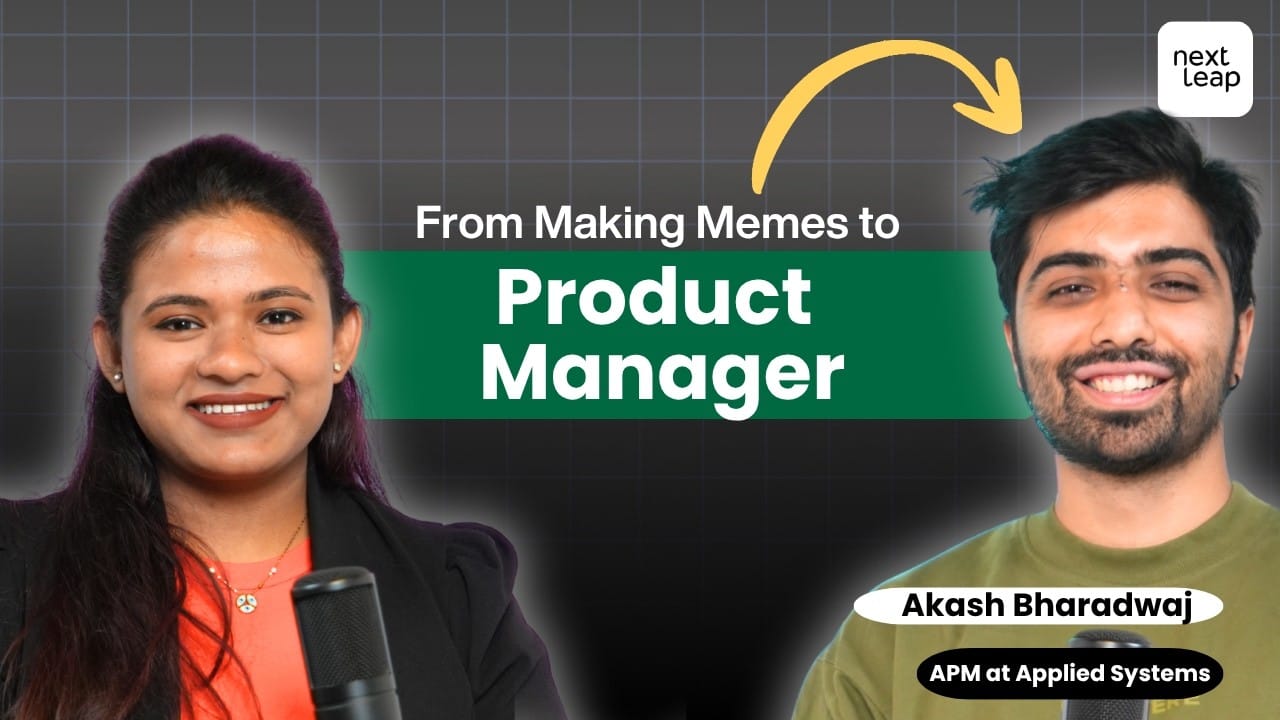
"Four years back I didn't even know about product management. I was literally making memes for a living." Akash's path from meme marketing to product manager has no MBA in it. It has cold emails to founders, a fast-moving startup internship and a lot of curiosity. He told the whole story, including the parts he calls the brutal truth, on the NextLeap Alumni Podcast.
How did Akash go from meme marketing to product manager?
By noticing that he liked building, and looking for the closest role to entrepreneurship. Akash is an engineer who did not want to go into development. He wanted to try something different, so he joined a meme marketing company as part of a team of about 20 people.
There, the team was building an app, and he realised that building is a field of its own. He was also watching a lot of Shark Tank and was interested in building. "The closest thing to entrepreneurship was product management." He researched it on YouTube and Google, took a small Udemy course and saw that he had already been doing product work without knowing it.
How does a fresher land a first PM internship?
By applying everywhere, cold emailing founders and being willing to start small. Akash hit a chicken-and-egg problem: you need PM experience to become a PM. Freshers were rarely considered unless they came from campuses where companies ran PM rotation programmes.
So internships were his only option. He emailed everyone, applied to any APM opening and asked for referrals. He says he was even willing to do an internship for free, because he wanted product management that badly. Eventually a founder gave him a shot at an early-stage startup. He was an intern for the first month, was converted to full-time and joined the founding team.
Why did Akash choose NextLeap for structured learning?
Because the startup was chaotic and he had no structure. "I didn't know how to work in a structured way, because I was an engineer. I didn't have any clue with regards to product management." The founders encouraged the whole team to learn, which is how he came across NextLeap. He joined the ninth batch.
He says there are other courses, including Udemy and many competitors, and anyone can learn anything on the internet. But "structured learning and the community, that is where NextLeap stands out." At the time, he says, it was also the most cost-effective option. He asked friends who had done it on LinkedIn, and they only had positive things to say. He also read up on NextLeap's co-founder, Arindam, and was fascinated that he had worked at Flipkart. As he puts it, it was "a one-stop solution for all my PM needs."
He calls himself a curious person who asks why about everything: why are we doing this, why are these principles needed. At that time, he says, NextLeap was the only place for structured learning and structured questioning. He joined the Product Manager Fellowship for that reason.
How do you build a product management portfolio?
Break down real products, then build your own. Akash's method at the start was simple. He would download an app, work out what it does differently and which features are unique, and keep asking why. He compared products like Zomato and Swiggy, wrote his observations as case studies and emailed them to the co-founder.
Today, he says, it is easier and better. With AI you can go to Lovable, build designs or even host full products and put them in your portfolio. "A stellar portfolio and building something will help you crack an internship right now."
What does a product manager do every day?
A lot of it is aligning people. Akash describes a typical day starting with a daily standup. Then you talk to the design team if you are building something new, the business team about requirements, and the data team about how current features are performing. You also talk to customer support about the problems customers face.
After that, you show the feature to stakeholders and CXOs and think about go-to-market. At a previous company, for example, area managers needed to learn how a feature worked, so he had to simplify it for them. Engineering resources are limited, and other PMs want their work prioritised too, so you also align with the engineering manager. His summary: "It's stakeholder management."
Which skills does a PM need?
Akash says you need to know a bit of everything, because PMs are essentially the owners of the product. He names four areas.
- Data. Know how to read it, and see how many people adopt a feature after launch.
- Design. You do not need to design products, but you should know how designs work. Download a lot of apps and ask why a button is there or why there is an infinite scroll.
- Stakeholder management and documentation. Communicate well and write features clearly so that engineering knows what to build.
- First-principles thinking. Be a thinker who uses apps as a user and thinks like a product manager.
Is it hard for freshers to get into product management?
Yes, and Akash does not sugar-coat it. "If I have to give you the brutal truth, getting into PM as a fresher is very, very hard." He suggests having some experience first, in development, marketing or something else. As a hirer, he says, he would look for someone with an engineering background and some development experience. He calls that the harsh reality but not a hard-and-fast rule, because he knows a friend from an arts background who joined his company after doing NextLeap.
Two myths he wants to break. You do not need an MBA: "I don't have an MBA. I think I'm doing pretty well for myself in product management right now." And you do not need many years of experience, although it is preferred. So prepare with structured learning so that nobody can point at what you lack.
His practical tip is to look for PM internships at early-stage startups with 10 to 30 people. They may pay less, but you learn a lot, and if you perform well and the company does well, they may give you a PM role. Big companies, unless you are from an IIT or IIM, are unlikely to give freshers that shot.
Akash's advice for freshers
Be curious, break down apps and learn to build with AI. His rapid-fire answers show what he values.
- First skill to learn: building products using AI.
- Harder part: doing the job, more than getting it.
- Common mistake: trying to get into PM without any PM experience.
- Habit that helped: being organised and structured, which he links to playing sports like basketball and cricket.
Apply to early-stage startups and try to learn and build using AI.
Watch the full conversation
Akash was in conversation with Nimisha on the NextLeap Podcast.
Start your own switch
Akash's route needed persistence, and he found the structure he was missing in a fellowship. If you are trying to move into product from another field, the NextLeap Product Manager Fellowship is a way to learn the fundamentals and build the projects that go into a portfolio.
Frequently asked questions
Can a fresher become a product manager?
Yes, but Akash says it is very hard, so be realistic. Freshers usually start with internships, especially at early-stage startups where small teams give more ownership. Having some experience in development, marketing or another field helps. A portfolio of product teardowns or projects built with AI tools can improve your chances of getting that first internship.
Do you need an MBA to become a product manager?
No. Akash says the belief that you need an MBA is a myth and points to his own career: he has no MBA and has worked as a founding product manager and an associate product manager. Years of experience are preferred by some companies, so prepare with structured learning and projects, so that nobody can point to what you lack.
How do you build a product management portfolio?
Start by breaking down apps you use. Akash compared products such as Zomato and Swiggy, asked why each feature exists and turned it into case studies that he emailed to a co-founder. Today you can also build designs or working products with tools like Lovable and add them to a portfolio to show what you can do.
Why should freshers target early-stage startups for PM roles?
Akash says early-stage startups of 10 to 30 people give freshers a chance that large companies rarely do. They may pay less, but you learn across functions, and strong performance can turn an internship into a PM role. Unless you come from an IIT or an IIM, big companies are less likely to take freshers into product roles.


