
 My Courses
 My Portfolio
 Refer & Earn
 My Purchases
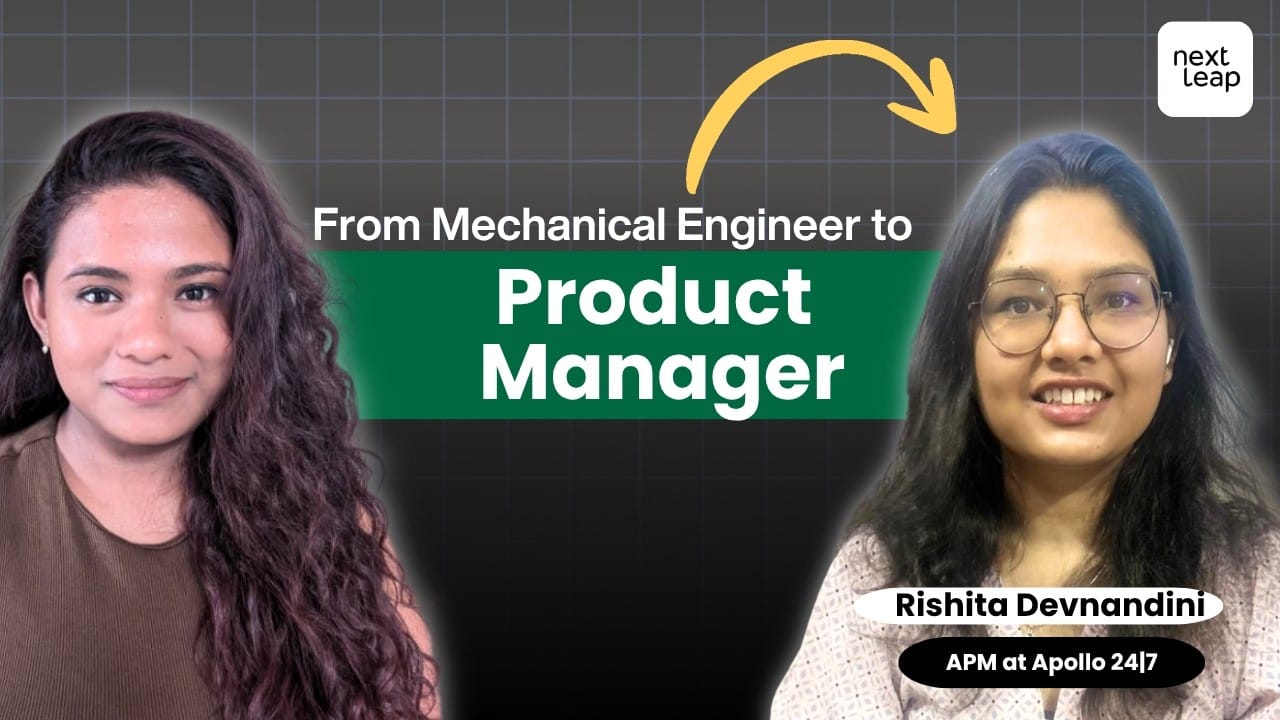
At a glance
- Before: IIT Roorkee mechanical engineer working as a project manager, then at a self-driving startup
- Now: Associate Product Manager at Apollo 24|7, in the insurance domain
- Program: NextLeap Product Manager Fellowship
- What made the difference: Peer discussions, mentorship and real-world problem solving
- Biggest lesson: "Product management is more about reasoning and decision making."
"One of the biggest shifts in my thinking during the transition was moving from solution-first thinking to problem-first thinking." That is how Rishita sums up her path from mechanical engineer to product manager. She studied at IIT Roorkee, managed large projects, worked on self-driving technology and is now an associate product manager at Apollo 24|7. She told her story on the NextLeap Alumni Podcast.
How did Rishita go from mechanical engineer to product manager?
In stages, with each one teaching her a different way of thinking. Rishita graduated from IIT Roorkee in 2023 with a degree in mechanical engineering. In college she was deeply involved in robotics and sports.
Robotics shaped how she thinks because it is so hands-on: you build something, test it, see where it fails and improve it. She also collaborated with a few startups, which gave her early exposure to how products are actually built in a real environment.
After graduating, she started in project management on large-scale projects, including a semiconductor project and a smart city project in Gurugram. That gave her a foundation in execution, multiple stakeholders and structured timelines. Over time she noticed something. She wanted to be closer to defining problems and making decisions, not only delivering on them.
That took her to a robotics startup working on self-driving technology for Indian roads. The culture was dynamic, and the environment was unpredictable. "You are constantly dealing with edge cases," she says, and adapting your approach. Around then she joined NextLeap to move into product management.
What is the difference between project management and product management?
Project management is about delivering outcomes on time, and product management is about deciding what to build for users. In project management, Rishita explains, you have targets to achieve within timelines and you provide the best solution for them.
In product management, it is about building for a user. You empathise with them, work out where they struggle and then build. That is why she says product management is more first-principles work. It is also why her early years in execution made her want a role closer to the problem.
How do you think like a product manager?
You start with the problem, not the solution. Rishita says her instinct used to be to jump into solutions. If she saw something, her reaction was to build it. Now she asks more fundamental questions: what is the actual problem, who is the user and what is causing the issue?
She gives an example. If conversions drop, an engineer's first thought might be to improve the UI or add features. In a discussion with peers at NextLeap she saw that everyone approached the same situation differently. That helped her see that there is no single correct answer and that you need to be comfortable with ambiguity.
I have realized that product management is less about having all the answers and more about asking the right questions and making thoughtful decisions.
She says skills matter, but the mindset matters most. Tools and problem-solving techniques can be learned. But if you do not have a way to approach a problem, or to look for one, that gap is what she felt most.
How did NextLeap help Rishita move into product?
It helped her think, not just learn. Rishita came to NextLeap through her alumni network, where a few seniors who had made the transition suggested it. She knew that solving case studies is one thing and real-world product work is another.
"It was not just learning frameworks. It was more about understanding how you think." Peer discussions and mentorship, she says, helped her build a different perspective. Mentors who had spent 10 or 15 years in the industry could answer directly how they would approach a problem. The NextLeap Product Manager Fellowship became the bridge from solving case studies to real product problems, where you often lack information, data and resources.
After the fellowship she moved quickly into product roles. She is now an associate product manager at Apollo 24|7 in the insurance domain.
What does a product manager actually do day to day?
In Rishita's case, a big part of the work is integrating partners into a single user journey. Insurance at Apollo involves different partners, such as banks, and each has its own requirements, data points, rules and flows.
The challenge is that the user still expects a smooth and simple experience. Her role has been to design and refine the user journey so that it fits every partner's requirements while staying intuitive. The team needs crucial information, such as identity and address proofs, without making the journey feel heavy or complicated. As she puts it, there is a lot of complexity behind the scenes, and the skill is simplifying it for users while managing technical constraints.
One decision she found valuable was how much information to collect and what to show. The team evaluated what was absolutely essential for users to proceed, and what could be removed. She says this taught her that product management is about balancing, not about finding perfect solutions.
How did Rishita prepare for PM interviews?
By showing how she approaches problems, not just how many frameworks she knows. She says a portfolio helps because it shows your best work, and it also matters which companies you target. But interviews play a bigger role, because that is where recruiters see how you approach problems.
Her advice is not to blindly follow jargon. "You should know the meanings of that and you should know where to apply and how to apply." She gives an example: users dropping off at one point in a journey. A recruiter will ask for the root cause, and in a case study you might jump to improving that step. But looking deeper, the real cause can be confusion created earlier in the flow, so you have to rethink the entire journey. Real problems need a more holistic view of how different parts of the system interact.
She names the skills that mattered most in her own switch.
- Problem structuring. Understand what the problem really is.
- Prioritisation. You cannot build everything, and the highest-impact issue gets solved first.
- Stakeholder communication. Designers, engineers and partners see things differently, and you have to align them.
Rishita's advice for engineers who want to switch to product
It is possible, and background matters less than thinking. She says it is not that a mechanical engineer cannot land in product management. It comes down to the skills and thinking process you build.
- "Don't just focus on frameworks. Try to apply what you learn in real situations."
- Build independent thinking rather than looking for correct answers.
- "Most importantly, be patient with the process."
- Read every day, for half an hour to an hour, across different domains. She once read about drones in agriculture and started thinking about how she would build such a product and for whom.
- Look after your mind and body with meditation and exercise, which she says help your thinking become more refined.
- Try new AI tools. She calls smart work a big thing, and says you should try things, fail and improve.
Product management is more about reasoning and decision making.
Watch the full conversation
Rishita shared her journey on the NextLeap Podcast.
Start your own switch
Rishita's switch was less about collecting frameworks and more about learning to think in problems. If you are an engineer or project manager who wants to make a similar move, the NextLeap Product Manager Fellowship combines peer discussion and mentorship with real product problems. It is a practical way to start building the mindset she describes.
Frequently asked questions
Can a mechanical engineer become a product manager?
Yes. Rishita moved from mechanical engineering, through project management and a self-driving startup, into an associate product manager role. She says background matters less than the thinking process you develop: understanding the problem, prioritising, communicating with stakeholders and being comfortable with ambiguity. Applying what you learn to real situations helps more than memorising frameworks.
What is the difference between project management and product management?
Project management focuses on delivering agreed outcomes within timelines. Product management focuses on understanding users, their problems and what should be built. Rishita moved from one to the other because she wanted to be closer to defining problems and making decisions, rather than only executing on them.
How do you think like a product manager?
Think problem-first rather than solution-first. Rishita learned to ask what the actual problem is, who the user is and what is causing the issue before proposing anything. She also learned that there is rarely a single correct answer, so product managers need reasoning, prioritisation and comfort with ambiguity.
Do you need to follow frameworks to crack PM interviews?
Frameworks help, but Rishita advises against following jargon blindly. Recruiters look at how you approach a problem, so you should understand what a framework means and where to apply it. In a drop-off case, for example, look at the whole user journey instead of only the step where users leave.


