My Courses
 My Portfolio
 Refer & Earn
 My Purchases
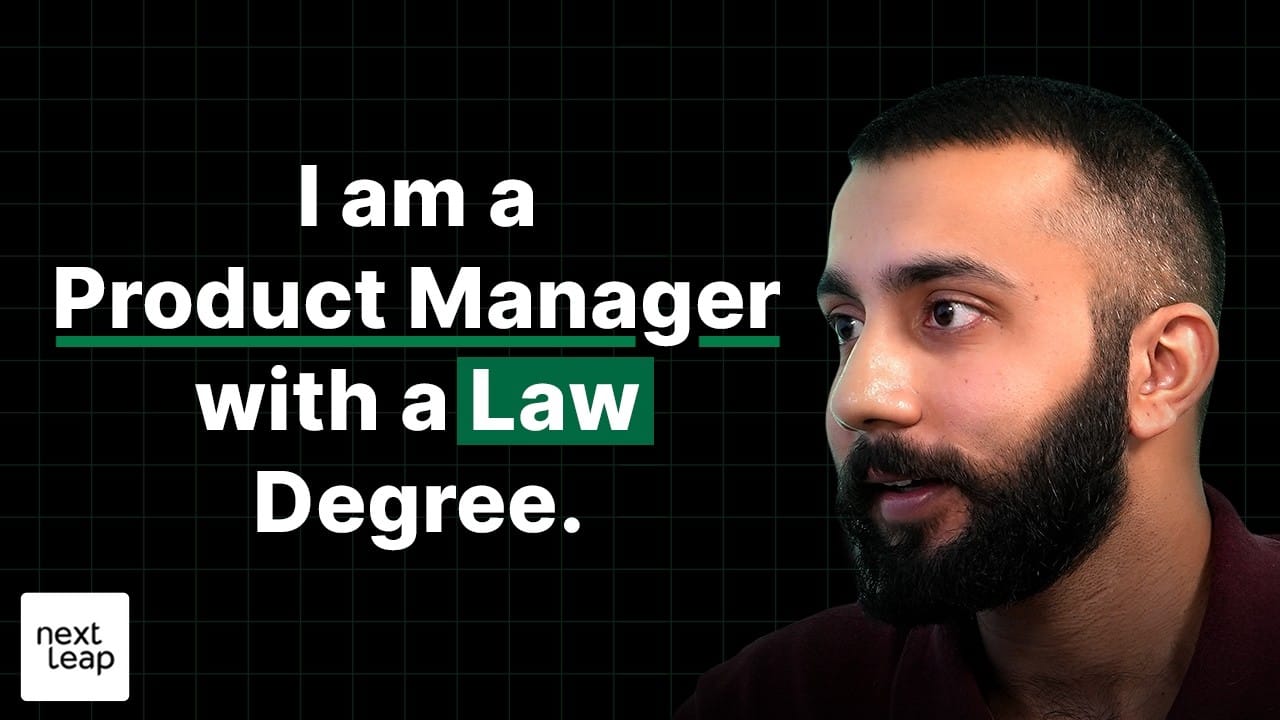
Lawyer to Product Manager After 4 Years in Law: Ashar's Story
Ashar practised law for over four years before moving into product management. He explains how he handled his doubts, why knowing your why matters more than the how, and how NextLeap's learn in public challenge gave him proof of work.
At a glance
- Before: Practising lawyer for over four years
- Now: Product manager, in a job that came through NextLeap
- Program: NextLeap Product Manager Fellowship
- What made the difference: A clear 'why', a structured cohort and public weekly work
- Biggest lesson: "Not everyone can be a product manager, but a good product manager can come from anywhere."
Ashar's lawyer to product manager switch started with a court martial in the snow and a passing thought: this could have been an email. After more than four years practising law, he moved into product, and the job came through NextLeap. On the NextLeap Podcast he explained how he handled doubts, why he says to figure out your why before the how, and what the fellowship gave him beyond content.
How did Ashar go from lawyer to product manager?
By noticing what kind of environment he wanted to work in. Ashar says that in school his teachers called him argumentative, but he prefers to say he was skilled at verbal combat. On the advice of his teachers and parents, who he says were looking out for his best interest, he studied humanities and went to a good law college. He had a lot of fun there.
At some point during the pandemic, he realised that building with technology was what he wanted to do. He continued to practise, but made the decision to move into product.
Why did he think tech was only for science students?
Because of the stream concept. Ashar says he always had the mindset that people from the science stream are the ones who work in tech. Then, while working on his college fest, he interacted with smart people who were very good with tech, and he realised that might not be true. Like him, there were many others who were not from a traditional tech background but had the ability to understand, work with and build technology.
His first step for anyone in the same position: remove from your mind the idea that only people from a certain field or background work in tech or product. That is not necessarily true, he says, particularly not anymore.
How did he handle his doubts?
By treating them as problems to solve. Ashar says one has many doubts, but most are founded in emotionalism that is unwarranted. Can I do this? Yes, you can. Will I lose out on the progress I made in this career? Probably, but nothing says you cannot leverage it in the future. What will people think of me? Forget about it, he says, it is not material.
He advises looking at each doubt at face value. If it is warranted, for example if you are not very good with math, then look at it carefully, and it stops being a doubt. It becomes a problem, and then a solution. He admits it is easier to say in retrospect, but says it can be handled with a calm mind.
What were the biggest struggles?
Money, stress and other people's opinions. Ashar says you cannot discuss a switch without the economic side. Product is a very rewarding field, but highly stressful: "I've not met a single product manager who doesn't have gray hair." He says the rewards make up for it, and that if you are skilled you will make enough money.
The other struggle is conversations with parents and other stakeholders you may need to convince. Here, he says, it depends on knowing why. If you know the why, it is easier to convince them and easier not to get distracted by the next shiny object. Figuring out the why is probably the number one thing.
What did the NextLeap fellowship give him?
A cohort, a structure, proof of work and a certificate. Ashar was in the Product Manager Fellowship for about three months. First, the cohort. He says you make friends at NextLeap, and humans compound: they teach you things, you teach them, and they are on the same journey, so they help on the emotional side too.
Second, the structure. Anyone can Google and work out what to learn, he says, but without a structure of what you do this week and how it connects to the last, it will not help in any meaningful capacity.
Third, the learn in public challenge. Each week you apply what you were taught to one product, build a deck communicating the problem and post it on LinkedIn. It builds the skill, and when it is time to apply for jobs you have proof of work. He gives an example: two identical CVs, one with twelve LinkedIn posts about what the person learned, and one with none. He would hire the first, because that person has shown proof of work and the confidence to put it into the real world and face criticism. It also builds your personal brand.
Finally, the certificate. In an ideal world everyone would be judged on what they know, but you cannot know what another person knows or what their intent is. A certificate from a position of authority solves part of that problem, he says, and placement support comes with it.
How did he get his first product job?
Through NextLeap. Ashar says the platform makes it easy to find jobs, starting with the portfolio it creates for you. Every submission, and the score from your top fellow submission, is presented neatly, which makes it easy for a hiring manager to see your skill set at a glance. The top fellow stamp helps too.
His current job, and his first job in product, came through a NextLeap job posting. He applied through NextLeap, interviewed through NextLeap and got the job. If you have done the work and know what you are talking about, he says, NextLeap can really help you go from law to product, as it did for him.
What advice does he give non-tech candidates?
Figure out your why, remove the streams from your head and find structure. Ashar says the world is not divided into streams. Focus on why you want to be a product manager before anything else. Quoting a smarter person, he says that if you know the why, any how becomes easy. Then look at courses such as NextLeap that give you a structure and an environment that makes it easy to become that version of yourself.
He sums up how he thinks about it in a line from the film Ratatouille, which he relates to strongly:
Not everyone can be a product manager, but a good product manager can come from anywhere.
What three lessons did the switch teach him?
All three come from introspection. Ashar tells a story about a court martial in Kashmir, with snow outside. A court martial is a military trial, he explains, with no technology involved, only pen and paper, in a very old-fashioned and formal form of law. He remembers writing something on paper and thinking that he could have typed it, that it could have been an email. That is when he realised he wanted an innovative environment, one moving with the times. Law thrives on rigidity and structure. He loves innovation and building.
- Work with innovation. He wants to see what is new and what more can be done.
- Choose an open environment. He means the physical environment too. If you do not like a courtroom, do not do it.
- Work with engineers. He describes a badminton game with four people and two rackets. Lawyers would debate the fairness of it, he says, while engineers just agreed on rules, five points each, switch teams, and got on with it. He loves working with smart, solution-oriented people solving real problems for real people.
The meta lesson, he says, is self-introspection. Without it, he would probably still be doing courts martial.
Watch the full conversation
Ashar shared his story on the NextLeap Podcast.
Start your own switch
Ashar's switch came from knowing his why, a structured cohort and work he posted in public every week. If you are coming from law or another non-tech field, the NextLeap Product Manager Fellowship offers structure, peers and placement support to start with.
Frequently asked questions
Can a lawyer become a product manager?
Yes. Ashar practised law for over four years and is now a product manager, in a job that came through NextLeap's job postings. He says the first step is dropping the idea that only people from certain fields work in tech, and the second is figuring out why you want to be a product manager before worrying about how.
Do you need a science or tech background to become a product manager?
Not according to Ashar. He studied humanities and law, and says the idea that only science-stream people work in tech is not necessarily true, particularly now. Many people without a traditional tech background can understand, work with and build technology. He says a good product manager can come from anywhere, if you have the right mindset.
How does a learn in public challenge help job seekers?
Ashar says the weekly challenge, where you apply that week's lesson to a product and post a deck on LinkedIn, builds the skill, gives you proof of work for hiring managers and grows your personal brand. He compares two identical CVs: the one with a dozen posts about what the person learned would win.
How should you handle doubts about switching careers?
Ashar says to look at each doubt at face value and not get carried away by emotion. If it is warranted, it is a problem with a solution, not a doubt. If it is about what other people think, he says to forget it. Knowing your why makes it easier to convince stakeholders and avoid distractions.