My Courses
 My Portfolio
 Refer & Earn
 My Purchases
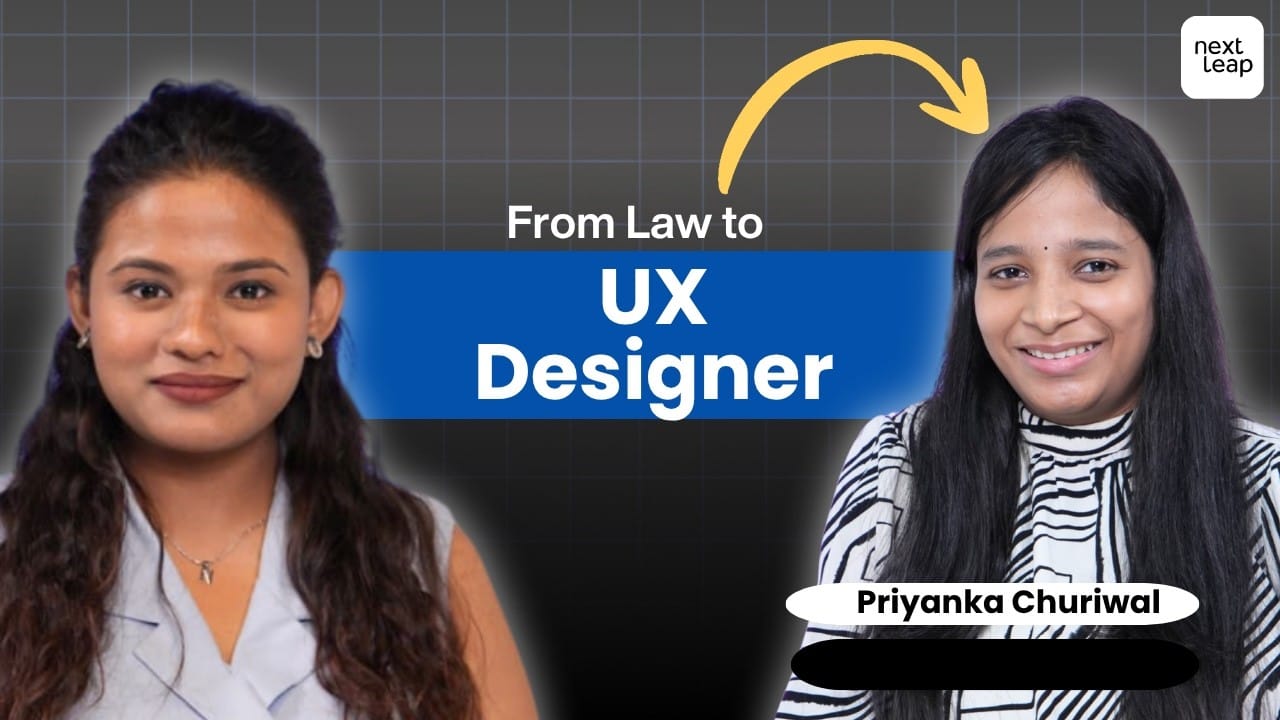
Law to UX Designer: Priyanka Made the Top 10 of 1,200 Candidates
Priyanka studied commerce and law and sat government exams before switching to UI/UX design. She explains what discouraged her, how a fellowship and a design challenge with 1,200 candidates built confidence, and how she prepared for interviews.
At a glance
- Before: Commerce degree, law and government entrance exams
- Now: UI/UX Designer
- Program: NextLeap UI/UX Design Fellowship
- What made the difference: A top 10 finish among 1,200 candidates in a design competition, and research-led portfolio work
- Biggest lesson: "Your skill is more important than your background."
Priyanka went from law to UX designer after studying commerce, law and sitting government entrance exams. Her interest in design, arts and crafts pulled her towards UI/UX, but negative YouTube videos and job posts asking for a design background made her doubt herself. On the NextLeap Podcast she explained what she did about it, how she prepared for interviews and what she would say to anyone starting from a different field.
How did Priyanka go from law to UX designer?
With a lot of family support and one big hurdle: discouragement. Priyanka says no one in her family was against her switch. Her problem was that before taking any course she kept watching YouTube videos to check whether the field was right for her, and many of them said the UX market is very hard. She was always discouraged.
Her husband encouraged her to stay consistent and keep learning instead of getting overwhelmed by negativity. She started learning from YouTube, then designed a few Swiggy screens and thought she understood UI/UX.
What is the difference between UI, UX and graphic design?
UX is about understanding the user, and it matters more than UI. Priyanka says that after joining the course she realised UI is completely different from UX. In UI you do not just design static things; you have to understand what the user's problem is, or nothing will work.
She separates this from graphic design too. Graphic design, she says, is about making templates and does not solve a user's problem. In UI/UX you learn what the user's problems are, what they demand and what their psychology is.
What was the hardest part of breaking in?
Seeing job posts that asked for a design background. Priyanka would scroll through LinkedIn to see whether there were jobs for her, and she got disappointed by the many companies that wanted designers from design or a related background.
What helped was that NextLeap offered placement support, so she felt a bit more confident. She also approached people already in the field through Telegram and Instagram. Some of them had faced obstacles getting jobs from other fields too.
What was the NextLeap bootcamp like?
Friendly and question-friendly. Priyanka describes the NextLeap online bootcamp where all the instructors were approachable and encouraged her to ask lots of questions, which she did. There were small assignments almost every week, and she completed all of them because she loved design.
There were four major assignments that together made one case study. After each, a mentor gave feedback on where she was lacking and where she was good, and that built her confidence. She finished the course as a top fellow, then entered a design competition that NextLeap also took part in. Out of 1,200 candidates, she finished in the top 10.
Your skill is more important than your background.
She says the result showed her that if she could pass this competition from a different background, she could get a job.
What did she do after the course to get a job?
She revised, improved her portfolio and practised interviews. Priyanka went back through the videos because she had missed things during the course. She improved her portfolio as per her mentors' feedback and gave many interviews, where she worked on how to talk and how to present her projects.
She adds that she originally focused on final designs, but that did not work. Companies wanted problem solvers and wanted to see how she thinks. Improving her design thinking was the skill that helped her most.
How do you build design thinking as a beginner?
Research first, screens later. Priyanka's advice is to skip beautiful screens at the start: do as much research as you can, think about the problems, talk to users and understand their problems before deciding what the real problem is. Then design.
The users depend on the problem statement. For her first project, a meal planner app aimed at women, she spoke to her mother-in-law, female friends and a few men who live alone in Bangalore and work. Problems are everywhere, she says, and family members can be users too.
How do you prepare for a UX design interview?
By starting with the problem, not the design. Priyanka gave two interviews. In the first, she was unsure how to interview well, sometimes stopped or gave a wrong answer, and got feedback: everything is good, keep working. The interviewers told her to speak slowly and to explain the problem first, not jump into the design.
She treats such feedback as important because the interviewers are senior and have more experience. In the second interview she explained why she chose the problem statement and what the real problem was, and it went more smoothly.
What should a UX portfolio include?
Research with sources, user conversations, the problems and how you would solve them, then wireframes and final design. Priyanka says she once made a mistake in her first research by simply copying content from the internet into her document. Her mentor told her to add the sources so a reader can tell whether it is true.
She then added the source for every piece of content, the questions users asked and how their problems might be solved, in a question and answer format, followed by wireframing and the final design. She says that helped in her challenge submission too.
How does her real job differ from portfolio work?
It runs on deadlines and client expectations. Priyanka says portfolio projects happen in a controlled environment, while at work she has to deliver under deadlines and to a client's expectations. She calls the work fun and says she learns a lot. Her team uses AI tools such as ChatGPT and Claude.
What would she tell someone switching to UX in 2026?
Do not watch too many videos and get overwhelmed by negativity. Learn the skill first, view problems from the user's perspective and develop your design thinking as much as you can. Final design is important, she says, but before designing you must understand the user problem, otherwise nothing will work.
Watch the full conversation
Priyanka shared her story on the NextLeap Podcast.
Start your own switch
Priyanka's route came from weekly assignments, mentor feedback and research-led portfolio work. If you want to move into design, the NextLeap UI/UX Design Fellowship offers live mentors, case-study projects and placement support.
Frequently asked questions
Can you become a UX designer with a law or commerce background?
Priyanka did. She studied commerce and law and sat government exams before moving to UI/UX. She says background matters but skill matters more. After a top 10 finish among 1,200 candidates in a design competition, she felt confident she could get a job, and she now works as a UI/UX designer.
What is the difference between UI/UX design and graphic design?
Priyanka says graphic design is about making templates and does not solve a user's problem. UI/UX involves understanding what the user's problems are, what they demand and how they think. She also says UX matters more than UI, because without understanding the problem no design will work.
How do you prepare for a UX design interview?
Priyanka advises explaining the problem before the design. Her interviewers told her to speak slowly and say why she chose the problem statement and what the real problem was. She also says to take feedback seriously, because senior interviewers have more experience, and to use each interview to improve the next.
What should a UX portfolio include?
Priyanka's portfolio included research with sources, conversations with users, the questions they asked and how their problems could be solved. It then showed wireframes and the final design. She says to name your sources, because otherwise a reader cannot tell whether your content is true.