
 My Courses
 My Portfolio
 Refer & Earn
 My Purchases
At a glance
- Before: IT analyst at an MNC, about three years
- Now: Data Analyst at Optimo Capital, a fintech startup
- Program: NextLeap Data Analyst Fellowship
- What made the difference: Project-based learning, a reworked resume and mentor feedback
- Biggest lesson: "Technical skills are taken for granted. They are the most basic thing."
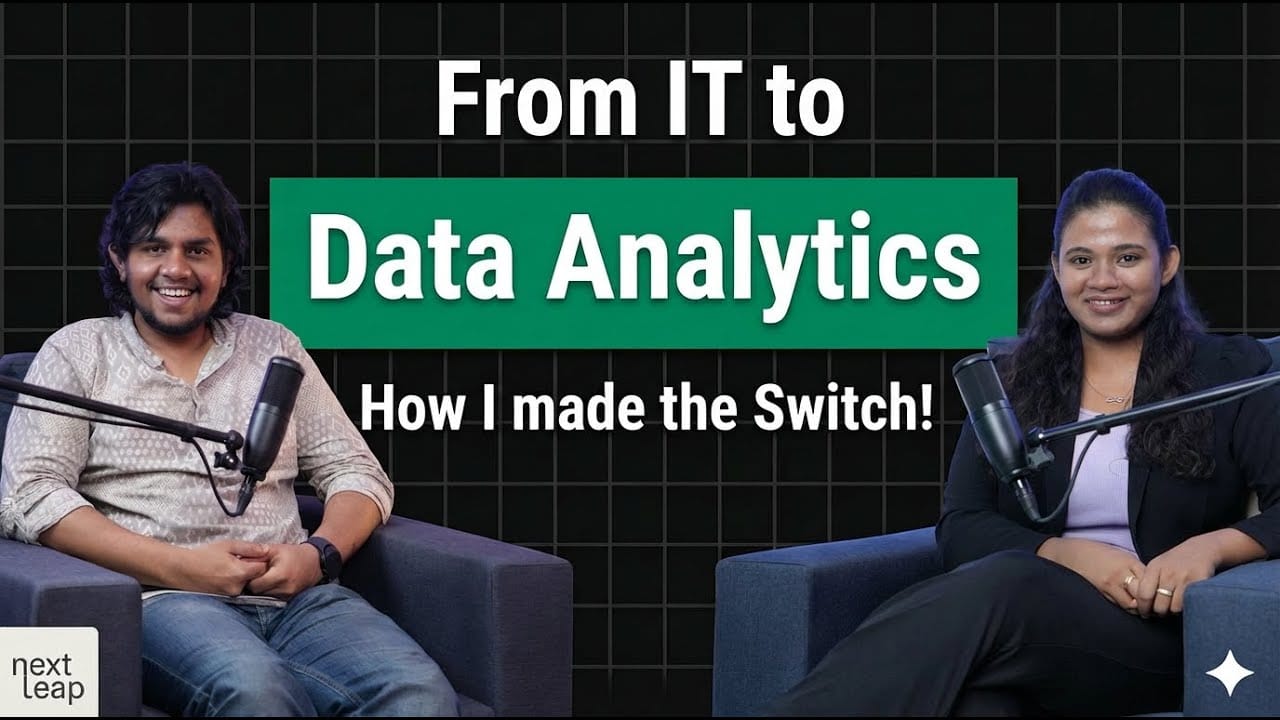
Rahul made an IT analyst to data analyst switch after about three years at an MNC. His old role touched data, but it was back-end database maintenance and he could not see his impact. He now works as a data analyst at Optimo Capital, a fintech startup. On the NextLeap Podcast he explained why he switched, how the job search went and what recruiters really care about.
Why did Rahul move from IT analyst to data analyst?
For impact, and for salary too. In his previous company, Rahul worked on logistics data for an international retail client, but the work was more back-end database maintenance than analytics. Because it was an MNC, he never had a clue what impact his work had on clients, and he says he did not get to dictate his salary either.
He is candid that salary was a reason. He has financial goals, and in the corporate world, he says, salary follows how much impact you have. More accountable roles also teach you how businesses work. Data analytics seemed a natural next step since his old job already touched data.
Why does data analytics appeal to him?
Because it sits in the middle. Rahul describes data analytics as solving business problems with the help of data, and an emerging field that he expects to boom over the next 10 to 20 years. It is not completely technical and not completely managerial. He uses technical skills to make business decisions that help the business grow.
How did he stay consistent while working full time?
By not relying on motivation. Rahul says he was not motivated all the way through, and that it is a fallacy to believe you will be. The process of reaching out to recruiters and moving to a new company took him three to four months, longer than he expected.
What mattered was being consistent. He took out an hour a day when he could, and on the busiest days 15 to 20 minutes, just to read a small tidbit about the industry or scroll LinkedIn to see what recruiters wanted in data analyst job posts. That gave him a clearer idea of the resume and profile he was building.
What did he get from NextLeap?
A peer group and mentors from industry. Rahul says he had taken many paid online courses before and could not stick with them, because he cannot learn from a lecture alone. A friend recommended NextLeap, describing it as a fellowship, not a student-teacher course.
The instructors and mentors were people working in the positions he wanted to move into, at big companies. Their experience, he says, is more valuable than the technical knowledge in any lecture, since you can get technical courses free on YouTube. The only thing worth paying for is the peer group. Some of his cohort members were extremely talented, and he learned from them too. He also values the focus on projects: in India, he says, people prepare for job transitions as if for an exam, but recruiters are not examiners. They ask whether you can fill a gap and create impact.
How long did it take to land his first data analyst role?
Longer than he thought. Rahul says he was naive: his first job came through campus placements, where the competition pool is small. He assumed that with his experience, the first recruiter he wrote to would call him. It did not happen. He reached out to around 40 to 60 recruiters before his first interview.
His resume was the problem. It was poorly formatted and packed with a long list of technical skills, and little else. He redid it several times after feedback. He also began the fellowship during this period and would chat with his mentors on Discord and LinkedIn, sending his resume for review. They took time out and gave honest feedback, which he calls absolute gold.
Halfway through the fellowship he had a good enough resume and began getting calls. Once he landed his first interview, five or six more followed, and he got through all but one. He chose Optimo Capital because it is in fintech, which interests him, and felt like a startup with good leadership where he could show impact.
What do recruiters look for in data analyst candidates?
Soft skills and impact, more than tools.
Technical skills are taken for granted. They are the most basic thing.
Rahul says even technical recruiters care about how you would work with their team and whether you are open to learning. In his toughest interviews, the technical section was 30 to 40 minutes, and the rest was discussion about his previous job and projects. Being proficient in Python and SQL, he says, is nothing special, and with AI something new arrives every six months.
The best companies drilled him on his projects, asking about every step and whether it could have been done better. What they want to see is what an analysis leads to, and how it affects decisions.
What should someone moving into data analytics keep in mind?
Three things, in Rahul's words. First, it is not a completely technical role, and preparing for a job switch is different from preparing for an exam. Think about what you can add to the organisation. Second, mentors and a good peer group are far more valuable than online lectures, and the casual conversations with people who have worked in these roles help you build perspective.
Third, do not rely on job portals. Thousands of people apply there, and most hiring still happens through referrals and LinkedIn. He suggests building a network and messaging recruiters directly; cold messaging works more, in his experience.
Will AI replace data analysts?
Only if you refuse to use it, Rahul says. If you are good with AI, it will not replace you. If you stick to standard ways, it may. At his startup, anything AI can do is automated, and he has used OpenAI APIs on two or three projects to automate work, which freed him for more impactful tasks.
Many people take it on their ego, he says, including himself. He would rather spend his time debugging code an AI wrote and making decisions from the analysis. He expects a data analyst's value in five or six years to depend on how many tasks they can automate, like a micro product manager.
What does a data analyst actually do?
It varies by company. Rahul lists spreadsheets, SQL queries and working with data, and at a startup a bit of product management, data engineering and sometimes machine learning. In essence, he says, you use data to drive business decisions. His CEO tells the team to give data before any decision.
From there, careers branch into business analytics, product analytics and product management, or into data science and machine learning.
What did his rapid-fire round add?
Business understanding beats technical skill, he says. Technical work is about 30 to 40% of the job, and the rest is business acumen and turning technical work into decisions. He prefers SQL over Excel, calls ChatGPT an underrated tool, and names the mistake beginners make as focusing too much on technical skills. He explains data analytics to a child as predicting the future using numbers, and recommends The Old Man and the Sea, a book about persistence.
Watch the full conversation
Rahul shared his story on the NextLeap Podcast.
Start your own switch
Rahul's route came from mentors, a peer group and project-based learning. If you want to become a data analyst, the NextLeap Data Analyst Fellowship offers mentors, real projects and interview preparation.
Frequently asked questions
How can an IT analyst become a data analyst?
Rahul did after about three years as an IT analyst. He wanted more impact than back-end database work gave him. He studied consistently, from 15 minutes to an hour a day, joined a fellowship for mentors and projects, reworked his resume to show impact, and got interviews after reaching out to recruiters directly.
What do recruiters look for in data analyst candidates?
Rahul says technical skills are taken for granted. Recruiters care about soft skills, openness to learning and how you would work with their team. Most of his interviews went deep into his projects: why he did each step and what impact the analysis had on decisions.
Will AI replace data analysts?
Rahul says it will only replace people who refuse to use it. If you use AI to be more productive, it will not replace you. At his startup he has used OpenAI APIs to automate work, which freed him for more impactful tasks. He sees the analyst's value as how much work they can automate.
How should you look for data analyst jobs?
Rahul suggests not relying only on job portals, since thousands apply there. He says most hiring happens through referrals and LinkedIn, and that cold messaging recruiters directly works more. He also recommends building a network through your peer group and asking mentors to review your resume.


