
 My Courses
 My Portfolio
 Refer & Earn
 My Purchases
At a glance
- Before: Investment analyst, then a startup founders office
- Now: Product Manager at Meesho, without an MBA
- Program: NextLeap Product Manager Fellowship
- What made the difference: Structured learning, weekly case-study decks and product decks sent to leaders
- Biggest lesson: Be a very good communicator
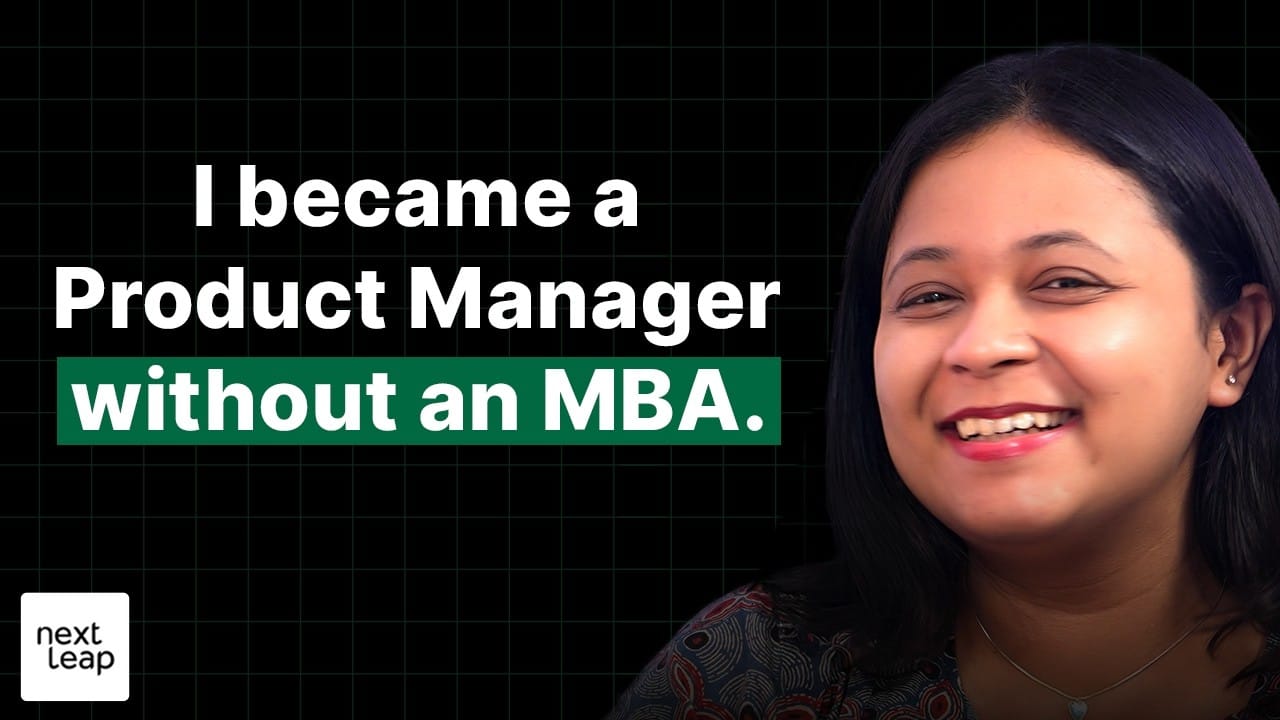
Ritika's investment analyst to product manager journey ran through a startup founders office before it reached Meesho. She describes it as a roller coaster. On the NextLeap Alumni Podcast she explained why she felt she would function better as an operator, how she filled the gaps in her tech knowledge, and how product decks sent to leaders got her a referral. She also explained why she thinks an MBA is not needed for entry-level product roles.
How did Ritika go from investment analyst to product manager?
Through an operator role in between. Ritika worked as an investment analyst for almost a year, then moved into the founders office of a startup, and is now a product manager at Meesho.
The investment path started in college. She was running a startup in her second year and took part in many business study competitions. One of the judges was a managing partner at a venture capital firm. When summer internship pressure built up, she messaged him on LinkedIn to ask whether any weekend positions were open, and got one. She learned a lot and met many founders. But having done both a startup and an investment analyst role, she felt she would function better as an operator.
What did the founders office teach her about product?
The founders office was an early-stage startup in the study-abroad space, and the role was horizontal. She worked across product, investor relations and marketing, with great mentors. Her manager helped her understand the nuances of building tech systems at scale.
A lot of her work involved coordinating with engineers and defining product requirements for the next phase of launches. That is where she began to like product. Even so, she says she always felt she needed a structured environment to understand what product management really is.
Why did she choose the NextLeap fellowship?
For the teaching method and the people. Ritika says she had tried several product management courses, but NextLeap stayed with her. She calls the teaching methodology something she admires, and says it gave her very high recall. The peer group she found was encouraging too.
She joined the Product Manager Fellowship for three months of intense sessions with Arindam, which she says got her into the thought process of product management. The weekly case studies helped as well. Every week the cohort uploaded case studies to LinkedIn. At first that felt intimidating, because she was unsure what to upload. Gradually, once you start building that thought process, she says, making product decks and facing the pressure of uploading every week helps a lot.
What were her biggest struggles?
Two: tech systems, and knowing where to start. Ritika says the first was building a good understanding of tech systems and how they work. The second was that she did not know where to begin: "It is such a vast ocean of knowledge and it is so ambiguous in nature that until and unless someone structures it down for you, you will be lost."
To build on technology, she took an interest herself. She researched how system design works, how different products are built and what architecture sits behind them, and read books. She names Tech Simplified as a very good book that helped her understand complicated concepts, and says the fellowship sessions on tech and system design helped her narrow down problems.
Do you need an MBA to become a product manager?
Not for entry-level roles, in her view. Ritika says that with AI and Agentic AI coming up, the skill set needed five or six years from now will be very different from what an MBA teaches today, unless MBA courses adapt. Once you are in an entry-level product role, it is up to you to create impact, to define your work and to build relationships with your manager and peers.
She points to her own company: many people at the senior level do not have an MBA at all. They have a bachelor's degree, but they drove impact, were hustlers and had good relationships with peers and managers. She grants that an MBA teaches strategy and communication very well, but says you learn those in entry-level roles anyway, because you have to talk to engineers, designers, business teams and data scientists and bring them to a common theme.
How did she land her first product manager role?
Ritika names two requirements: be ready whenever an interview comes, and get out into the market to find good jobs. Interview preparation, she says, is a really important piece.
For the second, she took a different approach. She narrowed down a list of target companies where she wanted to apply, then went through newspapers to find the common problem statements each company was dealing with. For each company she identified one or two, and built a product deck around how to solve them. She then sent the decks to leaders on LinkedIn.
One director of product replied the next day and gave her resume as a referral, which sped up the interview process. Meesho was the first company she applied to, and she got in.
What advice does she give people from finance?
Learn to turn problems into features. From a finance background, she says, you get good with numbers, but you may not know how to identify problem statements and convert them into user features that drive impact. Having the intuition to see where the problem areas lie, and then validating with numbers, is a very big skill. Data analysis will help there. The other piece is understanding tech systems, which she says she would advise everyone from a non-tech background to build.
For books she recommends The Lean Product Playbook, which teaches how to go from strategy to execution to impact and how to validate hypotheses again and again, and Tech Simplified, written so that even someone from an early school class can follow it.
The skill she thinks everyone in the corporate world should have is influence: "The ability to influence decisions is one skill which will really take you very far in corporate." Intuition is one thing, she says, but going deep into data to validate a hypothesis is what convinces leaders.
What did her earlier roles teach her?
Communication. Ritika says that as an investment analyst she represented her firm in front of founders and in forums. In the founders office she communicated with leaders, tech, marketing and design teams. As a product manager, explaining requirements so that tech, business and design can understand them is just as important.
One common theme across all the three roles was you have to be a very good communicator.
Watch the full conversation
Ritika shared her story on the NextLeap Podcast.
Start your own switch
Ritika's switch came from structured learning, weekly case-study practice and outreach that showed leaders how she thinks. If you are coming from finance or another non-tech field, the NextLeap Product Manager Fellowship offers cases, mentors and peers to practise with.
Frequently asked questions
Can an investment analyst become a product manager?
Yes. Ritika worked as an investment analyst for almost a year, then in a startup founders office, and is now a product manager at Meesho. She says finance candidates are strong with numbers, but need to learn to identify problem statements, turn them into user features and understand how tech systems work.
Do you need an MBA to become a product manager?
Ritika says you do not need an MBA for entry-level product roles. She sees AI changing the skills needed in five or six years, and notes that many senior people at her company have no MBA. In her view, impact, hustle and good relationships with peers and managers matter more than the degree.
How did Ritika get her first product manager interview?
She shortlisted target companies, read newspapers to find one or two common problem statements for each, and built product decks on how to solve them. She sent the decks to leaders on LinkedIn. A director of product replied the next day and referred her, which sped up the process. Meesho was the first company she applied to.
Which skills help finance candidates in product management?
Ritika names three. First, identifying problem statements and converting them into user features, then validating them with numbers. Second, understanding tech systems and how they are designed. Third, influencing decisions by going deep into data to validate a hypothesis, which helps convince leaders. She also stresses being a very good communicator.


