
 My Courses
 My Portfolio
 Refer & Earn
 My Purchases
At a glance
- Before: Graphic designer
- Now: Product designer, working directly with clients
- Program: NextLeap UI/UX Design Fellowship
- What made the difference: Solo case studies and mentor feedback on every section
- Biggest lesson: Be consistent, practise every day and stay positive
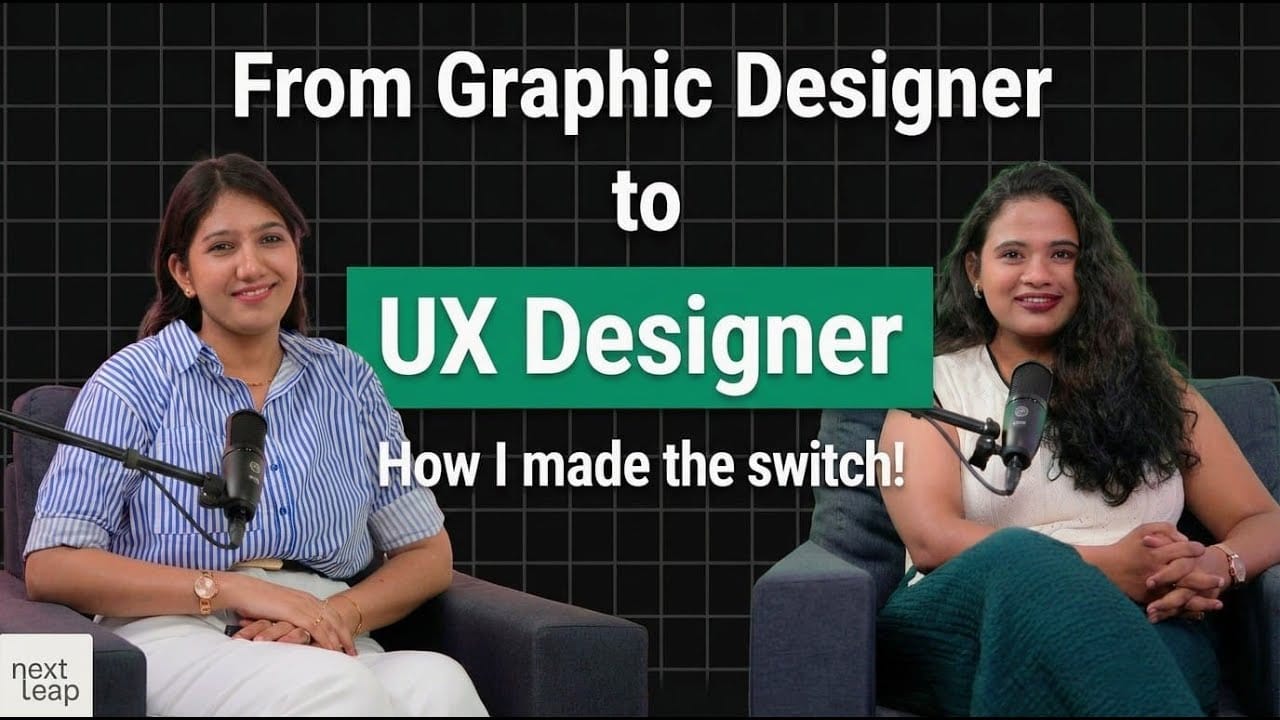
Muskan went from graphic designer to product designer after working in Jaipur creating visually appealing designs. The hardest part, she says, was changing her mindset from making things beautiful to making things that solve user problems. She joined a three-month NextLeap fellowship, did three internships and then got a full-time job. On the NextLeap Podcast she explained how the switch worked and what she tells beginners.
What was the hardest part of going from graphic designer to product designer?
Changing her mindset. As a graphic designer, Muskan created beautiful, aesthetic designs that were visually appealing. As a product designer, she says, you have to do deep research and understand what the user wants, who the final users are and where they come from.
In graphic design, visuals, fonts and typography matter. In product design she has to think deeper: why is she making this, and for whom? A design should be visually appealing, but it should also solve user problems. She keeps asking whether users are satisfied when they see her design, and whether the navigation she gives is actually helpful and understandable to them.
Does being good at graphic design help in product design?
A little. Many people think a graphic design background gives an edge. Muskan disagrees with the idea that it is enough:
If you are good at graphic design, it doesn't mean you are good at product design also.
Graphic design is an important asset, she says. She worked on Illustrator, CorelDRAW and Photoshop before, and knows what tools do. But as a product designer she has to do research and solve problems in depth, and create wireframes and prototypes at low and high fidelity. She says a graphic designer must unlearn making things merely aesthetic and learn what the final user needs.
How did the NextLeap fellowship help?
It was a game changer, she says. Muskan joined the three-month NextLeap product design fellowship, where she met professional product designers who taught her a step-by-step syllabus, from how to start as a product designer to how to finish designs neatly and cleanly. It gave her confidence.
She worked on hands-on projects solo. Her teacher gave feedback on every section of her large project, and taught the class how to build a portfolio. He also had a website where she built hers. She made friends in the cohort too, with whom she did group studies and chatted on WhatsApp about what everyone was working on.
How did she get from fellowship to full-time job?
Through three internships. Muskan says NextLeap played an important role: she did three internships, the first one unpaid and the next two paid, and then she got a full-time job. She adds that the course material is still available in her account, and she can rewatch the videos if she faces a problem.
How does she practise product design on her own?
Consistently, and with real apps. Muskan's advice for anyone starting or changing careers is to do whatever you do with consistency: be consistent about your course and your design skills, and practise a lot. She did many case studies on her own, because there was no one to help her and she worked solo.
If you are shifting into product design, she says, do a lot of research about it and look up many case studies. Practise every day. One method she suggests: open the apps you use regularly and notice what difficulty you face. Then redesign them, give navigation that is easy for users, and repeat. You will learn new things while practising.
She also points to free design material on YouTube, and says to check online free resources and practise.
What is her design work like now?
Client-facing. As a graphic designer, Muskan did brand campaigns and marketing materials. As a product designer she works on user experience and research, and faces clients regularly. Clients want designs to be more visually appealing while also communicating better, so that users understand them easily.
Before designing, she does research, even when time is short, because clients often want a project within a month or two. Her research includes market analysis of the product, competitive research and mind mapping, followed by the structure of the website or app. Then she designs low-fidelity and high-fidelity screens and builds a prototype. Clients keep asking for changes to fonts, images and sections, so she changes things often.
She gives an example. She is currently making a health website that older people and office employees can use, so she designs icons and headings in bold, dark colours and uses larger buttons. It should be aesthetic and intuitive, and both her ideas and the client's ideas have to come across in the design.
What does she enjoy most about design?
Difficult designs. Muskan says she loves creating hearts and animations, and doing things a developer says are impossible. She studies the creative designs big companies put on their websites and tries to create new designs in Figma every day. The more challenging the design, the more she likes doing it.
What is her biggest lesson from the journey?
Consistency, practice and attitude. Muskan says to be consistent, do more practice, be more communicative and be a good designer. Face every challenge and stay positive, because your attitude matters in the workplace and when you learn something new. If someone says something bad, they will say it in future too, so do not be afraid, and face it with confidence.
Watch the full conversation
Muskan shared her story on the NextLeap Podcast.
Start your own switch
Muskan's route came from a structured fellowship, hands-on projects with feedback and daily practice. If you want to become a product designer, the NextLeap UI/UX Design Fellowship offers mentors, portfolio projects and placement support.
Frequently asked questions
Can a graphic designer become a product designer?
Muskan did. She worked as a graphic designer in Jaipur, joined a three-month NextLeap fellowship, did three internships and then got a full-time job. She says graphic design helps a little, but you have to unlearn making things only aesthetic and learn to research and solve user problems.
What is the biggest difference between graphic design and product design?
Muskan says graphic design is about visually appealing work, such as branding and marketing materials. Product design needs deep research into who the users are and what they want, plus wireframes and prototypes. The design must be visually appealing and also solve user problems.
How can you practise product design on your own?
Muskan suggests doing many case studies, being consistent and practising every day. Open the apps you use regularly, notice the difficulties you face and redesign them with easier navigation. She also uses free YouTube material and other free online resources to keep learning.
How did a product design fellowship help a career switch?
Muskan calls her three-month NextLeap fellowship a game changer. It gave her a step-by-step syllabus, hands-on solo projects, feedback on every section from her teacher, portfolio guidance and a peer group. She then did three internships and secured a full-time job.


