
 My Courses
 My Portfolio
 Refer & Earn
 My Purchases
At a glance
- Before: Graduation in geophysical technology, then internships as a UI/UX designer and UX researcher
- Now: Associate Product Designer at Virtual Internships
- Program: NextLeap UI/UX Design Fellowship
- What made the difference: Learning the process of solving problems, plus a portfolio with real projects
- Biggest lesson: Design thinking is the non-negotiable trait
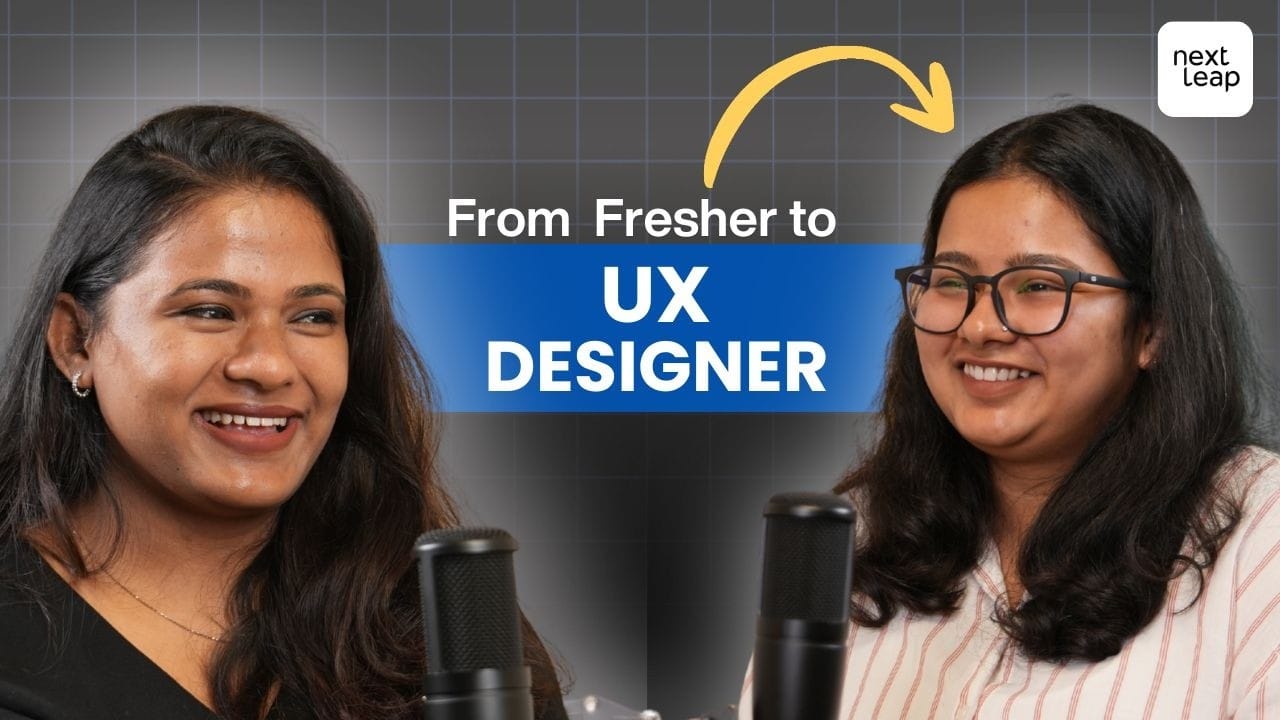
Rashi's geophysical technology to product designer switch began with curiosity rather than a plan. After trying web development, data science, coding and product management for two to three months each, she found flow in design. She now works as an associate product designer at Virtual Internships. On the NextLeap Alumni Podcast she explained how she got there, what a portfolio needs and how to choose a career.
How did the geophysical technology to product designer switch happen?
Through experimenting until one field clicked. Rashi says geophysical technology, or Earth Sciences, was not her priority; she wanted to get into her favourite institute. She then spent two to three months each on web development, data science, Python, coding and product management, and achieved flow state in design.
What drew her was the congruence between creativity and technical skills. She has always been a technical and creative person, she says, since she loved maths and physics and also painting and singing, and design is the balance where she applies all of that.
Do designers need a degree?
No. Rashi's answer is that designers just need design thinking. If you question the things around you, such as why something was made a certain way and what purpose it solves beyond its core use, then she thinks you are halfway to developing it. She calls that the most non-negotiable trait for a designer.
What is the difference between UI, UX and product design?
They are connected. Rashi explains that UI/UX are niches of product design. Product design as a whole means learning the business strategy as well, in order to design the complete product experience. User experience is what you can do with the product, and UI is how you do it.
She adds a saying she once read: UX is designing the right thing, and UI is designing the thing correctly. UI is what you see on the app or website, and UX is why you see it, or why you do not.
Why did she join NextLeap?
Because her skills had stagnated and her guidance was scattered. Rashi was at IIT Roorkee and had finished an internship at Edun Solutions as a UX research intern. She understood UX research and product management but lacked the hard skills to design apps or websites. Advice from friends and seniors did not come together, and two of her friends suggested NextLeap. She enrolled in cohort four.
Before, she says, she did not know the hows and whys of design. She also lacked the habit of defending her decisions, which she calls a big part of daily work. The instructors and mentors helped her build that mindset and upskill.
How did the program make her a better designer?
By teaching her the structure of problem solving. Rashi says she was connected with great mentors and instructors, and the lessons were helpful. She got guidance on the general flow of problem solving, which she calls the core of any career, and on how a designer solves a problem, including the unorganised part of it. That helped her find her own way of working.
Which tools should a new designer learn first?
Figma first, then AI in your workflow. Rashi calls Figma non-negotiable because it is the most widely used tool. To learn it well, she says, study design systems and try building your own, which shows what Figma can do.
Since AI is entering the picture, she suggests learning to integrate it, starting with UX copywriting and initial ideation. She mentions Lovable, Gemini Pro's UI generation and Claude Code as tools doing well. Beyond tools she wants design thinking, and she says to give equal importance to Figma, UI and UX, and not trade one off against the others.
How important is user research?
It is the only way to validate assumptions. Rashi says user research tells you whether your assumptions hold. She also says that as a designer, being unproductive is an important part of producing good designs. Thinking about what the user needs when you are not at the screen means you will not struggle with a blank canvas for long.
What should a beginner product designer's portfolio include?
Real problems, a complete flow and some personality. Rashi suggests finding problems in your own surroundings, then documenting why each occurs and how it affects users. Next, come up with ideas, make a mind map, and design a complete flow, because you will realise you missed some cases. Then move from rough sketches to high-fidelity wireframes and a prototype.
For her first full-time role, which she calls difficult for freshers in this job market, the trick was a good portfolio. That means projects that show impact. A design system project may have no business impact, she says, but it assures a recruiter that you know Figma and understand reusable components. She also wants one or two passion projects that show curiosity, and a portfolio with personality: recruiters want a glimpse of what it would be like to work with you.
How hard was the switch?
Hardest when she focused only on the tool. Rashi says it was tough initially, when she tried to learn only Figma. Once she started identifying problems and working on them side by side, she learned Figma too. That, she says, was the initial friction.
Is UI/UX a good career, given how the market looks?
She does not ask which career is good, she asks which field she is good at. Her advice to job seekers:
Don't choose a career because you feel this market is booming or something.
You should be comfortable in a field even when it is not booming, she says, because every market dips at some point. If you are good and evolving continuously, you are ready to face that dip.
What quick advice does she give beginners?
In a rapid-fire round Rashi said portfolio matters more than degree, and that the one skill beginners should focus on is design thinking: learn the whys and hows of products, apps and websites. The myth she believed earlier was that a product with good UX and weak UI would still work. It does not. She takes inspiration every day, from movies, music and Pinterest.
Watch the full conversation
Rashi shared her story on the NextLeap Alumni Podcast.
Start your own switch
Rashi's route came from testing several fields, then learning design through mentors and real problems. If you want to become a product designer, the NextLeap UI/UX Design Fellowship offers mentors, portfolio projects and placement support.
Frequently asked questions
Do you need a degree to become a product designer?
Rashi says no. She studied geophysical technology and became an associate product designer. In her view designers just need design thinking: questioning why things are made a certain way and what purpose they serve. She calls it the most non-negotiable trait and says portfolio matters more than a degree.
What is the difference between UI, UX and product design?
Rashi says UI and UX are niches of product design. UX is what you can do with the product, and UI is how you do it. Product design as a whole also involves business strategy, in order to design the complete product experience.
What should a beginner product designer's portfolio include?
Rashi suggests projects that identify real problems and follow a full flow from research to prototype, ideally with impact. She adds a design system project to show Figma skills, one or two passion projects that show curiosity, and some personality so recruiters see what it would be like to work with you.
Which tools should a new designer learn first?
Rashi calls Figma non-negotiable and suggests learning it by building a design system. She then recommends bringing AI into your workflow, starting with UX copywriting and early ideation. Beyond tools, she stresses design thinking and giving equal weight to UI, UX and Figma.


