
 My Courses
 My Portfolio
 Refer & Earn
 My Purchases
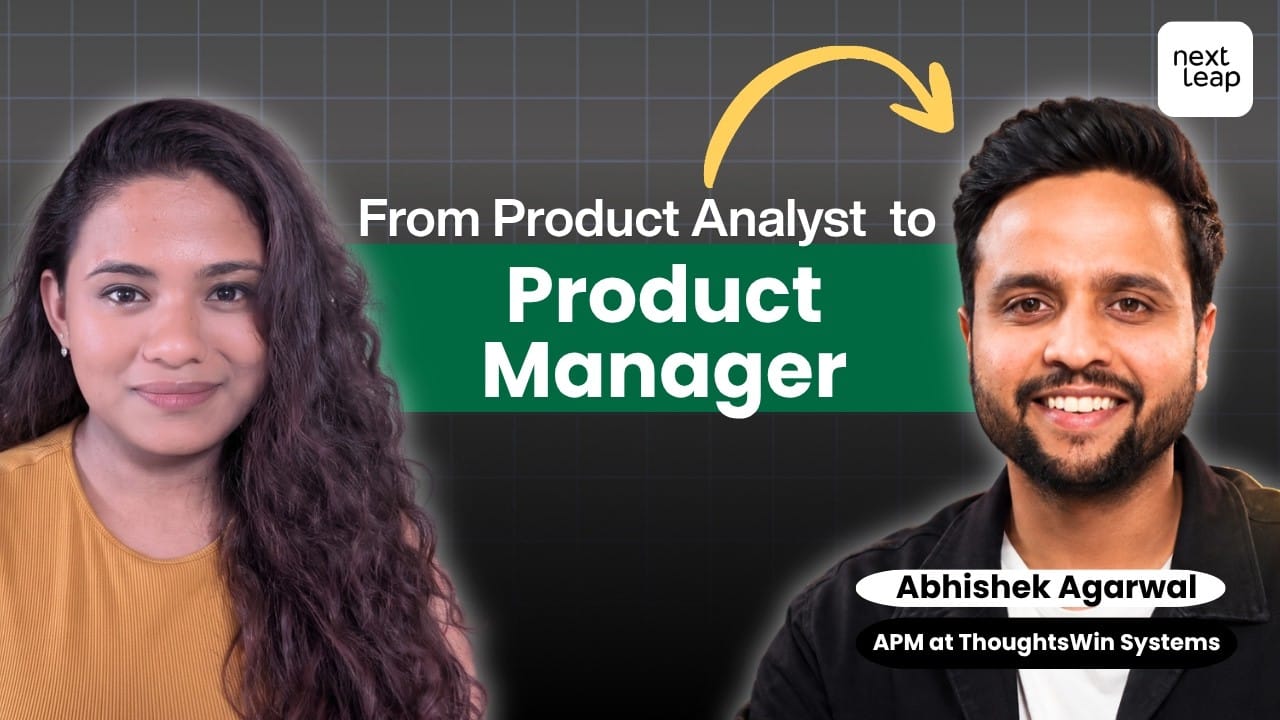
At a glance
- Before: Products at Park+, SteelNode and SafetyPin, plus his own AI startup
- Now: Product Manager building enterprise AI products at ThoughtsWin Systems
- Program: NextLeap Product Manager Fellowship
- What made the difference: Structured thinking, user conversations and building things
- Biggest lesson: "Talk to 10 people. Talk to 100 people."
Abhishek is an AI product manager who got there by building. A computer science graduate, he worked on growth and retention at Park+ and on products at SteelNode and SafetyPin, and founded an AI startup for apparel brands. He now builds enterprise AI products at ThoughtsWin Systems. On the NextLeap Alumni Podcast he explained what building taught him that theory could not, how he uses AI every day, and how to find a real problem.
What did building Bookshop teach him about products?
That theory and reality differ. Abhishek says he realised this while building Bookshop. On paper it looked like a good idea: students in Kota and Jaipur preparing for competitive exams wanted books delivered fast, so the idea was delivery in 30 minutes. His team partnered with local vendors, saw their inventory and built a simple WhatsApp business system to make it happen.
Once they delivered to a certain number of students, the operational complexity was going up and behaviour was changing fast. They made decent revenue and good profits, but students were moving to online education and getting learning material from there. The indication was clear: you have to adapt to user behaviour. Users tell you what will actually work, he says, and theory is more about what should work in an ideal world.
What did Park+ teach him about user behaviour?
That reducing friction drives outcomes. At Park+, Abhishek worked on retention and engagement metrics. He realised the team could drive certain outcomes by reducing friction in the user journey. He says a great product is one that people genuinely feel is solving a real problem, and that ends up moving business metrics too.
Tracking those numbers taught him that if you ask the right questions and move in a direction supported by metrics, you understand how user behaviour is changing and how to keep up with it.
What makes a product great, in his view?
Not features. Abhishek used to believe great products are those with great features. Now he sees a great product as one that communicates the right value, is easy and natural in people's lives, solves a real problem and is something people are happy to pay for. He points to quick commerce platforms such as Zepto and Instamart: convenience is a price that people would like to pay for, if you deliver in the right time.
To crack that, he says, you have to talk to a lot of users, understand their nuances and what frustrates them, and only then come up with the right solution.
Are the founder and product manager roles similar?
At the core, yes. Abhishek built Visuals, an AI product for apparel brands, after spotting a problem while working at SafetyPin. AI was becoming real, and small apparel brands he visited had a frustrating process: finding inspiration took a long time, and they could not afford big teams. He realised AI does not replace creativity but compresses the time it takes to get the same value. The hypothesis was that they could generate unique designs from a single prompt.
The team partnered with a couple of brands, who used the product and were happy with the designs. The revenue they hoped for did not come, but the learning did.
On whether founders and product managers are alike, he agrees. Both know what needs to be built, run toward the right problem, understand the market size and prioritise ruthlessly. A founder also carries the team and culture, but the core is solving a real problem, and a product manager looks for the actual problem behind the surface-level one too.
How does an AI product manager use AI?
As a thinking partner. Abhishek says that a year ago he used AI to draft emails and summarise content, and it was a learning phase. Today it helps him with documentation and presentations, and with improving his thinking. Problems that used to take weeks can go to days. It is also easy now to build a prototype once you have a real problem, and show it to leadership without waiting for a designer to craft a screen.
For documentation, he finds Claude better: with the right prompts and information, it gives a document you can present to stakeholders. He thinks people who know how to use AI will go further than those who do not.
What makes someone good at product management?
Three basics, in his view. First, talk to real users and listen rather than defending your idea. Second, communication. Once you are in the job, he says, you are answerable to engineering, design, sales, customer support and marketing without authority over them, so how well you understand and explain things matters. Third, creativity with AI: how fast you can identify a problem and build a solution that you can show real users.
Building will get easier, he says. What will get harder is finding the problem that actually generates value and business.
How did NextLeap help him?
With structure and a challenge to his assumptions. Abhishek had been doing product work without the title, a story he says is common among friends. A friend who had done the course gave positive reviews, and he joined the Product Manager Fellowship in July of the year before recording. He wanted a structured course that would challenge his assumptions, tell him what he did not know and let him ask questions.
He calls the journey good and surprising, because he evolved during it. The assignments and end-of-programme projects tested real skills: he had to speak to 100 plus users and build prototypes to show real users. Mentors told him why it is important to ask questions and identify the right problem before jumping to a solution, since building is no longer the hard part. It gave him structured thinking that he still uses in his job. One of the roles he cracked came through NextLeap's hiring partners.
How do you find a real problem to solve?
With research tools, then with people. Abhishek explains how it changed. Before, you had to do market research, speak to 100 to 200 users and run surveys, which took three or four months to tell you whether an idea made sense. Now you can use an AI research partner, point it to data sources such as LinkedIn or Gartner, and learn whether building in an industry makes sense and how big it is.
The groundwork stays the same, though. Talk to those 100 to 200 people. Ask what exact problem they face, how they solve it today, how painful it is and whether they pay to solve it. AI is not at the level of doing that for you, he says, because you are building real value. Platforms such as LinkedIn help you post and get real reviews, and people are supportive if they are engaged in a problem.
What is the one thing he tells every aspiring PM to do?
Build something. Take away the books, the frameworks and the courses, he says, and go build a WhatsApp business, an AI newsletter or a small software or hardware project. Then:
Talk to 10 people. Talk to 100 people.
Learning by building is the best way these days, he says. It teaches you what to prioritise, how to distribute to the right users and how to make money when a user says they will not pay. Learn theory in parallel, he adds, but learn by building, failing and improving.
For the highest-leverage move if your goal is a PM job, he suggests early-stage startups, internships and different roles, because they teach more than a senior role. Build small products that show how you think, and talk to real users.
Watch the full conversation
Abhishek shared his story on the NextLeap Podcast.
Start your own switch
Abhishek's route came from building, talking to users and adding structure through a fellowship. If you want to become an AI product manager, the NextLeap Product Manager Fellowship offers structured learning, mentors and projects that test real skills.
Frequently asked questions
What does an AI product manager do?
Abhishek builds enterprise AI products as a product manager. He says the job is still about finding a real problem, talking to users and prioritising, while AI helps with documentation, research summaries and fast prototypes. He stresses that the harder part is judging whether AI output makes sense for your problem and users, not generating the output.
How do you find a real problem to solve as a product manager?
Use AI research tools to check whether an industry is worth building in and how big it is, then talk to 100 to 200 people. Ask what exact problem they face, how they solve it today, how painful it is and whether they pay for a solution. Abhishek says AI cannot do that conversation for you.
Are the founder and product manager roles similar?
Abhishek says they are, at the core. Both run toward the right problem, work out the market size and prioritise ruthlessly. A founder also carries the team and culture. A product manager likewise looks for the actual problem behind the surface-level one and asks whether the solution provides real value before building.
What is the best way to learn product management?
Abhishek recommends learning by building. Create something small, such as a WhatsApp business or an AI newsletter, talk to 10 and then 100 people, and see how they behave and whether they pay. He says frameworks will not teach what a live user does. Learn theory in parallel, but do not wait for it.


