
 My Courses
 My Portfolio
 Refer & Earn
 My Purchases
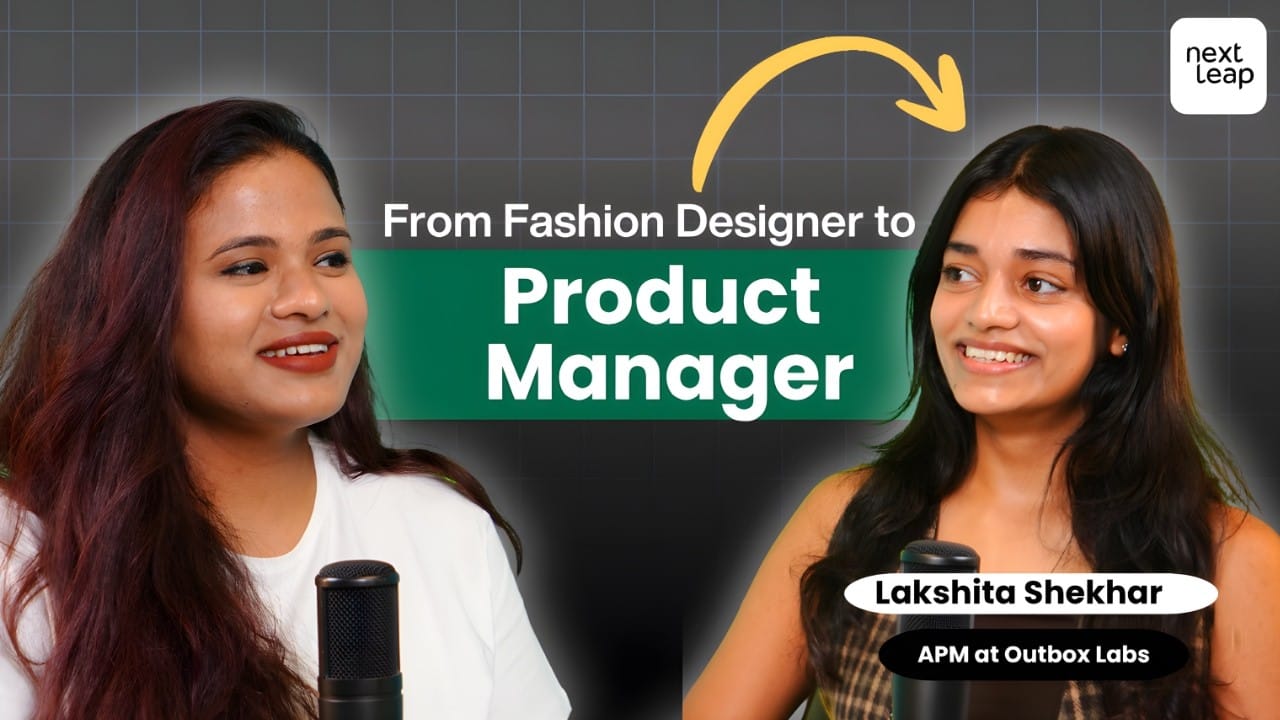
At a glance
- Before: Fashion designer with no technical background
- Now: Associate Product Manager at Outbox Labs, after starting as an intern
- Program: NextLeap Product Manager Fellowship, where she became a top fellow
- What made the difference: Weekend classes, steady projects and a willingness to start
- Biggest lesson: "The clarity comes with trying. Just start."
"The leap from fashion designing to PM was not easy." Lakshita was working as a fashion designer when she decided to leave for product management, with no technical background and, by her own admission, zero clue what the course would be about. Her journey from fashion designer to product manager has led to an associate product manager role at Outbox Labs. She shared it on the NextLeap Alumni Podcast.
Why did Lakshita move from fashion designer to product manager?
She wanted to be part of a bigger picture in the product world. As a designer, she always worked with users and customers, took feedback, iterated on products and released them again. That loop of research, breaking down what works and making it better is close to what product teams do, she says, though "obviously not directly."
The spark came from a LinkedIn post about product management and how people build products from zero to one and then grow them. "It was really captivating." A friend then referred her to NextLeap. She had zero clue what to expect, so she checked out the videos and the course, and it looked interesting.
How did Lakshita balance a job with the Product Manager Fellowship?
She did the first two months alongside work, and took a break for the third. The Product Manager Fellowship runs for three months. Classes were on weekends, so it did not clash with her job or leave her mentally exhausted.
She enjoyed talking to people from the industry. Her very first class explained the waterfall theory. From there she kept attending classes, did her projects on weekends and researched what was happening in the field.
The third month is the finale, which she calls a "make it or break it" situation. There is a project, and that is when the top fellow is chosen. She took a break from her role to focus on it and became a top fellow.
Was it hard to switch industries with no PM experience?
Yes, and most of the doubt came from herself. People around her asked how she would get a job with no technical background and a "manager" title. She admits many of those questions came from her own mind. "It was a really hard time. How do you switch from one industry to another?"
Her answer was to keep pushing and trust the process. Family and friends told her to explore it: she was young, and what was she going to lose?
What does a fashion designer bring to product management?
A habit of research, empathy and feedback. She says the first year of design school teaches you to break things down and to ask what a design makes people feel. That carries over to a product: what do you feel when you use this app, what actions will you take, and what feedback will you break down and apply?
The biggest difference is that fashion is a physical product and product management is digital. But what lies similar is the research that goes into a release, including a slight feature change. What are users liking, why, and how can you improve it? She loved the process of talking to users and empathising with them, and that helped her most.
Her advice to others coming from fashion is to take whatever you have learned to your advantage. Look at how you can apply it. How you experience and use the same classroom learning will be different from anyone else.
What did she have to unlearn? Fashion is based on trends and things change constantly. In a product, she says, the competitive edge means you have to release updates and understand what works for your users, in a different way, because it is a different industry.
What does an associate product manager do at Outbox Labs?
Lakshita began as an intern and was converted to a full-time role. Outbox Labs owns many products, and one of them is ReachInbox. The team works on cold email marketing tools and the infrastructure around them.
Her work includes planning the roadmap, talking to users about what is working, and keeping an eye on how the industry evolves. She describes it as a cycle: you release a feature, get feedback, improve it, and continue improving. Quality and time both matter. She has to work out the timeline and the execution, and understand whether a release will help the product and is something users require. A lot of this is covered in the PRD.
What is the biggest myth about product management?
That a product manager just writes a PRD or plans how a feature works. In practice, you wear many hats. "Sometimes you might have to actually design. Sometimes you might have to understand what's breaking in your product." If there is a bug, she says, you may need to work out what is causing it and which recent release could have affected it.
The skill that ties this together is ownership. You stand up for your team and for what you have released, including when a release may have caused an issue.
Lakshita's advice for people from non-tech backgrounds
Start before you feel ready. She gives two pieces of advice.
- Do not wait to know everything. "You don't need to know everything when you start. It's going to take you some time to learn stuff and figure it out." Get started somewhere, meet people and talk to people. If you really want to get there, you will find a way.
- Develop business thinking. You may bring design thinking from before, she says, but now you need business thinking: what will create an impact for users, and what will work in terms of return on investment. She points out that a lot of this is covered in the NextLeap course.
And is she enjoying it? She loves it. She likes building from zero to one and shipping features. She likes not having to do just one thing: she can give input on design, talk to users, understand what they need and build it for them. As she puts it, talking to people who use your product and hearing that they like it "really feels good."
The clarity comes with trying. Just start.
Watch the full conversation
Lakshita shared her story on the NextLeap Podcast.
Start your own switch
Lakshita joined with no technical background and used weekend classes and steady project work to move from fashion to product. If you are considering a similar leap, the NextLeap Product Manager Fellowship is built around live classes, projects and a finale project. It is a way to test your interest in product before making the jump.
Frequently asked questions
Can a fashion designer become a product manager?
Yes. Lakshita moved from fashion design to an associate product manager role at Outbox Labs. She says the research, empathy for users and feedback loops from design carry over to product work. The main differences are that products are digital rather than physical and that the pace of updates is driven by competition, not trends.
Do you need a technical background to become a product manager?
Not necessarily. Lakshita had no technical background and still made the switch. She advises that you do not need to know everything when you start, since clarity comes with trying. What helped her was learning through a structured course, doing projects and building business thinking alongside her design instincts.
What does an associate product manager do?
Lakshita describes planning the roadmap, talking to users about what is working, and releasing features, then collecting feedback and improving them in a continuous cycle. She also writes PRDs, thinks through timelines and execution, and sometimes helps debug issues or contribute to design. Ownership of what the team releases ties the work together.
Is it possible to do a PM course while working?
It can be. Lakshita did the first two months of the three-month fellowship alongside her job, because classes were on weekends and it did not leave her mentally exhausted. For the final month, which includes a graduation project, she took a break from work to focus on it fully.


