
 My Courses
 My Portfolio
 Refer & Earn
 My Purchases
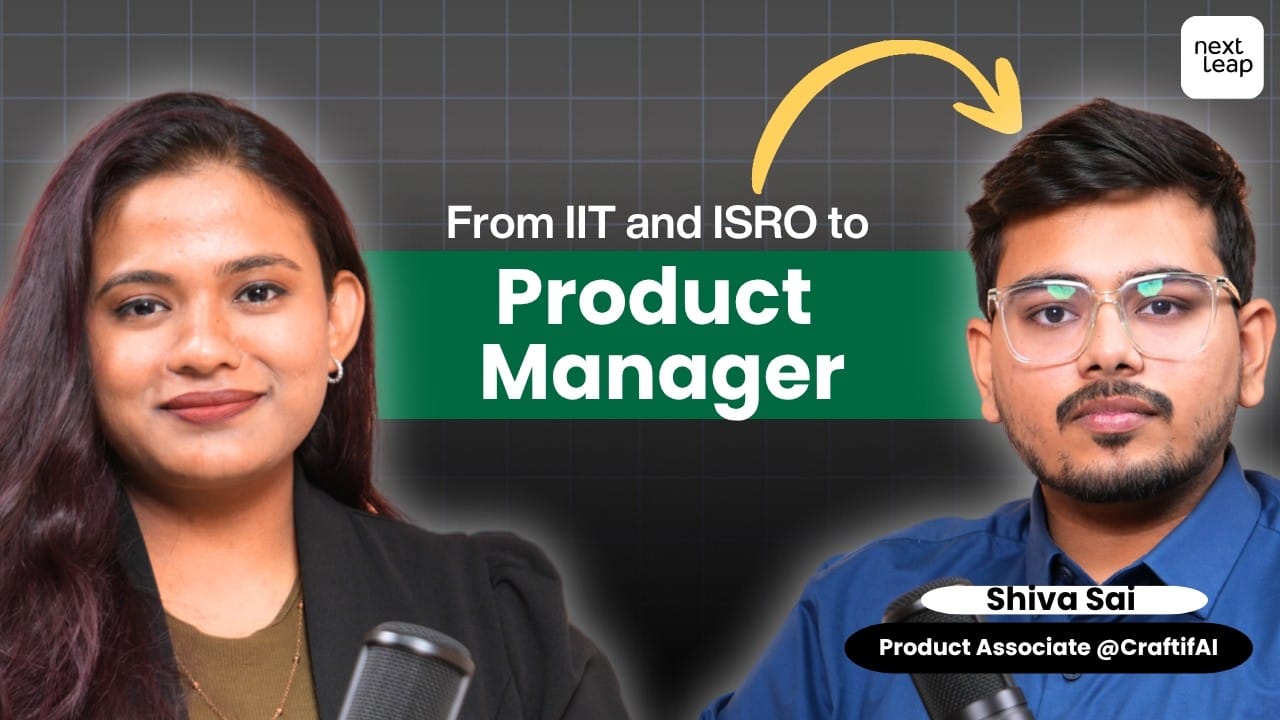
At a glance
- Before: Engineer with ISRO, BHAVINI and IIT Madras experience, rejected in PM interviews
- Now: Product Associate at CraftifAI
- Program: NextLeap Product Manager Fellowship
- What made the difference: Leading with users and taking a stance
- Biggest lesson: "Stop waiting until you're ready. You will never be ready."
"I was showing up at the product interviews like a debugger, like a developer actually." Shiva had ISRO, BHAVINI and IIT Madras on his resume. It was a dreamy CV, as the host put it, and it still led to rejections. His path from engineer to product manager after rejections is about learning to speak a different language. He shared it on the NextLeap Alumni Podcast.
Why did Shiva go from engineer to product manager?
Because he wanted to own the question of what gets built. Shiva interned at ISRO during Chandrayaan-3, interned at BHAVINI and was a project associate at the 5G test bed at IIT Madras. He says he did not walk out of engineering. "I grew out of it."
At some point, he says, every engineer wonders what kind of problem they are solving and whether it is impactful for users. "Engineers are trained to actually build anything, but being in product you get the responsibility of owning the product and to actually build what is needed." He wanted that responsibility to be his.
Why do engineers get rejected in PM interviews?
Because they answer like debuggers and jump straight to solutions. That was Shiva's own problem. Asked a question, he would say something like "let's optimise the latency to this level." The interviewer wanted to hear how he would prioritise features and which user pain points mattered.
His conclusion: "It was not about the lack of knowledge. It was mostly about the language which I had to hone." A rejection taught him to ask about the problem first and answer with the solution last.
What is the difference between a consultant answer and a PM answer?
A PM answer takes a stance. Shiva remembers one interview where a product lead gave him three features to prioritise for a B2B SaaS product. He built a matrix on the RICE framework, very textbook. The interviewer politely stopped him and asked which feature he would ship first and why.
"That is where I froze. I couldn't take a stance." He realised that interviewers do not want a consultant. They want someone who knows the hard trade-offs, can make a call and can defend it. He had been hiding behind structured thinking, afraid of being wrong.
What is the mistake engineers make about technical depth?
They treat it as a gift. Shiva thought his technical depth would impress interviewers. But an interviewer wants to know whether you can translate that understanding into what users need. He calls it the jump from being a great engineer to becoming a great product manager, and says he lacked user empathy at first.
That fits how his thinking changed in the Product Manager Fellowship. Before it, he thought getting into product meant having the most unique ideas. Afterwards, he understood that it means knowing users' pain points and what they need, and "that is where Arindam actually helped me change my habit."
How do you become an AI product manager?
Know the technology in depth and be specific about your own work. Shiva says wanting to be an AI PM is not enough. You should be able to explain each detail of the technology, even to a non-technical person.
He also notes that many people on LinkedIn call themselves AI product managers. What stands out is specificity: the best ones he has seen say what they built, what call they made and what impact it had on users. They spend less time on models and more on where the model fails, because that is where users lose trust.
Shiva's six-month roadmap for aspiring PMs
His plan is to observe first, then talk to users, practise, build in public and finally apply.
- Months 1 and 2: Observe the products you use instead of only consuming them. Pick three or four AI products you use often and test their onboarding, error rates and pricing pages. Ask why they were built this way.
- Month 3: Do 10 to 15 user interviews, even informal ones, to understand what frustrates users and what changes they want.
- Month 4: Practise cases, write PRDs, do product teardowns and work through prioritisation frameworks. For AI roles, add an AI lens: model accuracy, latency and cost trade-offs.
- Month 5: Build in public. He points to the learn-in-public challenge at NextLeap. Show what you are working on and your perspective on the gaps you see in the market.
- Month 6: Start applying for specific roles that match your background. As an electronics engineer, for instance, he would look at embedded or edge-device companies.
What skills does a deep tech product manager need?
Three things stand out. First, tolerance for long feedback loops: in deep tech, a decision can take six months or a year to validate, so you need "conviction without the confirmation."
Second, the ability to translate between three languages: the technical team, the business team and the regulations team. In AI infrastructure, he adds, you may manage GPU costs, enterprise procurement cycles and compliance requirements at once. Third, knowing when to productise a capability and when not to, and being right about it.
He also learned this while preparing for interviews. Talking to business people in deeply technical terms discourages them, so translating between technical, business, sales and marketing teams matters. He says he honed that skill during the fellowship.
What does Shiva do at CraftifAI?
He owns PipeGen from zero to one.CraftifAI is building an agentic platform that automates embedded software development for edge and IoT devices. The platform, CraftifAI Orbit, has three products in it: PipeGen, FirmGen and Agentic.
The problem, as he describes it, is that building a perception pipeline for a drone, an AI camera or a robot takes months of specialised, expensive work. PipeGen takes your requirements and produces a hardware-optimised pipeline that can be deployed straight to a chip such as Nvidia's Jetson Orin or Jetson Thor. In his words, it is "a brain for the edge devices."
Shiva was also a founder, and he does not see the mindsets as conflicting. A founder sets the direction of the product, and a product manager shows the path. His summary: a founder who ignores the product ends up with a feature nobody asked for, and a product manager who ignores the founder's conviction builds a feature nobody remembers.
Stop waiting until you're ready. You will never be ready.
Watch the full conversation
Shiva shared his story on the NextLeap Podcast.
Start your own switch
Shiva's turning point was learning to talk about users, trade-offs and decisions instead of only technology. If you are an engineer trying to make the same shift, the NextLeap Product Manager Fellowship offers projects, mentors and interview practice. It is a practical place to build the product language interviewers are listening for.
Frequently asked questions
Why do engineers get rejected in PM interviews?
Often because they jump straight to solutions. Shiva says he answered like a debugger, offering technical fixes when interviewers wanted to hear how he prioritised features and understood user pain points. He also froze when asked to take a stance. Interviewers look for someone who can make trade-offs, decide and defend the decision.
How do you become an AI product manager?
Shiva says wanting the title is not enough. Learn the technology deeply enough to explain it to a non-technical person, and be specific about what you built, the call you made and its impact on users. Look at where models fail, because that is where users lose trust in a product.
What skills does a deep tech product manager need?
Shiva names three. You need tolerance for long feedback loops and conviction without confirmation. You need to translate between technical, business and regulatory teams. And you need to know when to turn a capability into a feature and when not to, and to be right about it. These matter more in deep tech than in consumer apps.
What should a six-month plan to become a PM look like?
Shiva suggests two months of studying products you use, one month of user interviews, one month of cases, PRDs and teardowns, one month of building in public and one month of applying to specific roles. He recommends targeting companies that match your background instead of applying everywhere.


