
 My Courses
 My Portfolio
 Refer & Earn
 My Purchases
At a glance
- Before: Developer with experience in sales, marketing and an AI startup
- Now: Associate Product Manager
- Program: NextLeap Product Manager Fellowship, where he became a top fellow
- What made the difference: 100-plus mock interviews and a structured way to answer
- Biggest lesson: "If one thing is not working, do not just stick to that."
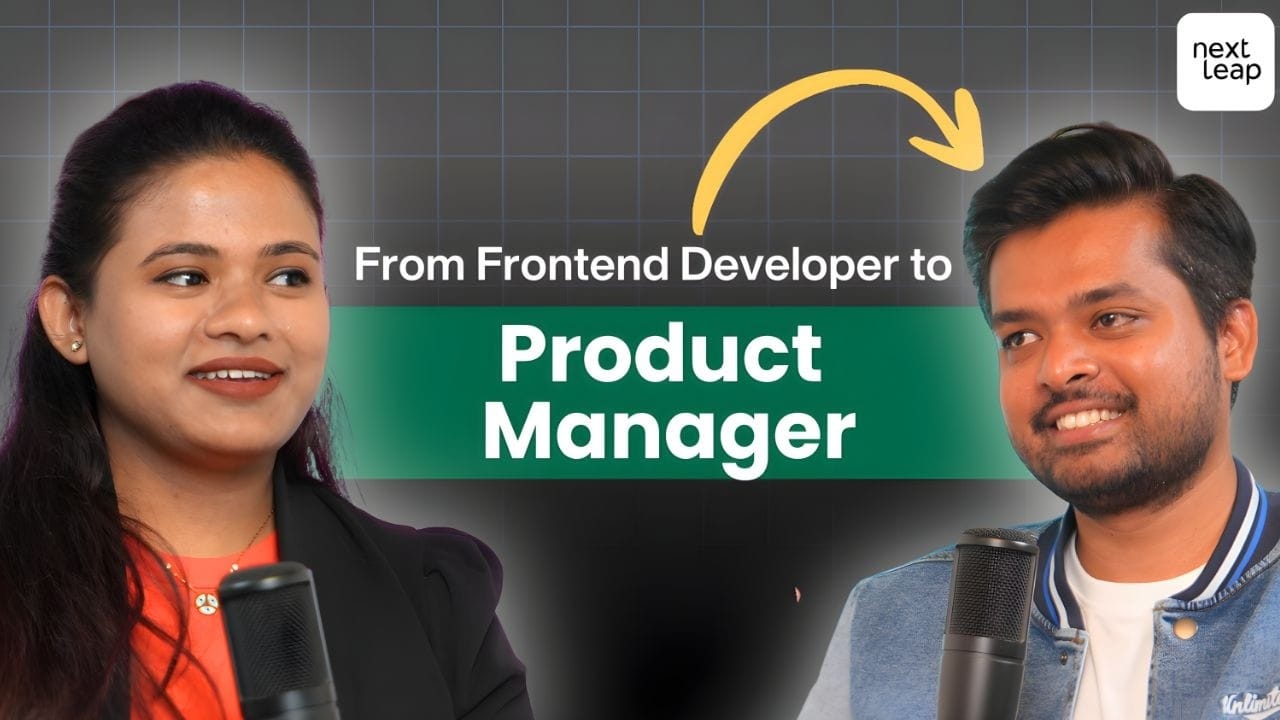
"I don't think it's very difficult to crack an APM role to be very honest, but the right question to ask is do I want to get into this kind of role?" That is Shikhar's view of the developer to product manager switch. He started as a developer, added sales, marketing and an AI startup, and became an associate product manager. He shared what worked on the NextLeap Alumni Podcast.
How did Shikhar go from developer to product manager?
Through curiosity about the why behind the code. Shikhar was getting good at development, but he wanted to see the bigger picture. He spoke to his manager and to other teams and found that a lot goes on behind the scenes once development is done.
He did not know it was called product management at first. He read business articles and news, listened to podcasts with founders and stayed interested in sales, marketing and why products get built. The interest took shape around 2021. By then he had finished almost 10 Udemy courses, but he still lacked structure and got stuck every other day. That is when he looked for a structured program with an experienced mentor and found NextLeap.
How hard is it for a developer to become a product manager?
Not very, in his view, but the question is whether you want the role. As a developer you write code. In a PM interview, the interviewer wants to know whether you understand why the product is being built and whether your thinking is clear. A product manager's suggestion is something the team may work on for the next three or six months.
So the real test is whether you want to carry that responsibility, "even if it's a fail or a success." His developer background still helps. He says he can understand the complexity of a problem, judge how best to solve it and talk to engineers easily.
What did the NextLeap Product Manager Fellowship teach him?
How to think, not only what to think about. Shikhar credits Arindam as his first mentor in product management. "He teaches you how to think." The Product Manager Fellowship gave him a framework he could apply to any problem, and in interviews it helped him break a confusing question into parts, cross-question and clarify.
He also became a top fellow. When the graduation project statement arrived, he was clueless for the first 10 days. Then he began meeting other fellows, joined a brainstorming session and studied the portfolios of earlier top fellows for structure. Before submitting, he met a few batchmates to compare notes and made last-minute changes.
How did Shikhar crack his first PM interview?
With practice, and by fixing how he told his own stories. After graduating, he says he did not apply right away. He did 100-plus mock interviews with other NextLeap fellows. He posted in the group, 10 to 15 fellows joined, and they practised on a fixed schedule every day.
Product sense and case studies came fairly well after that practice. The behavioural questions were the problem. Interviewers dig deep into problems you have solved, and Shikhar had such problems but could not structure his answers. After several failed interviews, he asked his mentor for help. The mentor asked him similar questions for a 50-minute session and then said this was not how he should answer.
They worked on a structured framework for behavioural answers, and he began cracking interviews after that. He had been telling himself it was luck.
How do you prepare for PM case studies?
Study how others structure them, then build your own and get it reviewed. Shikhar looked at the graduation projects of earlier top fellows. For someone else, he suggests looking at how decks are made and spotting the common pattern: problem statement, primary research, secondary research.
- Go through 10 or 15 decks, which he says takes a day or two.
- Pick any problem in any product and build a case study with that structure. The first one will not be good.
- Get it reviewed by someone in the industry.
- Repeat for four or five case studies, and interviews get much easier.
One interview question he remembers: after he described an AI product that simplifies buying health insurance, the interviewer asked how he would build something similar for an e-commerce platform, and where exactly AI would come in.
What separates a great product manager in the AI era?
Understanding the problem deeply. Shikhar says everyone from a tech lead to a developer may feel they can do a PM's job. "What differentiates a good product manager from a great product manager is when you understand the problem really deep." You can empathise with users genuinely, and that decides which direction to take and why.
He does not expect AI to replace that. His advice is to know what AI cannot do and use it for repeatable tasks that need little analytical thinking. On tools, he says the how matters more than the which. Prompting will become like a Google search that anyone can do, so understand the back end: what RAG is, what context is, and what separates a good prompt from a great one.
Can someone from a non-tech background become a product manager?
Yes, with effort. Shikhar knows several people in product who are not from a technical background. He says the fundamental job is to combine business requirements with what users need, and the product sits in the middle. Two skills matter most: clarity of thought and curiosity.
Understand how the business works, what metrics are tracked and why. Nobody expects you to write code, but you should be able to talk to developers in their language and understand how complex something will be.
Shikhar's six-month roadmap for developers
He describes a developer with one or two years of experience.
- Understand your own product. Ask why it is being built, who it is for and what the business use case is. Your manager can help.
- Learn what interviewers expect. Expect product sense, root cause analysis, guesstimates and a behavioural round.
- Capture your own stories. For problems you worked on, record the task, what you learned and the result for the business or users.
- Then apply. The first few interviews may go badly, but you learn how to approach them.
Just believe that product management is not very difficult to be cracked upon.
Watch the full conversation
Shikhar was in conversation with Nimisha on the NextLeap Podcast.
Start your own switch
Shikhar's turning point was a structured program plus a daily habit of practising with peers. If you are a developer thinking about product, the NextLeap Product Manager Fellowship offers mentors, projects and a cohort to practise interviews with.
Frequently asked questions
How hard is it for a developer to become a product manager?
Shikhar does not think it is very difficult, but says the right question is whether you want the role. PM interviews test whether you understand why a product is built and think clearly. Decisions you make as a product manager guide the team for months, so you must be ready to own both successes and failures.
How do you prepare for PM case studies?
Study how existing decks are structured, usually problem statement, then primary and secondary research. Go through 10 or 15, which he says takes a day or two. Then pick any product problem, build your own case study, and get it reviewed by someone in the industry. After four or five, he says interviews become much easier.
What skills separate a good product manager from a great one in the AI era?
Shikhar says a great product manager understands the problem deeply and empathises with users, which decides the direction to build in. Teams can supply the solutioning. He also advises knowing what AI cannot do, using it for repeatable tasks, and understanding how prompts and context work rather than just naming tools.
Can someone from a non-tech background crack a PM interview?
Yes, according to Shikhar, who knows several people in product without a technical background. He says to build clarity of thought and curiosity, understand how a business works and which metrics it tracks, and learn enough tech to talk to developers. Nobody expects you to write code.


