
 My Courses
 My Portfolio
 Refer & Earn
 My Purchases
At a glance
- Before: Mechanical engineer with almost three and a half years of experience in data
- Now: Associate Product Manager at Cheq
- Program: NextLeap Product Manager Fellowship
- What made the difference: Structured learning, mock interviews and winning a company competition
- Biggest lesson: "You have to bet on the data."
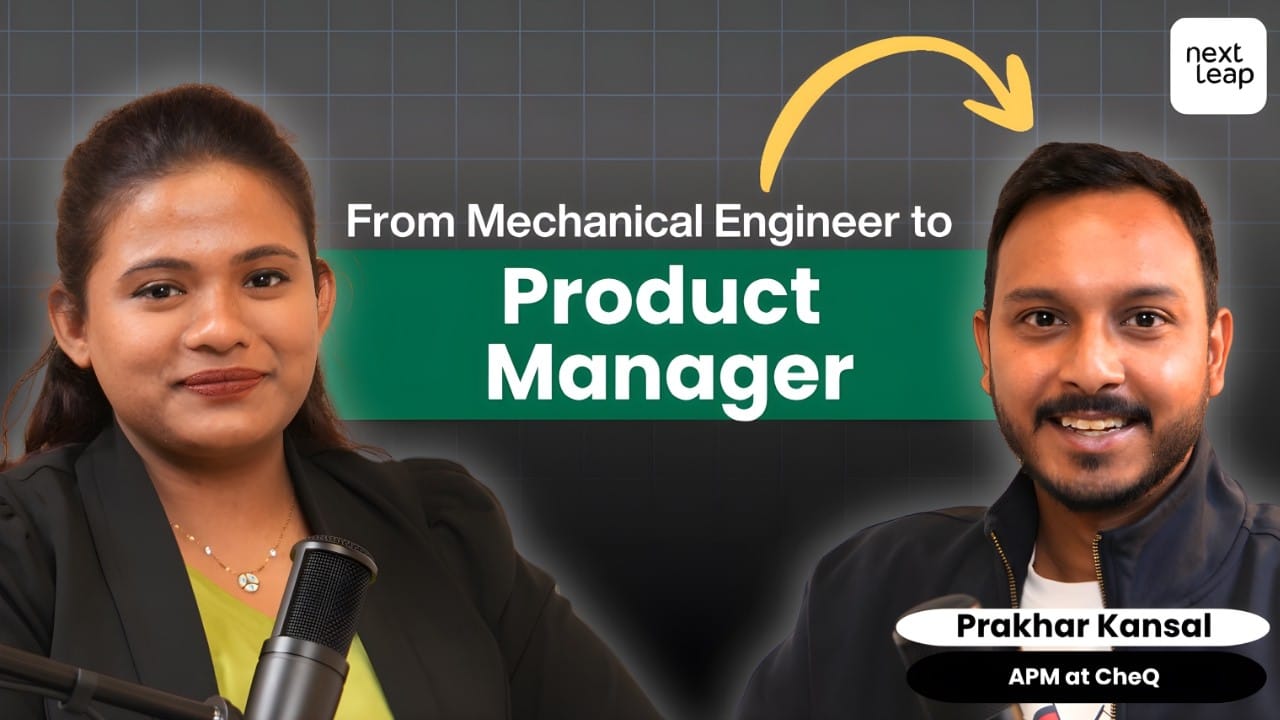
"I wanted to interact much with the stakeholders, and I wanted to do some work which had some impact on the ground." That is why Prakhar, a mechanical engineer who spent years working with data, started looking at product roles. His move from data to product management took a structured course, plenty of mock interviews and a company competition. He walked through it on the NextLeap Alumni Podcast.
How did Prakhar move from data to product management?
Through a slow realisation that he wanted more impact and more contact with stakeholders. Prakhar had a knack for cars as a child, which is how mechanical engineering came into the picture. But over time, through projects in college, he found himself drawn to the data side.
After almost three and a half years working in data, he wanted to interact more with stakeholders and do work that had impact on the ground. While researching, he came across product management. He assumed he would either need an MBA or some knowledge to crack the interviews. He had been watching YouTube videos on the topic, but he wanted structured learning. "This is how NextLeap came into place."
Does data experience help you become a product manager?
Yes, but he is careful about how he says it. "I won't say data is directly proportional to product management." There is a correlation, though, because a successful PM needs a lot of user empathy, and to understand what users want you have to look into data.
In his day-to-day work in data, he saw funnels and kept a lot of Google Sheets. He argues that if you know where the data comes from, how it is stored and how it lands in a sheet, you can make the most sense of what it means. "I was lucky enough to have this data experience and it has helped me till now."
How did NextLeap give Prakhar a structure?
By teaching him the whole product life cycle in depth. NextLeap was recommended to him by friends who had done the course and cracked PM roles. He had already learned the outline from YouTube, but going into every aspect was different: user interviews, user surveys, making hypotheses and validating them.
In the Product Manager Fellowship, he learned to identify a problem, form a hypothesis, validate it with user surveys, build features, prioritise them and set timelines. "It gave me the path where I can truly understand what product management exactly means."
How did Prakhar crack his first PM interview?
Through a competition and a lot of preparation. He calls it luck: his current company hosted a competition inside NextLeap, and he won. The top 10 people were then invited to interview. The interviews covered root cause analysis, optimisation techniques and culture.
He says top fellows at NextLeap get help with the interview process: interview classes, mock interviews and interviews conducted by working product managers. When he sat for his first interview, he was not nervous because he had already been through mock interviews. Questions on RCA, optimisation and product design had been covered.
What are the most important skills for a product manager?
Patience, listening, user empathy and product sense. Prakhar reminds aspirants that the role can look fancy but involves managing a team of designers, stakeholders and developers. You are the owner of the product or feature and have to bring everyone to a common place.
On user empathy, his advice is blunt. You have to disassociate yourself from the product and look at the data. "You have to understand what the user wants and you have to build it whether you like it or not. It's not a game that you can bet on your guts. You have to bet on the data."
What mistakes do candidates make in PM interviews?
The main one is treating a question as a straight line. Prakhar says he used to think a root cause analysis (RCA) question was linear: a metric has dropped, so how do you increase it? But interviewers can ask, for example, how a data person and a product person would each think about it.
His fix is system thinking, which he says was the first chapter taught at NextLeap by Arindam. Consider all the scenarios, including guesstimates and other question types. He suggests going beyond YouTube videos and handbooks: sit with ChatGPT or another AI tool and ask it to take you through all the cases that can happen.
The same habit helps him at work. "Instead of making a simple line, it helps me grow a web in my mind." When he studies a metric or a conversion drop, he keeps all the metrics and conversions in mind and correlates them, instead of assuming one directly causes another.
How important is a portfolio for a product manager?
Very, because there can be hundreds of applicants for a single opening. Prakhar says a portfolio is how you stand out. But you need to be smart about showing it: cold email, and even in an interview, drive the interviewer to click on it, or at least make sure they know it exists.
His advice is to build a project of your own on a no-code tool. If you have shipped a feature or a product you can showcase, it gives you an edge, and you learn how designers, front end and back end fit together. He uses AI daily himself, both chat tools and no-code tools, and says aspirants should know both.
Prakhar's advice for aspiring product managers
Know what the job really involves, then show it. If your past work is not strictly product, look for moments where you brought many people together and drove something forward, and bring those up in interviews. In your portfolio, show the features and products you have shipped, so the interviewer feels confident taking a bet on you.
If he were starting again, he says he would still take a structured course. And whichever one you pick, two things apply.
- Believe in yourself and in the goal you have taken up.
- Put in your weekends, and give time after your office hours.
You have to be very honest with yourself, and you have to believe in yourself.
Watch the full conversation
Prakhar shared his story on the NextLeap Podcast.
Start your own switch
Prakhar credits structured learning, mock interviews and industry interviews for turning his data background into a PM offer. If you are looking for a similar path, explore the NextLeap Product Manager Fellowship and see how the interview preparation and projects fit with your own background.
Frequently asked questions
Does data experience help you become a product manager?
Yes, though Prakhar says data is not directly proportional to product management. Data helps you build user empathy, because to understand what users want you need to read funnels and know where numbers come from. Combined with structured learning, projects and interview practice, it became a strong base for his move into product.
How do you prepare for PM interviews like RCA and guesstimates?
Do not treat a question as a straight line. Prakhar recommends system thinking: consider all the scenarios that could cause a metric to move, and prepare for varied versions of each question type. He also suggests practising with mock interviews and asking an AI tool to take you through all the possible cases.
How important is a portfolio for a product manager?
Very important, because a single opening can attract hundreds of applicants. Prakhar says a portfolio helps you stand out, especially if it includes a project you built on a no-code tool. Cold email it, and steer interviewers towards it, since they may only look at your resume otherwise.
Can a mechanical engineer become a product manager?
Yes. Prakhar started in mechanical engineering, moved into data and then into product. He advises learning what a product manager actually does, drawing on past moments when you brought people together, and showing shipped features in a portfolio. That gives an interviewer confidence to take a bet on you.


