
 My Courses
 My Portfolio
 Refer & Earn
 My Purchases
At a glance
- Before: Chemistry student who tried software development and a data analyst internship
- Now: Associate Product Manager at Kapture CX, his first role after college
- Program: NextLeap Product Manager Fellowship, joined in his last year of college
- What made the difference: A product mindset, a portfolio and mock interviews
- Biggest lesson: "I look for a lot of clarity in things."
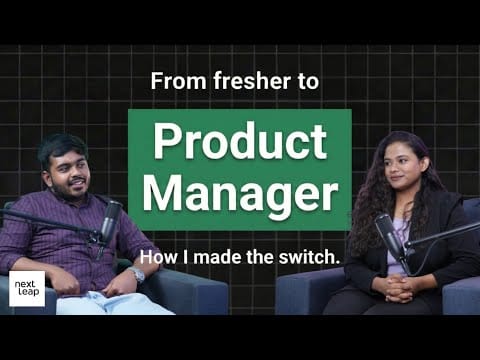
"Again the spark was something missing." That is how Biky describes his early years, after software and data both left him feeling he had more to give. His journey from chemistry graduate to product manager passed through software development and a data internship before he found product. He shared it, and the interview habits that helped him, on the NextLeap Alumni Podcast.
How did Biky go from chemistry graduate to product manager?
By trying fields until one gave him the spark. Biky chose chemistry because it was the subject among mathematics, chemistry and physics that he related to most. At college he got exposure to other fields and started with software development, which is what everyone around him did. He did an internship in his second year.
He did not enjoy coding much. It needs discipline and dedication, he says, and it did not spark anything. He explored data and machine learning, learned SQL and Python, and did a data analyst internship at the Indian School of Business. That went well, but he still felt he had more to give and was not in the right field.
How did he find product management and NextLeap?
Through a friend. Biky came to know about product management because, in recent years, it had come up so much. He was skeptical about joining a course, so he first browsed resources and applied for internships. He kept failing interviews and could not work out what was missing.
His best friend, a batchmate who had done NextLeap, told him to join. The friend did not pitch placements or a brand. He said it would build his product mindset and core fundamentals. Biky joined the Product Manager Fellowship during his last year of college. He says it changed how he looks at the PM field and gave him confidence in his communication and in how he approaches a problem. His first role was an APM role.
What do recruiters look for in an APM resume?
Product internships and projects. Biky says one or two internships in product really stand out, and he had done one or two during college. Case studies also help. He specialised in entrepreneurship and innovation, where he solved business cases and made decks, which gave him practice at breaking down a problem.
If you are on the fellowship, he says to showcase your NextLeap projects. He used NextLeap as a header in his resume, along with the problem statement solved in the final month of the fellowship, and described the deck and the thought approach.
His advice for people from arts, commerce or science is to try for an internship first. Do it for three to six months. You may even get a pre-placement offer, and the experience makes landing an APM role easier.
What did he struggle with during the fellowship?
Product mindset. Biky says it is the hardest thing to build, because you have to spend time working through many cases. It was missing in him when he failed interviews earlier. Mentors from large companies solved cases with the cohort, and that helped him build it.
The second struggle was structure: framing down whatever you are trying to solve. The third was technology. He says you do not need to code, but as AI comes into the picture, products are built around it, and a product manager should know fundamentally how AI works: the architecture and what models could be used. Companies do not want a PM to code, he says, but to understand how the technology evolves and how to build a product with it.
Why do candidates get filtered out in PM interviews?
Because of how they think and speak in the first minutes. Biky says an APM process usually has three rounds built around product cases: product improvement, metrics questions and guesstimates. "Your biggest deal breaker is how you are good at your cases, how you crack that interview."
He says recruiters can filter you out in five to ten minutes. It comes down to how you speak, how you structure your answer, how you take a pause and how you ask the right questions, "and definitely not jumping into conclusions or solution." Practising many cases and mock interviews is what builds that. The fellowship arranged mock interviews with other fellows and gave materials to work through.
What habits does he recommend?
Two. Both come from the fellowship.
- Take a pause. Biky says Arindam used to tell them that when you get a question, you should take a pause of about a minute, analyse the problem, think and then answer.
- Ask the right questions. Once the interviewer sees some product mindset, they engage more, because a product interview has to be interactive, with both sides solving the problem together.
He says the same habits help in any profession.
Do product managers need to know design and tools?
Some, yes. Biky says that after college he got a lot of interest in design, because when you build a feature or a UI, you have to jot it down as wireframes or on paper. He names Jira as his favourite tool. As a PM you sit between developers and QA, and agile tracking makes it easier to keep track of what each person has to do and to structure a feature.
His dream company is Flipkart, because he has heard that a PM there gets exposure to many kinds of work. His mantra is clarity: think first, then take action.
I look for a lot of clarity in things.
Watch the full conversation
Biky shared his story on the NextLeap Podcast.
Start your own switch
Biky's switch came from building a product mindset, a portfolio of projects and plenty of mock interviews. If you are coming from a non-tech field, the NextLeap Product Manager Fellowship offers cases, mentors and peers to practise with.
Frequently asked questions
Can a chemistry graduate become a product manager?
Yes. Biky studied chemistry, tried software development and data, and found product management through a friend. After the NextLeap fellowship, with a product internship and a portfolio, his first role was as an associate product manager at Kapture CX. He suggests a three to six month internship if you come from a different field.
What do recruiters look for in an APM resume?
Biky says one or two product internships stand out, along with case studies and projects. He put his NextLeap projects and the final-month problem statement in his resume, describing the deck and his approach. For people without experience, he recommends trying an internship first, for three to six months, before aiming for a full-time APM role.
Why do candidates get filtered out in PM interviews?
According to Biky, recruiters can filter candidates in five to ten minutes based on how they speak, how they structure answers, whether they pause, and whether they ask the right questions. Jumping to conclusions or solutions hurts. Product cases such as improvement, metrics and guesstimates decide most APM interviews, so practise them with mock interviews.
Do product managers need to know AI?
Biky says a product manager should understand fundamentally how AI works, including its architecture and which models can be used, because products are now built around AI. Companies do not expect a PM to write code, but they expect you to understand how the technology evolves and how to frame a product around it.


