
 My Courses
 My Portfolio
 Refer & Earn
 My Purchases
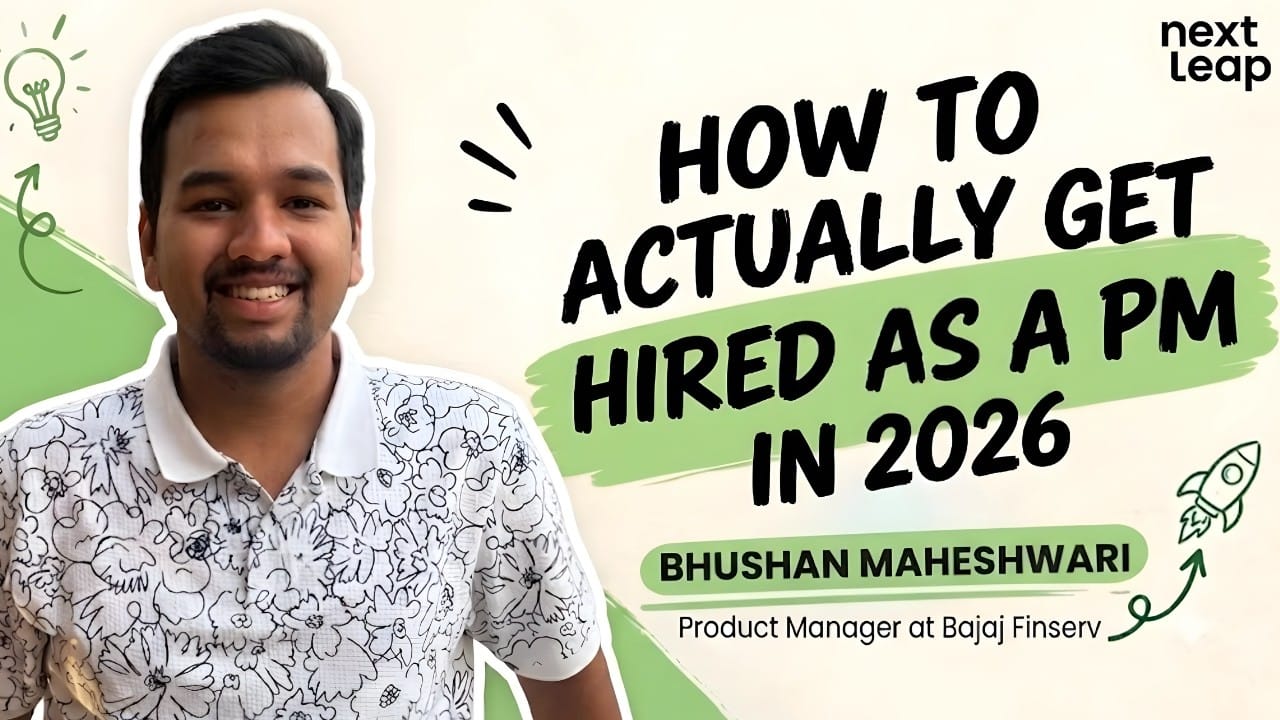
At a glance
- Before: B.Tech computer science student unsure whether he needed an MBA for product management
- Now: Product Manager at Bajaj Finance, after starting as an APM at BrightChamps
- Program: NextLeap Product Manager Fellowship
- What made the difference: Public projects, weekly mock interviews and daily practice
- Biggest lesson: "Consumption definitely gives you knowledge but practice gives you the ability to use that knowledge."
"I could not wait for the company to give me the opportunity. So I started demonstrating my skills myself." That decision took Bhushan from a B.Tech computer science classroom to a product manager role at Bajaj Finance. His journey from B.Tech to product manager, with no MBA along the way, ran through public projects, weekly mock interviews and a lot of practice. He shared the whole story on the NextLeap Alumni Podcast, and here it is.
Why did Bhushan move from B.Tech to product manager?
He was more curious about why a product gets built than about how to code it. Computer science was always part of his education, but his questions kept drifting somewhere else.
I was more interested in knowing the why and what behind the things, like why should we build it and what should we build it, rather than just focusing on how should we build it.
Whenever he learned about a product, he found himself asking why it was designed a certain way and who a feature was really meant to help. He enjoyed working "at the intersection of technology, business and users." That pull is what led him to product management. He began as an associate product manager (APM) at BrightChamps and is now a product manager at Bajaj Finance.
Do you need an MBA to become a product manager?
No. Bhushan believed an MBA was essential at first, then changed his mind.
I initially thought that MBA is must to get into product, to be a PM. But eventually I realized that MBA can definitely help you to become a PM, but it is not a mandatory requirement to be a PM.
In his view, what matters most is how you demonstrate your product thinking, your understanding of users and your problem-solving. A degree can give you an edge. It cannot replace proof that you can think like a product manager.
Which skills matter most for a first PM role?
Problem solving, user research, writing PRDs, defining product metrics and prioritisation come first. Bhushan adds two that people often underrate: communication and structured thinking.
He is clear that soft skills carry real weight, because the job is a conversation with many teams. As he put it, "you need to interact with the developer, you need to interact with the design team, you need to sit with the QA to solve the problem."
What about frameworks? They are useful when you are starting off, he says, because they give you a structure for an unfamiliar problem. But a framework "can't tell you what decisions you should make." His advice is to learn from frameworks initially and "very quickly move towards applying them." He adds that just memorising them does not work: "you need to apply it properly."
How did Bhushan build proof of work without PM experience?
He created his own projects and shared them in public. As a fresher, he was not getting into companies, and he decided not to sit and wait.
He would pick any company and any feature, then write user stories, prioritise, propose solutions, plan execution and define metrics. Then he posted the work on LinkedIn. Doing this taught him the frameworks, showed him how to approach a problem and cleared his thinking about the range of solutions possible.
NextLeap gave him a push here. The Product Manager Fellowship has weekly milestones and weekly leaps, where projects can be shared publicly. They were optional, but he opted in and posted on LinkedIn every week.
His advice for a first role is to stay flexible. "Be open. You are just starting off with your career. Be open with everything, because wherever you go you will learn a lot." In his experience, up to level two or three you are learning, and an APM assists the manager, whether the company is big or small.
On getting shortlisted, he describes three things working together: "Resume gives you a platform to get yourself considered. Projects give you something to talk about yourself. And networking or referrals can help you to get to the doors of the company." Then keep applying, because a résumé that fails at one company can be a perfect fit for another.
How did Bhushan prepare for PM interviews?
He practised, out loud and often. Knowing frameworks was not enough, so he worked on the concept behind each answer and on expressing his thinking clearly.
He says the classic mistake is to jump straight to the solution. Instead, spend time on the "why" in a pre-solutioning stage first. He notes that many aspirants know what to say but cannot express themselves, and that counts against them.
NextLeap's weekly mentor sessions included mock interviews. There was also a set of questions on the platform. He would put a question on his screen and answer it aloud to himself, as if he were both the interviewer and the candidate.
He also learned how quickly an interview can turn. The interviewer, he says, can ask a follow-up from a single word you say, and one weak answer can hurt the rest of the conversation. He has experienced that himself. He is blunt about the alternative to practice: "If by listening to people you can crack interview, then everyone would have been a PM now."
How does Bhushan use AI as a product manager?
He uses AI as a helper for prototypes, data and research, and keeps the thinking for himself. His everyday tools are Claude, GPT, Figma AI and Lovable. He builds prototypes to show how a product could look, creates data views, and solves SQL queries quickly. He also uses AI for user research and for pulling out user stories.
The line he draws is clear: "There is a big difference between using AI to enhance your thinking and letting AI think for you." An AI can hand you a full case-study answer, but it has not built your judgment. In a real interview, he says, you get stuck when you are asked why you chose one feature over another. His advice is to use AI for user research, brainstorming and challenging your assumptions, and not to limit your own thinking.
Bhushan's roadmap for aspiring product managers
He boils it down to three steps for a B.Tech student who wants to break into product in the next few months.
- Learn the fundamentals. Understand how PMs think: users and their problems, frameworks, product strategy, execution and prioritisation.
- Build. Don't wait for opportunities to come to you. Pick a real product and a problem statement, work on it and show it on LinkedIn. Bhushan says NextLeap co-founder Arindam gave him this nudge: pick a product you use every day, such as an e-commerce app, Uber, Ola or Spotify, and create a deck on it.
- Start applying and talk to people early. Networking matters for PMs, so ask for feedback along the way.
His parting thought is about readiness: "No one is 100% ready."
Consumption definitely gives you knowledge but practice gives you the ability to use that knowledge.
Watch the full conversation
Bhushan was in conversation with Nimisha on the NextLeap Podcast.
Start your own switch
Bhushan credits NextLeap's weekly projects, mentor-led mock interviews and question bank for helping him turn interest into interview-ready practice. If you want a similar structure, explore the NextLeap Product Manager Fellowship and see how the curriculum maps to the skills he describes. It is a good place to start building proof of work you can show recruiters.
Frequently asked questions
Do you need an MBA to become a product manager?
No. An MBA can help, but it is not a mandatory requirement. Bhushan, who moved from B.Tech computer science to a product manager role without one, says hiring comes down to how well you demonstrate product thinking, user understanding and problem solving. Projects, case studies and clear communication can show that without a management degree.
Can a computer science graduate become a product manager?
Yes. Bhushan studied B.Tech computer science, worked as an associate product manager and is now a product manager. His advice is to stay curious about why products are built the way they are, learn user research, prioritisation and metrics, and build projects that show your thinking.
How do you get a first PM job with no PM experience?
Build proof of work yourself. Bhushan picked real products, wrote user stories, prioritised solutions and defined metrics, then posted them on LinkedIn. He also suggests staying open to different companies, since early PM roles are mostly about learning, and applying widely instead of waiting until you feel completely ready.
How should you use AI when preparing for PM interviews?
Use AI as a helper, not a substitute for thinking. Bhushan uses it for user research, brainstorming, challenging assumptions and prototypes, but warns that letting AI think for you leaves you unable to defend your choices when an interviewer asks why. Practise answering questions out loud so your own judgment does the work.


