
 My Courses
 My Portfolio
 Refer & Earn
 My Purchases
At a glance
- Before: Computer science degree, then a master's in management in Spain
- Now: Associate Product Manager at Infinity Learn
- How she got in: NextLeap Product Manager Fellowship, A coffee conversation, cold LinkedIn messages and books on the PM interview
- What she says matters now: Product judgement, problem framing and using AI well
- Biggest lesson: "Don't discount yourself."
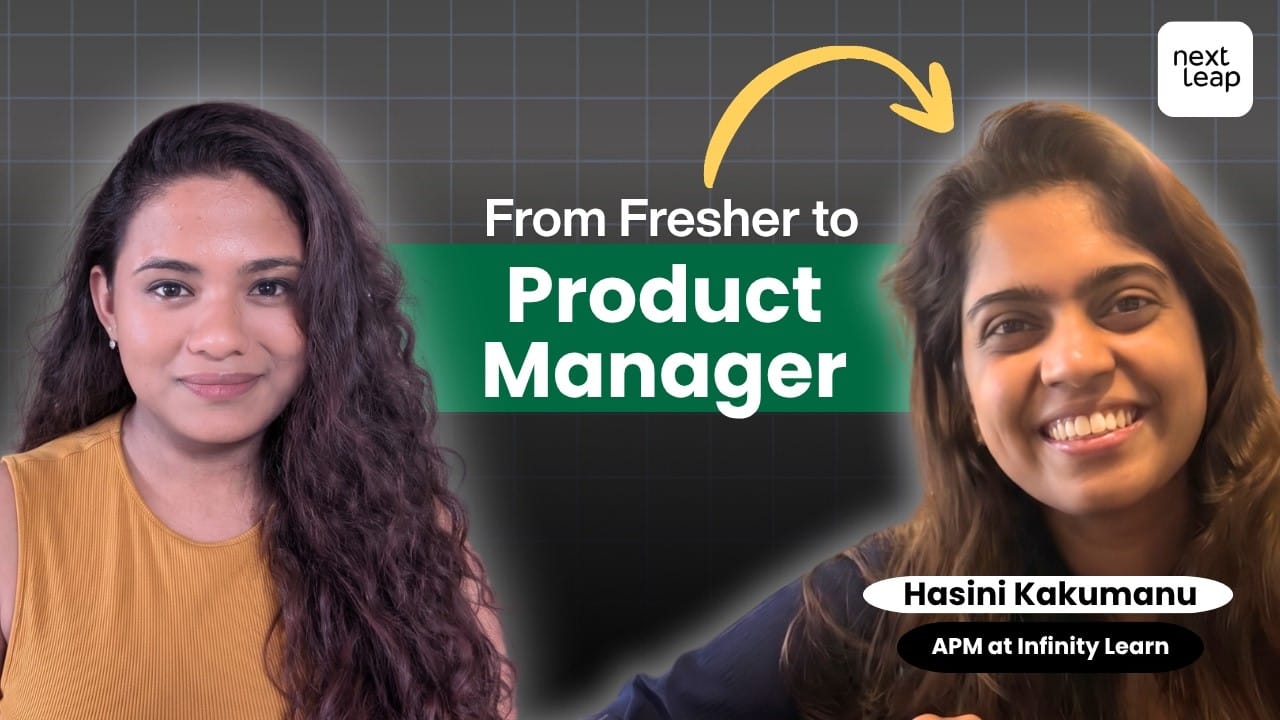
Hasini is an associate product manager who found a way to break into product management through a coffee chat and a lot of networking. She started with a computer science degree, moved to Spain for a master's in management and, three years on, has worked across growth, acquisition, retention and engagement, and more recently on AI product work. On the NextLeap Alumni Podcast she explained how she got in and what she would tell an aspiring PM today.
How did Hasini first discover product management?
By accident, over a coffee. Hasini was completing her master's in Spain and sat down in an Indian restaurant with a friend to talk about placements and the different routes they could take. Hers was an accelerated programme, so the choice had to come quickly: sales and marketing, strategy or consulting.
Big things happen on small tables.
She was also looking at project management, since she thought she was good at organising. Then her friend mentioned a newer career she kept hearing about, product management. Hasini says she still imagines where she would be if she had skipped that coffee.
Why did she want the business side of things?
Because everyone else in her family works in medicine, and business was the field nobody had entered. Hasini says that from school she imagined a job with a lot of phone calls and a busy day in the business sector. She planned a BBA and an MBA. Like many Indian parents, hers asked her to do engineering first and then whatever she wanted.
She now sees that as a good sequence. Engineering built her technical foundation, which she says works well in the PM industry, and she still wanted business acumen on top of it.
Why did product management appeal more than consulting?
Because a product manager stays for the result. Hasini noticed that much of what a consultant does resembles what a PM does. The difference, in her view, is that in consulting you give the solution to the company, pack your bags and leave. You are not there for the execution or to see the result. A PM extends a little further.
She did not want to keep packing up and jumping to another industry, so she chose the role where she could stay for execution. She also sees the founder and PM jobs as similar. The PM is often called the CEO of the product, and the thinking is alike, though a PM works on the corporate side and a founder on the entrepreneur side.
How did she learn enough to break into product management?
She read, reached out and asked questions. Hasini says that about three years ago the first steps were basic: go on LinkedIn, watch videos on YouTube and pick up the books on cracking the PM interview. She bought them all and read how interviews go.
The step that helped most was connecting with PMs at other companies. She sent cold LinkedIn messages, written humbly, because people are giving you their time when you have nothing to offer them. One person with around 15 years of experience agreed to a call that lasted about 45 minutes. She kept asking detail-oriented questions, and he recommended good books and introduced her to Lenny's podcast, which she found worth the cost.
That search is also how she came across NextLeap. She noted that the instructor is himself a PM, and she wanted to learn, since learning from books is different from learning from experience.
What did she underestimate about the PM role?
The ambiguity. Hasini thought the job was mainly about taking decisions. Once she was inside, she realised there is a lot of noise and uncertainty, and that it is the PM's responsibility to move away from the fluff, get to the point and frame the problem well. She says that is also how you separate problems into priorities or handle them one at a time.
She also thinks a lot of PM job descriptions look intimidating. Her answer to whether she felt she was the right fit was that it is a yes and no. Some descriptions felt like her; others felt like a list she could not meet. What she learned is that companies do not expect you to know everything. They want someone with at least a little of it who can be trained the way they need.
Does a B.Tech help you become a product manager?
A little, mostly through confidence. Hasini says the main gain is that you are not scared of tech. People from non-tech backgrounds, she notes, can be very afraid of it. With a B.Tech you can pick things up quickly, even if you are not a developer and cannot fully read the code.
More foundational, she says, is the problem-solving mindset, and that can come from any engineering branch. A PM deals with designers, marketing, sales and development, and everyone brings their problems, so you need to solve them rather than just tell people what to do.
Which skills matter most for a product manager now?
Product judgement comes first. Hasini says that since AI does many tasks well, what matters is knowing the product, the market, the user and the persona, and being able to give reasons for a decision when someone asks why. Her list, in her own order of emphasis:
- Product judgement, with reasoning behind it
- Problem framing and problem solving
- Using AI effectively, since the quality of your input decides the quality of the output
- Communication, adapted to whether you speak to engineers, designers or business teams
- Curiosity about the problem and the industry
On hard skills, she suggests a little SQL so you are not dependent on another team, a little Figma to guide others, and some prototyping.
How does she use AI as a product manager?
As a learning aid and a sounding board, with judgement on top. Hasini says AI is trained on data and answers confidently based on patterns, so you should read the output and ask whether it makes sense for your problem. That ability to question, she adds, is critical thinking, and it is a skill.
She uses AI for research summaries, which used to be time-consuming, and to learn by asking the dumbest questions she would not ask out loud. She also gives it a problem statement and treats it as a sounding board, asking why it said something different from before. Her view is that AI will not replace you, but people who use it effectively might.
What advice would she give an aspiring PM today?
Do not take on too much, and do not discount yourself. Hasini says three years ago the advice was to do product cases and learn frameworks, and that worked because AI was weaker. Now, she says, what works is using AI effectively, critical thinking and good product judgement.
AI should not become a crutch. You should be far better with it, and still able to think independently and break a problem into pieces. Building with AI is easy; the question is whether you are building the right thing for the user.
On certifications, she sees them as a seal of approval for the recruiter, a sign you tried to learn. But do not collect them all.
Don't discount yourself.
Have your seal of approval, she says, and then hone your own skills. The interview is where you show the rest.
Watch the full conversation
Hasini shared her story on the NextLeap Alumni Podcast.
Start your own switch
Hasini's route was curiosity, networking and structured learning. If you want to break into product management, the NextLeap Product Manager Fellowship gives you mentors from the industry and projects that build real product judgement.
Frequently asked questions
How can you break into product management without a PM background?
Hasini did it by reading the standard PM interview books, sending humble cold messages to working PMs on LinkedIn and asking detailed questions on calls. One call with an experienced PM lasted about 45 minutes and led to book and podcast recommendations. She says information consumption matters, but so does learning from experience.
Does a B.Tech help you become a product manager?
Hasini says its main gain is that you are not afraid of tech and can pick things up quickly, even if you are not a developer. More foundational is the problem-solving mindset, which any engineering branch can build. That confidence helps when you work with engineers, designers, marketing and sales.
Which skills matter most for a product manager in the AI era?
Hasini names product judgement with reasoning, problem framing, using AI effectively, communication adapted to each audience, and curiosity. She adds a little SQL, Figma and prototyping. Her point is that AI shrinks the technical gap, so what an experienced PM brings is judgement.
Do you need certifications to get a product manager job?
Hasini says certifications act as a seal of approval that tells a recruiter you tried to learn. She does not think you need to collect them all. Have enough to get past the first screen, then build your own skills, because the interview is where you show them.


