
 My Courses
 My Portfolio
 Refer & Earn
 My Purchases
At a glance
- Before: Bioengineering background, with a research internship and hospital work
- Now: Full-time product manager in fintech
- Program: NextLeap Product Manager Fellowship
- What made the difference: Structured thinking, a community and a portfolio
- Biggest lesson: "Show up, even if you feel like you are not good enough."
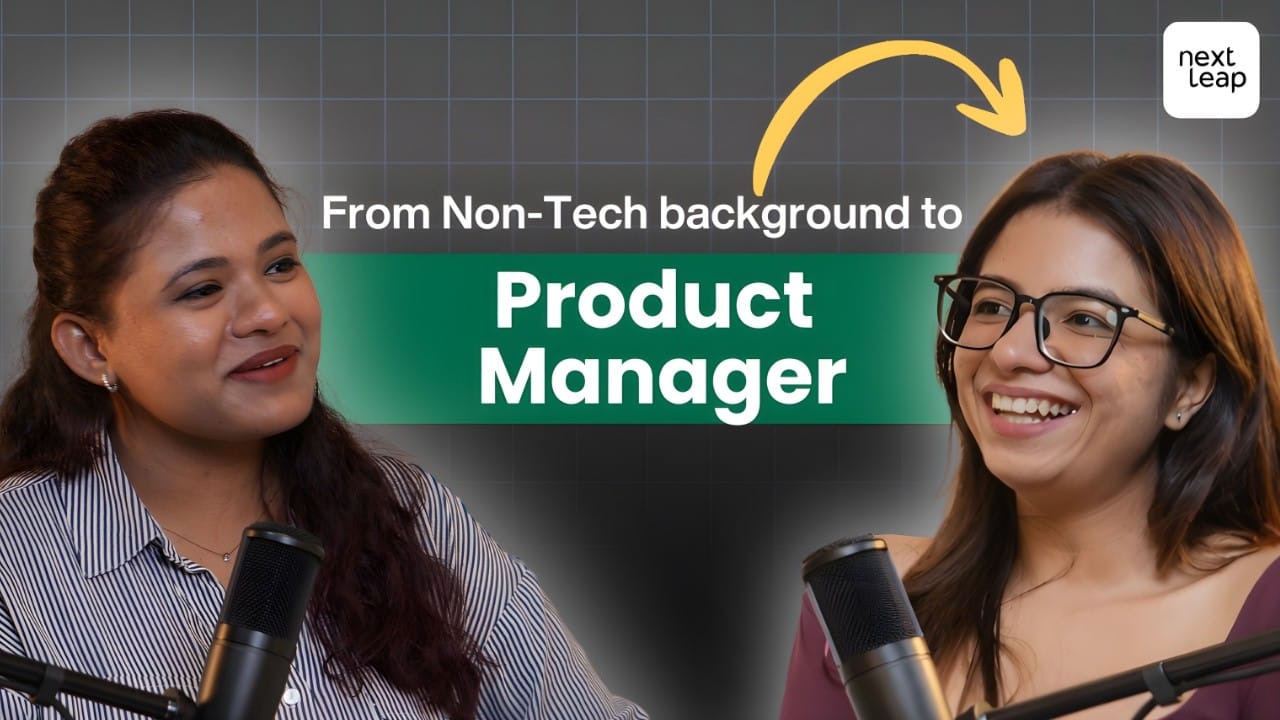
"It's not a glamorous role. You are always in the middle of ambiguity. It's a messy role." That is how Pragati describes product management after moving from bioengineering to product manager in fintech. She had no IIT degree, no MBA and little experience when she started. She explained the switch, the skills that matter and her advice for non-tech professionals on the NextLeap Podcast.
How did Pragati go from bioengineering to product manager?
Through what she calls a rollercoaster journey. First came the realisation that something was not working. Then she had to convince herself and her parents that a switch was needed, because they had supported her through a specific subject. After that she had to work out what would work instead.
She found that other fields might fit better, worked out how to get into one, found a course, connected with peers and eventually landed a job. Product management appealed to her mainly because of ownership. She had been a people person since college and had managed many events. In an early internship she joined as a researcher but ended up managing the whole project, setting timelines. She also worked in a hospital and realised she could not do that anymore.
She also likes helping people. As a product manager, she says, you can affect many people's lives without even interacting with them.
Can you become a product manager without an IIT or MBA?
Yes, but you have to keep proving yourself. Pragati says that was the hardest part. She did not have much experience, came from a different field, was not from an IIT and did not have an MBA. She splits the challenge in two.
- Getting the resume shortlisted. Have a good ATS score and projects, which NextLeap helped with. Make sure your experience is relevant to product management and that you can explain everything you write.
- Cracking the interview. This was the harder part. Interviews are mostly about how you think in different situations, not what you know.
What do PM interviews really test?
How you think through a problem, not the answer. Pragati says interviewers look at how you handle things going wrong, how you think about a user, how you frame your frameworks and how much you pause before answering. She learned this the hard way: when someone gives a problem, an average person jumps to a solution.
Her fix was to ask questions first. Why do you think it is a problem? How is it affecting you? Do you want to solve it right now, and why? "Don't be afraid to ask questions," she says, even in an interview and even if a question feels stupid. Interviewers also ask why they should trust you. It is a high-ownership role, and a silly mistake at the top of the funnel can lead to a big blunder.
What are the most important skills for a product manager?
Pragati names three that she uses regularly.
- Product thinking. You cannot just say you are a PM. Prove it by framing a problem from A to Z, showing empathy for users and using feedback, examples and competitive research.
- Metric orientation. Numbers shift your mindset "from being a feature factory to be a value factory." It does not matter how many features you ship, but what the impact on the numbers is. Moving a metric from 18 percent to 20 percent is a 2 percent increase, and that is how you talk about it.
- Communication. You are a glue, a bridge between all the stakeholders, and you have to convey what you want to build.
What does thinking like a product manager mean?
Making it a lifestyle. In Pragati's words, "You cannot be a product manager without being a product manager in your own life." When she joined NextLeap she kept one line in mind, that it is not a role but a lifestyle. She was weak in areas such as guesstimates and root cause analysis, so she started thinking that way in daily life.
In a grocery store, she wonders how much revenue the store makes and what its average order value is. On Zepto or Zomato she looks at the journey as a product manager, not as a user, and takes screenshots when she sees a glitch. When a friend brings her a problem, she asks counter-questions instead of offering a solution. Her line to friends: "The role will come later, the mindset will come first."
How did NextLeap help Pragati?
In three ways, she says. It helped her structure her thoughts: talk about the problem and the users facing it, then possible solutions, then prioritise them. It gave her a community of product manager friends, including some in fintech, whom she messages when she is stuck. And it gave her a mentor, with whom she is still in touch. Before interviews she asks him to run a mock.
She also says the Product Manager Fellowship gave her a portfolio. In interviews she presented her project because she had no experience or internships to show, and it reflected the effort and mindset she had.
What is the biggest misconception about product management?
That it is glamorous and about authority. Pragati thought PMs sit in meetings, make decisions about users and tell people what to build. She also believed she had to be from tech or an IIT, or have an MBA. "It's more about having responsibilities," she says, and about accountability. If something goes wrong, you are accountable.
You also sit with developers and designers and help in ways you did not expect. She sometimes gives designers a prompt she used in ChatGPT and asks them to improve or mimic it. And you often need to play the developer, marketer or designer if someone is missing.
How is AI changing the product manager's job?
She uses AI to review PRDs and uses ChatGPT and Lovable to design. She can get a prompt from ChatGPT, put it into Lovable, refine it and show the team her vision. She also says PMs must think about how to give users AI, not just use it themselves. If you are only a consumer of AI, you are missing the builder side.
Pragati's advice for non-tech professionals
Show up. She says she failed many times early on, and product management cannot be learned without a taste of it or from a textbook. When she felt unprepared, she treated it as a problem statement and did a root cause analysis on herself. Had she done her mocks? Was the feeling just a bad one?
Her mottos are simple: make mistakes and learn from them, ask silly questions and be shameless about it. "If I'm learning, I'm happy."
Show up. Even if you feel like you are not good enough.
Watch the full conversation
Pragati shared her story on the NextLeap Podcast.
Start your own switch
Pragati's switch came from a structured way of thinking, a community and a project she could present. If you are coming from a non-tech field, the NextLeap Product Manager Fellowship offers mentors, projects and peers to practise with.
Frequently asked questions
Can you become a product manager without an IIT or MBA?
Yes. Pragati came from bioengineering, had little experience and had neither an IIT degree nor an MBA, and she now works as a product manager in fintech. She says the hardest parts were getting the resume shortlisted and then cracking interviews, which test how you think through problems rather than what you know.
What are the most important skills for a product manager?
Pragati names product thinking, metric orientation and communication. Product thinking means framing a problem from start to finish with empathy for users. Metrics shift you from shipping features to creating value. Communication makes you the glue between stakeholders, so you can convey clearly what you want to build.
What is the biggest misconception about product management?
Pragati thought it was a glamorous role about authority, where you tell people what to build. In reality, she says, it is messy, and you work in the middle of ambiguity. It is more about responsibility and accountability than authority. If something goes wrong, you are the one accountable.
How do you think like a product manager?
Pragati says to treat it as a lifestyle. She looks at everyday apps and stores as a product manager would, asks about revenue and journeys, and answers friends' problems with counter-questions. Her line is that the role will come later and the mindset comes first. She also recommends asking questions freely, even in interviews.


