My Courses
 My Portfolio
 Refer & Earn
 My Purchases
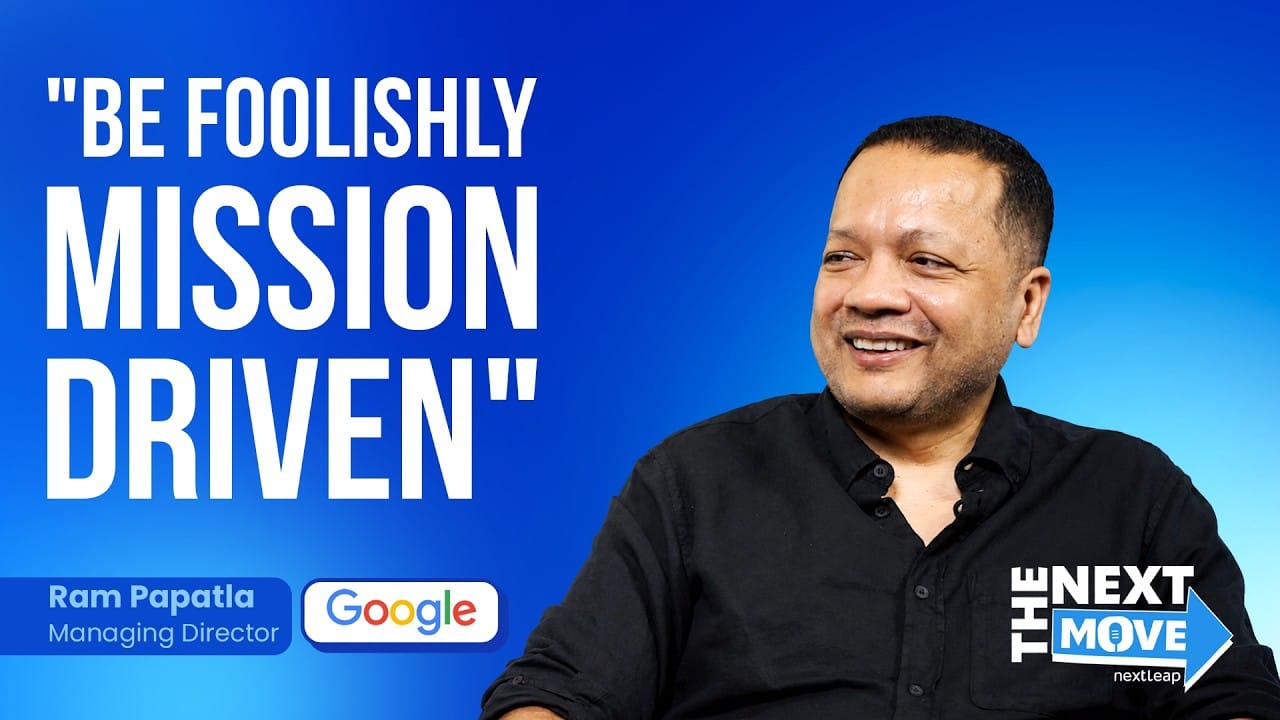
The Next Move is a NextLeap podcast where I sit down with leaders in tech to unpack the career decisions that shaped them, so you can make better ones of your own.
I first worked with Ram Papatla at Flipkart, and he's still one of the people I call when I'm stuck on a career question. So it felt right that he'd be our very first guest.
Ram's 26-year career reads like a map of the tech industry: 15 years at Microsoft (web services, server, Windows Phone, Office on Android and iPhone, Visio), then Amazon's India marketplace, then Flipkart, where he went from individual contributor to running most of the consumer business. After that he moved his family to Amsterdam to build Booking.com's flights business in about 40 countries, then came back to India to lead Android as a general manager at Google. Today he's Managing Director of Trust & Safety at Google, working on AI safety, fraud and prompt injection.
What struck me most is that Ram says he has never planned his career. But he has used the same few tests for every move. Here are the 12 lessons I took away from our conversation on growing from IC to general manager.
At a glance
- Who: Ram Papatla, Managing Director, Trust & Safety, Google
- Career path: Engineer → PM → GPM → consumer head → GM
- Companies: Microsoft, Amazon, Flipkart, Booking.com, Google
- His core test for any move: "Am I in a point of learning more, or [have my] returns of learning actually reduced quite a bit?"
- Best for: Mid-career PMs and engineers thinking about their next move, or about the path to a GM role
Watch or listen: YouTube
1. Build AI fluency first, but judgment is the top rung
Ram thinks about AI as a ladder. The bottom rung is personal fluency: pick small projects, modernise something you already do, and repeat until you're comfortable. The middle rung is taking it to your team through shared rituals. At Google, he started a monthly, no-judgment forum called Collective where people show what they've built and what they're stuck on.
The top rung is where most people stall:
"That's the part where very few people can actually make that transition, and that is really about using your judgment... making sure that there's a balance between your judgment versus what AI can do."
He's also optimistic. "A lot of the AI talk is by default a bit negative... I actually believe the opposite, because I'm seeing it in action."
2. Leave when your returns on learning drop
Ram spent 15 years at Microsoft, but he admits he "cheated a bit": he moved teams roughly every three years. His signal to move was simple:
"You're just walking in to work and everything's pretty simple and all the systems and rituals are working just fine. You're not really adding a lot of value as a PM. So that's when I decided it's a good time to pack up bags."
When he joined the Windows Phone team and got it launched with large US carriers, he "ran out of juice in three years" once the product settled into predictable processes. That's when he moved to lead Office on Android and iPhone.
3. But stay long enough to see one product through its full lifecycle
Ram is fine with people switching jobs. What worries him is shallow learning. As the sponsor of Google's Associate Product Manager program in India, he meets dozens of impressive finalists every year:
"There's a lot more show, and the density of show has increased. I have multiple GitHub links, I have lots of vibe-coded projects. That's great, that's awesome. It's not a replacement for learning deeply, thinking deeply."
His advice: spend at least a year to a year and a half following one product from build through launch and after. Write a vision, then come back a year or two later and check whether you built what you said you would. "You cannot do that in 6 months, even with the advancement of AI."
4. Before you say yes, check four things
Ram has used the same four checks for most of his moves:
- The manager. "Even if they're there for a year it means a lot. You'll meet them 52 times in that one year. So you better make sure that meeting is fun."
- The peers. "The big red flag was if I found more individual accomplishments and less team language."
- The product. Would you use it and recommend it to friends and family? He turned down an early, attractive offer at a betting company because "I cannot recommend it to anybody, because I don't believe in it."
- The bar. Is this team pushing the envelope, or can you take it to world class? "It has to really push me to a level where I just can't do it on my own."
5. Pick the role with room to flex, even over better pay
When Ram joined Booking.com, his team was four people in an old building. They told him he could show up on the thank-you page after a hotel booking:
"I was like, oh great, that's how many people see the thank-you page. And I worked my way to the homepage. It took like a couple of years."
That team grew to about 300 people. Along the way, he turned down other offers: "Those were better positions, better pay, but they had limited opportunity to come flex." The same instinct took him to Flipkart. "Almost everybody said don't join, and I was like, oh my god, that's a signal to join."
6. Judge compensation over two to three years, not one quarter
Ram doesn't dismiss pay. Early in his career it was a big factor, and he urges people to speak up when they know the market rate. But he warns against short-term thinking:
"If you just take one quarter or a couple of quarters' view, you may end up making a wrong decision. So think about compensation more in the cycle of a couple of years, two, three years out."
In his senior mid-career, the question changed from "what's in it for me" to whether the charter would be good for everyone on his team.
7. Network out of curiosity, and ask a specific question
Ram calls himself an "active networker". A Google VP once asked him how he knew more about the VP's team than the VP did. His current job came out of these conversations: while leading Android in India, he wrote an internal paper on fraud and scams in Asia, talked to the head of Trust & Safety, and "before you know it I joined the team."
His tip for cold outreach:
"99% of the time, if you send a message and say hi, you'll not get a response. But if you say hi and, 'I'm so curious about what you're working on... do you have 10 minutes?' I bet you 100% you'll get an answer back."
It doesn't have to be an after-hours event either. Talk to 10 college friends at other startups about how they're using AI, then bring five good practices back to your team.
8. Unlearn your old company, fast
After 15 years at Microsoft, Ram joined Amazon to lead marketplace and marketing for Indian merchants. His first rule:
"Make sure that you unlearn the old company very quickly, because you don't want to go and say that this is how we did it in Microsoft on the first day in Amazon. You'll not make many friends."
He found Amazon's onboarding document "very limited and very shallow", so he wrote his own, in PR FAQ style, by talking to peers and stakeholders about what leadership meant there. Once he'd adapted, he could bring his past experience back in. Today he gives every new director on his team a 90-day onboarding program that ends with a test.
9. Write down what you believe, and show your work
Ram credits a lot of his growth to writing and repeating what he believes, in town halls, OKRs and documents. His newest habit: attaching the AI prompts he used as an appendix to his documents.
"Why do I hide all the prompts that I have used to create something? ... I felt like the narrative is going towards AI slop and it's diminishing people's thinking."
The first time he did it with a senior Google leader, there was an awkward pause. The second time, they used his prompts.
Communicating with a CEO or board was a new skill. "They no longer care about your little product and your framework and your principles." He failed the first few times, then spent about a year learning from people who wrote board decks and earnings releases. Now he plans board demos like a movie, with a strong opening, a twist, and an ending that leaves people wanting more.
10. You become a GM in pieces, long before the title
There aren't many official GM roles in tech. Ram's advice is to build the muscle anyway: work closely with finance, legal and compliance, and eventually help people in those functions do their jobs better. When you can show that a product change could cut the cost of acquisition, "there you go, you've done like a mini GM role there."
Even when the role exists, you often have to define it yourself:
"Even though the roles are defined, I think you have to shape the role by pitching it."
A month into Google, he wrote a document on what the Android India GM role should do, collected feedback from dozens of people (including some who told him he was wasting their time), and took it to his manager. It was accepted.
He also says it's "lonely at the top", so build your own network of people who will give you honest feedback.
11. Learn to define problems and kill projects
When Ram hires, he spends most of the interview on one thing:
"I would say for the next 100 years, even with the advancement of AI, defining clear problem statements is probably the best thing you can do as a leader, and the best thing you can do as a young person as well."
If a candidate can't do that, the interview stops. He then looks for customer obsession shown through team rituals, not "I talked to six people last week", and for systems thinking. His newest question is when you last killed a project. "Believe it or not, a lot of the senior candidates struggle [with] kill." The worst hire, he says, is someone who will "make everybody happy and keep the music running for a while."
12. Be foolishly mission-driven, then know when to let go
Ram believed in Windows Phone. His team built five or six demo apps every quarter to show leadership what the platform could do. His lesson from that time:
"Sometimes you have to be a little bit mission-driven, foolishly mission-driven, for a bit, and there's a point where you have to give up."
He applies the same honesty to himself. When I asked about his next move, he said he's excited to push the frontier of AI safety. But if he ever decides someone with decades of institutional knowledge should run it instead, "then I'll just step away and do something else."
In this episode, we cover
- 0:00 Introduction
- 0:36 Career navigation in AI
- 2:13 Adapting to AI disruption
- 14:04 Transparency in thinking
- 22:09 Principles of longevity
- 25:49 Navigating team transitions
- 45:03 Adapting to new cultures
- 52:21 Mastering marketplace models
- 1:05:03 Transitioning to GM roles
- 1:10:21 The MBA perspective
- 1:17:00 Hiring and team building
- 1:22:49 Engineering and trust
- 1:27:20 Conclusion
Referenced
- Collective: Ram's monthly, no-judgment AI learning forum at Google
- Google's Associate Product Manager (APM) program
- Amazon's PR FAQ writing format
- Fill-and-kill framework: Ram's approach to deciding when to back a project and when to stop it
- Levels.fyi: compensation benchmarks
Want to build the foundations Ram talks about?
Ram's advice keeps coming back to depth: owning a product end to end, writing clear problem statements, and learning from people further along. If you're starting or growing a product career, NextLeap's Product Manager Fellowship is built around exactly that kind of hands-on practice, with mentors from leading tech companies.
Subscribe to The Next Move on YouTube so you don't miss the next conversation.
Frequently asked questions
How do you move from individual contributor to general manager in tech?
Official GM roles are rare in tech, so most people build the skills first. Work closely with finance, legal and compliance, learn to communicate with senior leaders and boards, and connect your product decisions to business results like acquisition cost. Ram Papatla calls this doing "mini GM" work. The title usually follows once you're already doing the job.
How long should you stay in a job early in your career?
Long enough to see at least one product through its full lifecycle, which Ram Papatla puts at a year to a year and a half, and ideally two to three years in a domain. Switching is fine, but moving every few months usually means shallow learning. A useful signal to move is when the work feels easy and you're no longer adding much value.
What should you check before accepting a new role?
Check four things: whether you'll enjoy working with the manager, whether the peers talk as a team or as individuals, whether you believe in the product enough to recommend it to friends, and whether the role will push you beyond what you can do alone. Also ask whether you'll have room to shape the work, not just maintain it.
Do you need an MBA to become a general manager?
No. An MBA can be a faster, more predictable route if you want to switch functions entirely, and it gives you a strong network. But many people reach the same senior roles without one. Ram Papatla, who did not do an MBA, sees roughly half of leaders get there each way. Weigh the cost against other ways to build business skills.
How should you think about compensation when switching jobs?
Treat it as important but slightly secondary, and judge it over two to three years rather than one or two quarters. Check market rates with tools like Levels.fyi and speak up if you're underpaid. Chasing a short-term correction can lead to a poor decision if the role doesn't help you grow.